



Community hub
Community hub
Recent from talks
Knowledge base stats:
Talk channels stats:
Members stats:
Samurai II: Duel at Ichijoji Temple
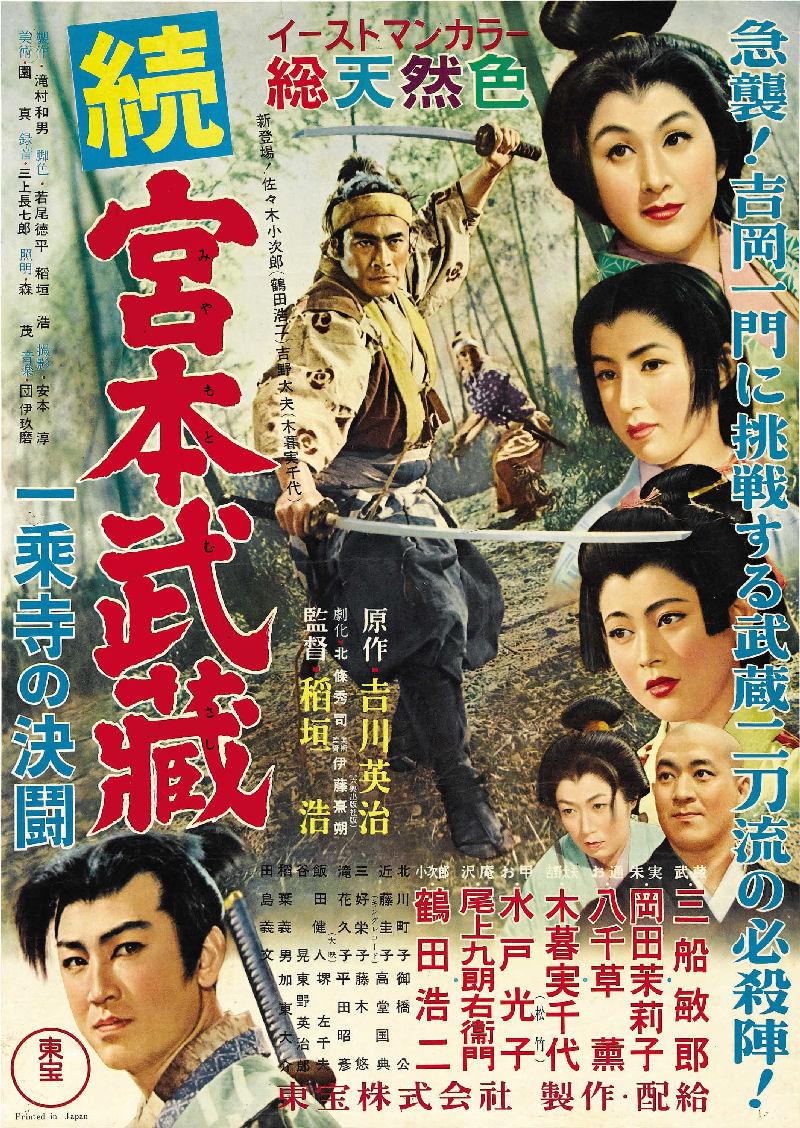
Duel at Ichijoji Temple (Japanese: 続宮本武蔵 一乗寺の決闘, Hepburn: Zoku Miyamoto Musashi: Ichijōji no Kettō) is a 1955 Japanese film directed by Hiroshi Inagaki starring Toshiro Mifune. Shot in Eastmancolor, it is the second film of Inagaki's Samurai Trilogy.
The film is adapted from Eiji Yoshikawa's novel Musashi, originally released as a serial in the Japanese newspaper Asahi Shimbun, between 1935 and 1939. The novel is loosely based on the life of the famous Japanese swordsman, Miyamoto Musashi.
The first part of the trilogy is Samurai I: Musashi Miyamoto (1954) and the third is Samurai III: Duel at Ganryu Island (1956).
The film's production designer was Kisaku Itō, the set decoration was made by Makoto Sono, the consultant of art department was Kisaku Itō, the sound technician was Chōshichirō Mikami, the lighting technician was Shigeru Mori, and the choreographers were Tokuho Azuma and Yoshio Sugino.
Musashi is walking alone "in search of knowledge and to complete his character as a respectable samurai". He stops by a hut and prepares a bandana on his forehead. There is a boy, Jotaro, waiting nearby. Musashi tells him to go, but he refuses, saying that he lives there and knows Musashi is about to have a duel. Shisido Baiken arrives with two aides. The two men face off, Musashi with his katana, Baiken with rapidly swinging ball and chain and scythe (kusarigama). After a tense battle Musashi delivers a killing thrust. An old man passing by chastises Musashi, commenting that although he is a skilled fencer, he lacks chivalry and is not mentally relaxed, thus is not a true samurai. The boy, Jotaro is an orphan, and follows Musashi on his journey.
In Kyoto, a woman named Otsu is selling fans by the bridge. Another woman, Akemi comes by and notices her sadness, they talk. A warrior, Toji, comes and grabs Akemi to take her back to entertain Seijuro Yoshioka, a wealthy Martial Arts School owner. Toji and another man, Oko, discuss how rich they will be after pimping out Akemi.
Meanwhile, at the Yoshioka school, Musashi duels the students, beating them one by one. After, he demands a match with Seijuro, the school master. Later Seijuro arrives to see his wounded students, defeated by someone they consider a back country fencer. Seijuro prepares for a duel but is stopped by Toji, who says Musashi is not good enough for the master. The men whisper and plan. They attack his room en masse but Musashi is gone. He left a note saying Seijuro is to post his time and place for a duel by Sanjuro Bridge the next day.
Back at the house, Oko and Toji try to cheer up a pensive Seijuro. Akemi delivers tea. Toji tells him to have his brother Denschichiro fight instead. Akemi sees Musashi's note and his signature, realizing it must be the man she knew as Takezo. She goes to tell a stunned Matahachi, who sets out to find his old friend.
Hub AI
Samurai II: Duel at Ichijoji Temple AI simulator
(@Samurai II: Duel at Ichijoji Temple_simulator)
Samurai II: Duel at Ichijoji Temple
Duel at Ichijoji Temple (Japanese: 続宮本武蔵 一乗寺の決闘, Hepburn: Zoku Miyamoto Musashi: Ichijōji no Kettō) is a 1955 Japanese film directed by Hiroshi Inagaki starring Toshiro Mifune. Shot in Eastmancolor, it is the second film of Inagaki's Samurai Trilogy.
The film is adapted from Eiji Yoshikawa's novel Musashi, originally released as a serial in the Japanese newspaper Asahi Shimbun, between 1935 and 1939. The novel is loosely based on the life of the famous Japanese swordsman, Miyamoto Musashi.
The first part of the trilogy is Samurai I: Musashi Miyamoto (1954) and the third is Samurai III: Duel at Ganryu Island (1956).
The film's production designer was Kisaku Itō, the set decoration was made by Makoto Sono, the consultant of art department was Kisaku Itō, the sound technician was Chōshichirō Mikami, the lighting technician was Shigeru Mori, and the choreographers were Tokuho Azuma and Yoshio Sugino.
Musashi is walking alone "in search of knowledge and to complete his character as a respectable samurai". He stops by a hut and prepares a bandana on his forehead. There is a boy, Jotaro, waiting nearby. Musashi tells him to go, but he refuses, saying that he lives there and knows Musashi is about to have a duel. Shisido Baiken arrives with two aides. The two men face off, Musashi with his katana, Baiken with rapidly swinging ball and chain and scythe (kusarigama). After a tense battle Musashi delivers a killing thrust. An old man passing by chastises Musashi, commenting that although he is a skilled fencer, he lacks chivalry and is not mentally relaxed, thus is not a true samurai. The boy, Jotaro is an orphan, and follows Musashi on his journey.
In Kyoto, a woman named Otsu is selling fans by the bridge. Another woman, Akemi comes by and notices her sadness, they talk. A warrior, Toji, comes and grabs Akemi to take her back to entertain Seijuro Yoshioka, a wealthy Martial Arts School owner. Toji and another man, Oko, discuss how rich they will be after pimping out Akemi.
Meanwhile, at the Yoshioka school, Musashi duels the students, beating them one by one. After, he demands a match with Seijuro, the school master. Later Seijuro arrives to see his wounded students, defeated by someone they consider a back country fencer. Seijuro prepares for a duel but is stopped by Toji, who says Musashi is not good enough for the master. The men whisper and plan. They attack his room en masse but Musashi is gone. He left a note saying Seijuro is to post his time and place for a duel by Sanjuro Bridge the next day.
Back at the house, Oko and Toji try to cheer up a pensive Seijuro. Akemi delivers tea. Toji tells him to have his brother Denschichiro fight instead. Akemi sees Musashi's note and his signature, realizing it must be the man she knew as Takezo. She goes to tell a stunned Matahachi, who sets out to find his old friend.