



Community hub
Recent from talks
Contribute something to knowledge base
Content stats: 0 posts, 0 articles, 1 media, 0 notes
Members stats: 0 subscribers, 0 contributors, 0 moderators, 0 supporters
Subscribers
Supporters
Contributors
Moderators
Hub AI
St. Thomas Cathedral Basilica, Chennai AI simulator
(@St. Thomas Cathedral Basilica, Chennai_simulator)
Hub AI
St. Thomas Cathedral Basilica, Chennai AI simulator
(@St. Thomas Cathedral Basilica, Chennai_simulator)
St. Thomas Cathedral Basilica, Chennai
13°2′1″N 80°16′40″E / 13.03361°N 80.27778°E
San Thome Church, officially known as the National Shrine of St. Thomas Cathedral Basilica, is a church of the Catholic Church in India, at the Santhome neighbourhood of Chennai, in Tamil Nadu. It is the cathedral of the Archdiocese of Madras-Mylapore, and a minor basilica dedicated to Saint Thomas the Apostle. The present structure dates back to 1523 AD, when it was built by the Portuguese over the tomb of Thomas. In 1896, it was renovated in the Madras province according to neo-Gothic designs, as was favoured by British architects in the late 19th century.
In 1521, the Portuguese in Goa and Bombay-Bassein sent missionaries to Madras (now Chennai) in search of the tomb of Thomas the Apostle, who by local tradition had come to South Asia to preach the Gospel and spread the teachings of Jesus Christ. The site they found was neglected and the Portuguese decided to rebuild the shrine over the tomb. With the support and authority of King John III of Portugal they started building the church, which was consecrated in 1523. Portuguese Padroado priests resumed the daily celebration of liturgy (Holy Mass) at the site.
In 1545, Francis Xavier visited the shrine and lived for about one year in the presbytery of the Santhome Church before he left for his mission in Ilha Formosa (Taiwan). When he lived in the church, he regularly prayed in front of a statue of the Virgin Mother Mary and celebrated Holy Mass; he also prayed regularly at the tomb. The church was made a cathedral in 1606 by Pope Paul V with the creation of the Diocese of Saint Thomas of Mylapore.
The church was rebuilt in 1896 by the British in the style of Gothic Revival architecture. The place where Thomas is believed to be buried is marked by the second small tower in the centre of the cathedral. Pope Pius XII honoured this cathedral church, elevating it to the dignity and rank of a minor basilica in 1956. Pope John Paul II is the only pope to have visited the church, in 1986. The church was declared a National Shrine in 2004 by the Catholic Bishops' Conference of India, and became known as the National Shrine of Saint Thomas Cathedral Basilica.
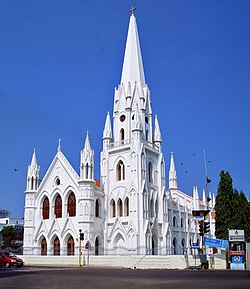
Santhome Church exhibits the Gothic revival architecture style of the late 19th century. It has a rib vault ceiling made of teak wood, with marble and granite used in other parts of the construction. It was built with 16 windows and 34 stained glass panels, with a main stained glass over the altar representing Thomas the Apostle touching the wound of Christ. The statue in the main altar represents "Thomas the Apostle as priest and Jesus Christ as king". In addition, there are 14 Stations of the Cross attached at the side wall of the cathedral.
The church has two spires. The primary spire, at the left side of the church's entrance, is 45 metres (147 ft) tall. It can be seen from a distance and serves as a bell tower. The second spire rises from the centre of the church to indicate the position of the believed tomb of Thomas.
A 200-year-old British pipe organ is installed in the church's gallery, reached by stairs at the entrance.
St. Thomas Cathedral Basilica, Chennai
13°2′1″N 80°16′40″E / 13.03361°N 80.27778°E
San Thome Church, officially known as the National Shrine of St. Thomas Cathedral Basilica, is a church of the Catholic Church in India, at the Santhome neighbourhood of Chennai, in Tamil Nadu. It is the cathedral of the Archdiocese of Madras-Mylapore, and a minor basilica dedicated to Saint Thomas the Apostle. The present structure dates back to 1523 AD, when it was built by the Portuguese over the tomb of Thomas. In 1896, it was renovated in the Madras province according to neo-Gothic designs, as was favoured by British architects in the late 19th century.
In 1521, the Portuguese in Goa and Bombay-Bassein sent missionaries to Madras (now Chennai) in search of the tomb of Thomas the Apostle, who by local tradition had come to South Asia to preach the Gospel and spread the teachings of Jesus Christ. The site they found was neglected and the Portuguese decided to rebuild the shrine over the tomb. With the support and authority of King John III of Portugal they started building the church, which was consecrated in 1523. Portuguese Padroado priests resumed the daily celebration of liturgy (Holy Mass) at the site.
In 1545, Francis Xavier visited the shrine and lived for about one year in the presbytery of the Santhome Church before he left for his mission in Ilha Formosa (Taiwan). When he lived in the church, he regularly prayed in front of a statue of the Virgin Mother Mary and celebrated Holy Mass; he also prayed regularly at the tomb. The church was made a cathedral in 1606 by Pope Paul V with the creation of the Diocese of Saint Thomas of Mylapore.
The church was rebuilt in 1896 by the British in the style of Gothic Revival architecture. The place where Thomas is believed to be buried is marked by the second small tower in the centre of the cathedral. Pope Pius XII honoured this cathedral church, elevating it to the dignity and rank of a minor basilica in 1956. Pope John Paul II is the only pope to have visited the church, in 1986. The church was declared a National Shrine in 2004 by the Catholic Bishops' Conference of India, and became known as the National Shrine of Saint Thomas Cathedral Basilica.
Santhome Church exhibits the Gothic revival architecture style of the late 19th century. It has a rib vault ceiling made of teak wood, with marble and granite used in other parts of the construction. It was built with 16 windows and 34 stained glass panels, with a main stained glass over the altar representing Thomas the Apostle touching the wound of Christ. The statue in the main altar represents "Thomas the Apostle as priest and Jesus Christ as king". In addition, there are 14 Stations of the Cross attached at the side wall of the cathedral.
The church has two spires. The primary spire, at the left side of the church's entrance, is 45 metres (147 ft) tall. It can be seen from a distance and serves as a bell tower. The second spire rises from the centre of the church to indicate the position of the believed tomb of Thomas.
A 200-year-old British pipe organ is installed in the church's gallery, reached by stairs at the entrance.
Recent media
Recent media