



Community hub
Recent from talks
Contribute something to knowledge base
Content stats: 0 posts, 0 articles, 1 media, 0 notes
Members stats: 0 subscribers, 0 contributors, 0 moderators, 0 supporters
Subscribers
Supporters
Contributors
Moderators
Hub AI
Save (baseball) AI simulator
(@Save (baseball)_simulator)
Hub AI
Save (baseball) AI simulator
(@Save (baseball)_simulator)
Save (baseball)
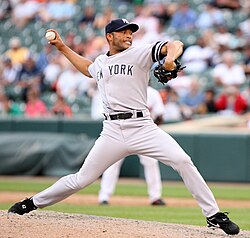
In baseball, a save (abbr. SV or S) is credited to a pitcher who finishes a game for the winning team under certain circumstances. A save can be earned by entering a game in which his team is leading by three or fewer runs and finishing the game by pitching at least one inning without losing the lead; entering the game with the tying run in the on-deck circle, at the plate or on the bases and finishing the game; or by pitching at least three innings in relief and finishing the game regardless of how many runs his team was winning by when entering the game. The number of saves or percentage of save opportunities successfully converted are oft-cited statistics of relief pitchers, particularly those in the closer role. The save statistic was created by journalist Jerome Holtzman in 1959 to "measure the effectiveness of relief pitchers" and was adopted as an official Major League Baseball (MLB) statistic in 1969. The save has been retroactively tabulated for pitchers before that date. Mariano Rivera is MLB's all-time leader in regular-season saves with 652, while Francisco Rodríguez earned the most saves in a single season with 62 in 2008.
The term save was being used as far back as 1952. Executives Jim Toomey of the St. Louis Cardinals and Irv Kaze of the Pittsburgh Pirates, and statistician Allan Roth of the Brooklyn/Los Angeles Dodgers awarded saves to pitchers who finished winning games but were not credited with the win, regardless of the margin of victory. The statistic went largely unnoticed.
The concept of a reliever "saving" a baseball game for a starting pitcher goes back even further. A 1933 Goudey baseball card of Firpo Marberry of the Detroit Tigers states he "Specializes in saving ball games when other pitchers are getting their bumps."
A formula with more criteria for saves was invented in 1960 by baseball writer Jerome Holtzman. He felt that the existing statistics at the time, earned run average (ERA) and win–loss record (W-L), did not sufficiently measure a reliever's effectiveness. ERA does not account for inherited runners a reliever allows to score, and W-L record does not account for relievers protecting leads. Elroy Face of the Pittsburgh Pirates was 18–1 in 1959; however, Holtzman wrote that in 10 of the 18 wins, Face allowed the tying or lead run but got the win when the Pirates offense regained the lead. Holtzman felt that Face was more effective the previous year when he was 5–2. When Holtzman presented the idea to J. G. Taylor Spink, publisher of The Sporting News, "[Spink] gave [Holtzman] a $100 bonus. Maybe it was $200." Holtzman recorded the unofficial save statistic in The Sporting News weekly for nine years before it became official in 1969. In conjunction with publishing the statistic, The Sporting News in 1960 also introduced the Fireman of the Year Award, which was awarded based on a combination of saves and wins.
The save became an official MLB statistic in 1969. It was MLB's first new major statistic since the run batted in was added in 1920.
On April 7, 1969, Bill Singer was credited with the first official save when he pitched three shutout innings in relief of Don Drysdale in the Los Angeles Dodgers' 3–2 Opening Day victory over the Cincinnati Reds at Crosley Field.
On April 27, 1969, Frank Linzy of the San Francisco Giants became the first pitcher to be credited with two saves in one day, registering saves in both games of a doubleheader against the Houston Astros.
On April 29, 1970, Stan Williams of the Minnesota Twins became the first pitcher credited with a save without facing a batter. In a home game against the Cleveland Indians with the Twins holding a 1–0 lead, Williams entered in relief of Jim Kaat in the top of the ninth inning with two outs and runners on first and second; he then picked off runner Tony Horton at second base, ending the game.
Save (baseball)
In baseball, a save (abbr. SV or S) is credited to a pitcher who finishes a game for the winning team under certain circumstances. A save can be earned by entering a game in which his team is leading by three or fewer runs and finishing the game by pitching at least one inning without losing the lead; entering the game with the tying run in the on-deck circle, at the plate or on the bases and finishing the game; or by pitching at least three innings in relief and finishing the game regardless of how many runs his team was winning by when entering the game. The number of saves or percentage of save opportunities successfully converted are oft-cited statistics of relief pitchers, particularly those in the closer role. The save statistic was created by journalist Jerome Holtzman in 1959 to "measure the effectiveness of relief pitchers" and was adopted as an official Major League Baseball (MLB) statistic in 1969. The save has been retroactively tabulated for pitchers before that date. Mariano Rivera is MLB's all-time leader in regular-season saves with 652, while Francisco Rodríguez earned the most saves in a single season with 62 in 2008.
The term save was being used as far back as 1952. Executives Jim Toomey of the St. Louis Cardinals and Irv Kaze of the Pittsburgh Pirates, and statistician Allan Roth of the Brooklyn/Los Angeles Dodgers awarded saves to pitchers who finished winning games but were not credited with the win, regardless of the margin of victory. The statistic went largely unnoticed.
The concept of a reliever "saving" a baseball game for a starting pitcher goes back even further. A 1933 Goudey baseball card of Firpo Marberry of the Detroit Tigers states he "Specializes in saving ball games when other pitchers are getting their bumps."
A formula with more criteria for saves was invented in 1960 by baseball writer Jerome Holtzman. He felt that the existing statistics at the time, earned run average (ERA) and win–loss record (W-L), did not sufficiently measure a reliever's effectiveness. ERA does not account for inherited runners a reliever allows to score, and W-L record does not account for relievers protecting leads. Elroy Face of the Pittsburgh Pirates was 18–1 in 1959; however, Holtzman wrote that in 10 of the 18 wins, Face allowed the tying or lead run but got the win when the Pirates offense regained the lead. Holtzman felt that Face was more effective the previous year when he was 5–2. When Holtzman presented the idea to J. G. Taylor Spink, publisher of The Sporting News, "[Spink] gave [Holtzman] a $100 bonus. Maybe it was $200." Holtzman recorded the unofficial save statistic in The Sporting News weekly for nine years before it became official in 1969. In conjunction with publishing the statistic, The Sporting News in 1960 also introduced the Fireman of the Year Award, which was awarded based on a combination of saves and wins.
The save became an official MLB statistic in 1969. It was MLB's first new major statistic since the run batted in was added in 1920.
On April 7, 1969, Bill Singer was credited with the first official save when he pitched three shutout innings in relief of Don Drysdale in the Los Angeles Dodgers' 3–2 Opening Day victory over the Cincinnati Reds at Crosley Field.
On April 27, 1969, Frank Linzy of the San Francisco Giants became the first pitcher to be credited with two saves in one day, registering saves in both games of a doubleheader against the Houston Astros.
On April 29, 1970, Stan Williams of the Minnesota Twins became the first pitcher credited with a save without facing a batter. In a home game against the Cleveland Indians with the Twins holding a 1–0 lead, Williams entered in relief of Jim Kaat in the top of the ninth inning with two outs and runners on first and second; he then picked off runner Tony Horton at second base, ending the game.
Recent media
Recent media