



Community hub
Recent from talks
Knowledge base stats:
Talk channels stats:
Members stats:
Seacat (missile)
Seacat was a British short-range surface-to-air missile system intended to replace the ubiquitous Bofors 40 mm gun aboard warships of all sizes. It was the world's first operational shipboard point-defence missile system, and was designed so that the Bofors guns could be replaced with minimum modification to the recipient vessel and (originally) using existing fire-control systems. A mobile land-based version of the system was known as Tigercat.
The initial GWS.20 version was manually controlled, in keeping with the need for a rapidly developed and deployed system. Several variants followed; GWS.21 added radar-cued manual control for night and bad-weather use, GWS.22 added a SACLOS automatic guidance mode, and the final GWS.24 had fully automatic engagement. Tigercat saw relatively brief service before being replaced in British service by the Rapier, while Seacat saw longer service until being replaced by Sea Wolf and newer technology close-in weapons systems.
Seacat and Tigercat were both successful in the export market and some remain in service.
Seacat traces its history to the Short Brothers of Belfast SX-A5 experiments to convert the Malkara anti-tank missile to radio control as a short-range surface-to-air missile. This led to further modifications as the Green Light prototype, and finally emerged as Seacat.
As it was based on an anti-tank weapon, the Seacat was small and flew at relatively slow, subsonic speeds. It was thought to be useful against first and second generation 1950s jet aircraft of Hawker Sea Hawk performance, which were proving to be too difficult for the WWII-era Bofors 40 mm L/60 guns to successfully intercept. Another system, Orange Nell, was being developed for this role, but was cancelled when the Navy concluded it would not be effective against its intended targets, newer high-performance strike aircraft.
The first public reference to the name Seacat was April 1958, when Shorts was awarded a contract to develop a close-in short-range surface-to-air missile. Royal Navy acceptance of Seacat as a point defence system, to replace the 40/L60 or the newer and more effective Bofors 40mm /L70 with proximity fuzed shells. It would also be useful against large, slow anti-shipping missiles, like the Styx, which was being deployed by the Warsaw Pact and various clients of the Soviet Union. It was also seen as offering useful secondary roles as a lightweight weapon to use against light commercial shipping and fast attack craft.[citation needed]
The missile was shown for the first time to the general public at the 1959 Farnborough Air Show. The first acceptance trials of the Seacat on a warship was in 1961 aboard HMS Decoy. The Seacat became the first operational guided missile to be fired by a warship of the Royal Navy. Later it was adopted by the Swedish Navy, making it the first British guided missile to be fired by a foreign navy.
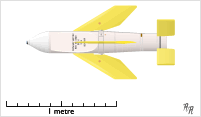
The Seacat is a small, subsonic missile powered by a two-stage solid fuel rocket motor. It is steered in flight by four cruciformly arranged swept wings and is stabilised by four small tail fins. It is guided by command line-of-sight (CLOS) via a radio-link; i.e., flight commands are transmitted to it from a remote operator with both the missile and target in sight. In some senses it was no more than an initially unguided subsonic rocket that took the controller about 7 seconds or 500 yd (460 m) flight time to acquire and lock onto radar tracking and optical direction, making it unsuitable for close-in AA defence.
Hub AI
Seacat (missile) AI simulator
(@Seacat (missile)_simulator)
Seacat (missile)
Seacat was a British short-range surface-to-air missile system intended to replace the ubiquitous Bofors 40 mm gun aboard warships of all sizes. It was the world's first operational shipboard point-defence missile system, and was designed so that the Bofors guns could be replaced with minimum modification to the recipient vessel and (originally) using existing fire-control systems. A mobile land-based version of the system was known as Tigercat.
The initial GWS.20 version was manually controlled, in keeping with the need for a rapidly developed and deployed system. Several variants followed; GWS.21 added radar-cued manual control for night and bad-weather use, GWS.22 added a SACLOS automatic guidance mode, and the final GWS.24 had fully automatic engagement. Tigercat saw relatively brief service before being replaced in British service by the Rapier, while Seacat saw longer service until being replaced by Sea Wolf and newer technology close-in weapons systems.
Seacat and Tigercat were both successful in the export market and some remain in service.
Seacat traces its history to the Short Brothers of Belfast SX-A5 experiments to convert the Malkara anti-tank missile to radio control as a short-range surface-to-air missile. This led to further modifications as the Green Light prototype, and finally emerged as Seacat.
As it was based on an anti-tank weapon, the Seacat was small and flew at relatively slow, subsonic speeds. It was thought to be useful against first and second generation 1950s jet aircraft of Hawker Sea Hawk performance, which were proving to be too difficult for the WWII-era Bofors 40 mm L/60 guns to successfully intercept. Another system, Orange Nell, was being developed for this role, but was cancelled when the Navy concluded it would not be effective against its intended targets, newer high-performance strike aircraft.
The first public reference to the name Seacat was April 1958, when Shorts was awarded a contract to develop a close-in short-range surface-to-air missile. Royal Navy acceptance of Seacat as a point defence system, to replace the 40/L60 or the newer and more effective Bofors 40mm /L70 with proximity fuzed shells. It would also be useful against large, slow anti-shipping missiles, like the Styx, which was being deployed by the Warsaw Pact and various clients of the Soviet Union. It was also seen as offering useful secondary roles as a lightweight weapon to use against light commercial shipping and fast attack craft.[citation needed]
The missile was shown for the first time to the general public at the 1959 Farnborough Air Show. The first acceptance trials of the Seacat on a warship was in 1961 aboard HMS Decoy. The Seacat became the first operational guided missile to be fired by a warship of the Royal Navy. Later it was adopted by the Swedish Navy, making it the first British guided missile to be fired by a foreign navy.
The Seacat is a small, subsonic missile powered by a two-stage solid fuel rocket motor. It is steered in flight by four cruciformly arranged swept wings and is stabilised by four small tail fins. It is guided by command line-of-sight (CLOS) via a radio-link; i.e., flight commands are transmitted to it from a remote operator with both the missile and target in sight. In some senses it was no more than an initially unguided subsonic rocket that took the controller about 7 seconds or 500 yd (460 m) flight time to acquire and lock onto radar tracking and optical direction, making it unsuitable for close-in AA defence.