
Recent from talks
Sebring International Raceway
Knowledge base stats:
Talk channels stats:
Members stats:
Sebring International Raceway
Sebring International Raceway is a road course auto racing facility in the southeastern United States, located near Sebring, Florida.
Sebring Raceway is one of the oldest continuously operating race tracks in the U.S., its first race being run in 1950. Sebring is one of the classic race tracks in North American sports car racing, and plays host to the 12 Hours of Sebring.
The raceway occupies a portion of Sebring Regional Airport (an active airport for private and commercial traffic that was originally built as Hendricks Army Airfield, which was a World War II training base for the United States Army Air Forces).
Sebring Raceway occupies the site of Hendricks Army Airfield (a training base for B-17 pilots in operation from 1941 to 1946), in the middle of southern Florida, 70 mi (110 km) south and southeast respectively of Orlando and Tampa, and 140 mi (230 km) northwest of Miami. After the war, Russian-American aeronautical engineer Alec Ulmann was seeking sites for converting military aircraft to civilian use when he discovered potential in Hendricks' runways and service roads to stage a sports car endurance race similar to the 24 Hours of Le Mans, a race Ulmann was inspired to somewhat re-create in the United States. Sebring's first race was held on New Year's Eve of 1950, attracting thirty race cars from across North America. The Sam Collier 6 Hour Memorial race was won by Frits Koster and Ralph Deshon in a Crosley Hot Shot that had been driven to the track by Victor Sharpe.
The first 12 Hours of Sebring was held on March 15, 1952, shortly growing into a major international race. In 1959, the track hosted the U.S.' first Formula One race (the successor to historic European Grand Prix motor racing), held as that year's instalment of the historic United States Grand Prix competition (although the Indianapolis 500 was an official part of the Formula One World Championship from 1950 to 1960, the 500 was never considered a true Grand Prix by the European and British based teams who largely ignored it at the time). However poor attendance and high costs relocated the next U.S. Grand Prix to Riverside International Raceway in southern California.
For much of Sebring's history, the track followed a 5.200 mi (8.369 km) layout. After a disastrous 1966 12 Hours with five fatalities, the track was widened in parts and also lengthened a total of 50 yd (46 m) for 1967 with the removal of the Webster Turn between the hairpin and the top of the track and replacement with the faster Green Park Chicane, further down the track. This was closer to the hairpin and allowed a flat-out run through a very fast corner to the top of the track and the runway. This was done to move the track off the dangerous Warehouse Straight and the warehouses, hangars and airplanes flanking it; a crash during that 1966 12 Hours involved a privately entered Porsche that went into one of the warehouses (this area was off-limits to non-track personnel) and into a crowd, killing four spectators.
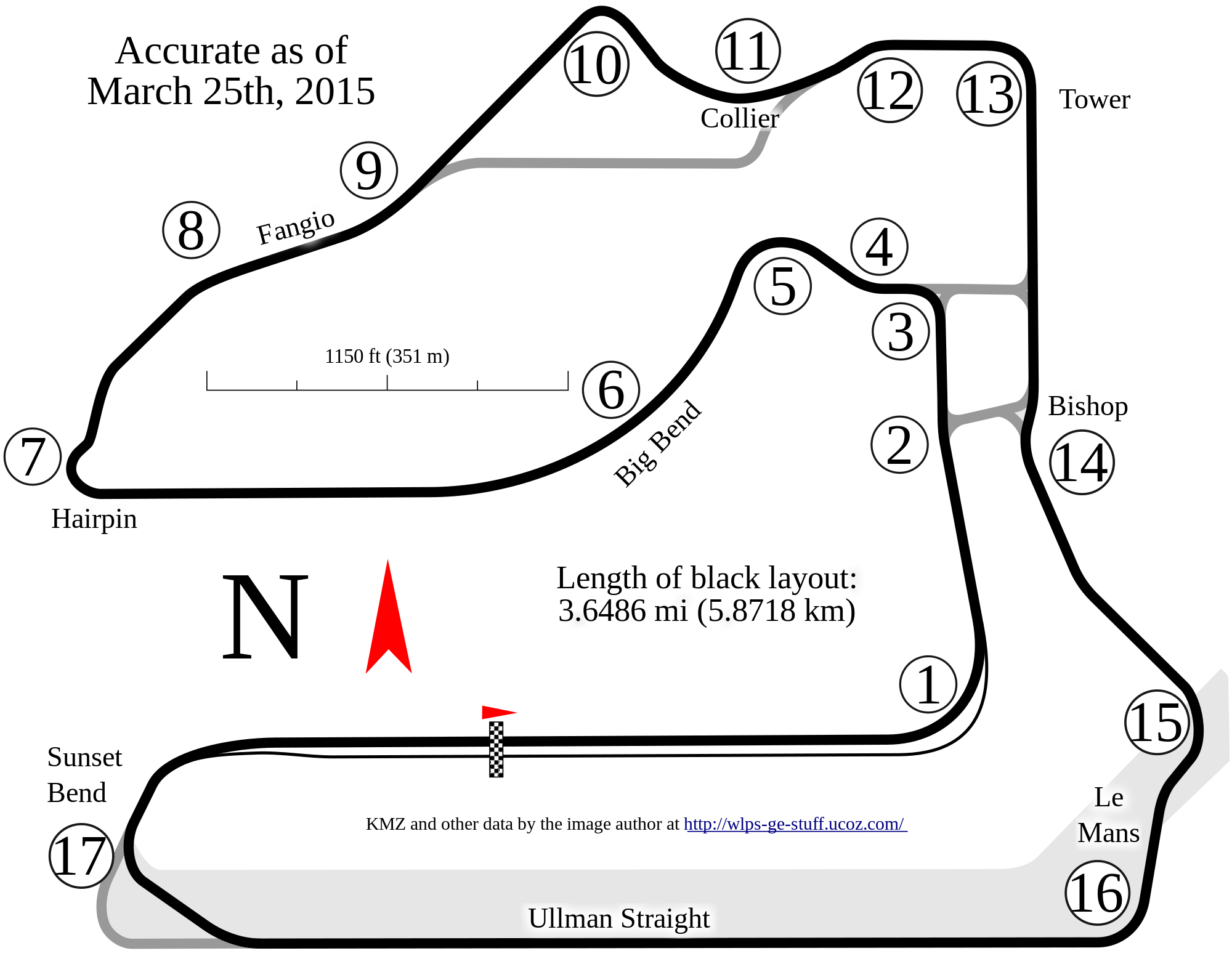
The circuit was changed and shortened in 1983 to allow simultaneous use of the track and one of the runways, and major changes in 1987 allowed use of another runway. Further changes in 1991 accommodated expansion of the airport's facilities, allowing the entire track to be used without interfering with normal airport operations and bringing it close to its current configuration. The hairpin was removed in 1997 due to a lack of run-off, and replaced with what became known as the "safety pin". Gendebien Bend was also re-profiled to slow the cars' entry to the Ullman straight.
The track is currently owned by IMSA Holdings, LLC through its subsidiary Sebring International Raceway, LLC via its purchase of the Panoz Motor Sports Group in September 2012. It is currently leased by the Sebring International Raceway, LLC, which acquired the facility from Andy Evans in 1997.
Hub AI
Sebring International Raceway AI simulator
(@Sebring International Raceway_simulator)
Sebring International Raceway
Sebring International Raceway is a road course auto racing facility in the southeastern United States, located near Sebring, Florida.
Sebring Raceway is one of the oldest continuously operating race tracks in the U.S., its first race being run in 1950. Sebring is one of the classic race tracks in North American sports car racing, and plays host to the 12 Hours of Sebring.
The raceway occupies a portion of Sebring Regional Airport (an active airport for private and commercial traffic that was originally built as Hendricks Army Airfield, which was a World War II training base for the United States Army Air Forces).
Sebring Raceway occupies the site of Hendricks Army Airfield (a training base for B-17 pilots in operation from 1941 to 1946), in the middle of southern Florida, 70 mi (110 km) south and southeast respectively of Orlando and Tampa, and 140 mi (230 km) northwest of Miami. After the war, Russian-American aeronautical engineer Alec Ulmann was seeking sites for converting military aircraft to civilian use when he discovered potential in Hendricks' runways and service roads to stage a sports car endurance race similar to the 24 Hours of Le Mans, a race Ulmann was inspired to somewhat re-create in the United States. Sebring's first race was held on New Year's Eve of 1950, attracting thirty race cars from across North America. The Sam Collier 6 Hour Memorial race was won by Frits Koster and Ralph Deshon in a Crosley Hot Shot that had been driven to the track by Victor Sharpe.
The first 12 Hours of Sebring was held on March 15, 1952, shortly growing into a major international race. In 1959, the track hosted the U.S.' first Formula One race (the successor to historic European Grand Prix motor racing), held as that year's instalment of the historic United States Grand Prix competition (although the Indianapolis 500 was an official part of the Formula One World Championship from 1950 to 1960, the 500 was never considered a true Grand Prix by the European and British based teams who largely ignored it at the time). However poor attendance and high costs relocated the next U.S. Grand Prix to Riverside International Raceway in southern California.
For much of Sebring's history, the track followed a 5.200 mi (8.369 km) layout. After a disastrous 1966 12 Hours with five fatalities, the track was widened in parts and also lengthened a total of 50 yd (46 m) for 1967 with the removal of the Webster Turn between the hairpin and the top of the track and replacement with the faster Green Park Chicane, further down the track. This was closer to the hairpin and allowed a flat-out run through a very fast corner to the top of the track and the runway. This was done to move the track off the dangerous Warehouse Straight and the warehouses, hangars and airplanes flanking it; a crash during that 1966 12 Hours involved a privately entered Porsche that went into one of the warehouses (this area was off-limits to non-track personnel) and into a crowd, killing four spectators.
The circuit was changed and shortened in 1983 to allow simultaneous use of the track and one of the runways, and major changes in 1987 allowed use of another runway. Further changes in 1991 accommodated expansion of the airport's facilities, allowing the entire track to be used without interfering with normal airport operations and bringing it close to its current configuration. The hairpin was removed in 1997 due to a lack of run-off, and replaced with what became known as the "safety pin". Gendebien Bend was also re-profiled to slow the cars' entry to the Ullman straight.
The track is currently owned by IMSA Holdings, LLC through its subsidiary Sebring International Raceway, LLC via its purchase of the Panoz Motor Sports Group in September 2012. It is currently leased by the Sebring International Raceway, LLC, which acquired the facility from Andy Evans in 1997.
Recent media