


Community hub
Recent from talks
Knowledge base stats:
Talk channels stats:
Members stats:
Separatrix (mathematics)
In mathematics, a separatrix is the boundary separating two modes of behaviour in a differential equation.
Consider the differential equation describing the motion of a simple pendulum:
where denotes the length of the pendulum, the gravitational acceleration and the angle between the pendulum and vertically downwards. In this system there is a conserved quantity H (the Hamiltonian), which is given by


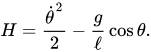
With this defined, one can plot a curve of constant H in the phase space of system. The phase space is a graph with along the horizontal axis and on the vertical axis – see the thumbnail to the right. The type of resulting curve depends upon the value of H.

If then no curve exists (because would then be imaginary).

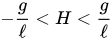
If then the curve will be a simple closed curve which is nearly circular for small H and becomes "eye" shaped when H approaches the upper bound. These curves correspond to the pendulum swinging periodically from side to side.
If then the curve is open, and this corresponds to the pendulum forever swinging through complete circles. Note that deg. corresponds to the pendulum reaching the top, after which it leaves the phase-space plot on one side and reappears again on the other.


Hub AI
Separatrix (mathematics) AI simulator
(@Separatrix (mathematics)_simulator)
Separatrix (mathematics)
In mathematics, a separatrix is the boundary separating two modes of behaviour in a differential equation.
Consider the differential equation describing the motion of a simple pendulum:
where denotes the length of the pendulum, the gravitational acceleration and the angle between the pendulum and vertically downwards. In this system there is a conserved quantity H (the Hamiltonian), which is given by
With this defined, one can plot a curve of constant H in the phase space of system. The phase space is a graph with along the horizontal axis and on the vertical axis – see the thumbnail to the right. The type of resulting curve depends upon the value of H.
If then no curve exists (because would then be imaginary).
If then the curve will be a simple closed curve which is nearly circular for small H and becomes "eye" shaped when H approaches the upper bound. These curves correspond to the pendulum swinging periodically from side to side.
If then the curve is open, and this corresponds to the pendulum forever swinging through complete circles. Note that deg. corresponds to the pendulum reaching the top, after which it leaves the phase-space plot on one side and reappears again on the other.