



Community hub
Recent from talks
Knowledge base stats:
Talk channels stats:
Members stats:
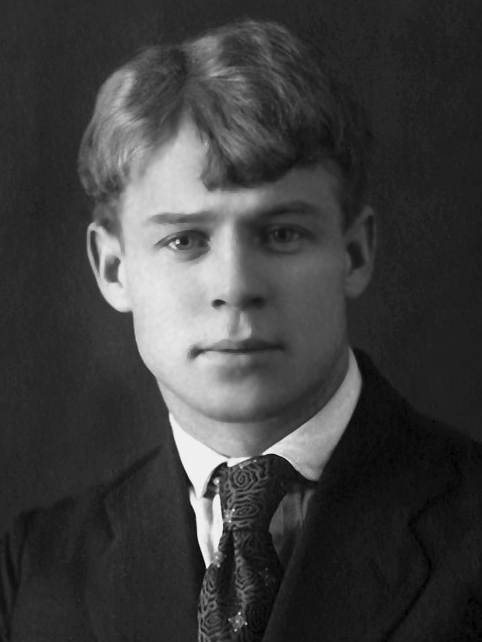
Sergei Yesenin
Sergei Alexandrovich Yesenin (Russian: Серге́й Алекса́ндрович Есе́нин, IPA: [sʲɪrˈɡʲej ɐlʲɪkˈsandrəvʲɪtɕ jɪˈsʲenʲɪn]; 3 October [O.S. 21 September] 1895 – 28 December 1925), sometimes spelled as Esenin, was a Russian lyric poet. He is one of the most popular and well-known Russian poets of the 20th century. One of his narratives was "lyrical evocations of and nostalgia for the village life of his childhood – no idyll, presented in all its rawness, with an implied curse on urbanisation and industrialisation".
Sergei Yesenin was born in the village of Konstantinovo in Ryazan County, Ryazan Governorate of the Russian Empire (now Rybnovsky District, Ryazan Oblast) into a peasant family. His father was Alexander Nikitich Yesenin (1873–1931), his mother was Tatyana Fyodorovna Yesenina, née Titova, (1875–1955).
Both his parents spent most of their time looking for work, his father in Moscow, his mother in Ryazan, so at age two Sergei was moved to the nearby village of Matovo to join Fyodor Alexeyevich Titov and Natalya Yevtikhiyevna Titova, his relatively well-off maternal grandparents, who essentially raised him.
The Titovs had three grown-up sons, who were Yesenin's companions in his early life. "My uncles taught me horse riding and swimming, one of them... even employed me as a hunting dog when he went duck hunting in local ponds," he later remembered. He started to read at age five, and at nine began to write poetry, inspired originally by chastushkas and folklore, provided mostly by his grandmother, whom he also remembered as a highly religious woman who used to take him to every single monastery she visited. He had two younger sisters, Yekaterina (1905–1977), and Alexandra (1911–1981).
In 1904 Yesenin joined the Konstantinovo zemstvo school, where in 1909 he graduated with an honorary certificate. He then went on to study in the local secondary parish school in Spas-Klepiki. From 1910 onwards he started to write poetry systematically; eight poems dated that year were later included in his 1925 Collected Works. In all, Yesenin wrote around thirty poems during his school years. He compiled them into what was supposed to be his first book, which he entitled "Volnye Dumy" (Free Thoughts) and tried to publish it in 1912 in Ryazan, but failed.
In 1912, with a teacher’s diploma, Yesenin moved to Moscow, where he supported himself working as a proofreader's assistant at Sytin's printing company. The following year he enrolled in Shanyavsky Moscow City People's University to study history and philology as an external student (вольнослушатель), but had to leave after eighteen months due to lack of funds. At the University he became friends with several aspiring poets, among them Dmitry Semyonovsky, Vasily Nasedkin, Nikolai Kolokolov and Ivan Filipchenko. Yesenin’s first marriage (which lasted three years) was in 1913 to Anna Izryadnova, a co-worker from the publishing house, with whom he had a son, Yuri.
1913 saw Yesenin becoming increasingly interested in Christianity, and biblical motives became frequent in his poems. "Grisha, what I am reading at the moment is the Gospel and I find a lot of things which for me are new," he wrote to his close childhood friend G. Panfilov. That was also the year when he became involved with Moscow revolutionary circles: for several months his flat was under secret police surveillance and in September 1913 it was raided and searched.
In January 1914 Yesenin's first published poem, "Beryoza" (The Birch Tree), appeared in the children's magazine Mirok (Small World). More appearances followed in minor magazines such as Protalinka and Mlechny Put. In December 1914 Yesenin left his job "and dedicated himself to poetry, writing continually," according to his wife. Around this time he became a member of the Surikov Literary and Music circle.
Hub AI
Sergei Yesenin AI simulator
(@Sergei Yesenin_simulator)
Sergei Yesenin
Sergei Alexandrovich Yesenin (Russian: Серге́й Алекса́ндрович Есе́нин, IPA: [sʲɪrˈɡʲej ɐlʲɪkˈsandrəvʲɪtɕ jɪˈsʲenʲɪn]; 3 October [O.S. 21 September] 1895 – 28 December 1925), sometimes spelled as Esenin, was a Russian lyric poet. He is one of the most popular and well-known Russian poets of the 20th century. One of his narratives was "lyrical evocations of and nostalgia for the village life of his childhood – no idyll, presented in all its rawness, with an implied curse on urbanisation and industrialisation".
Sergei Yesenin was born in the village of Konstantinovo in Ryazan County, Ryazan Governorate of the Russian Empire (now Rybnovsky District, Ryazan Oblast) into a peasant family. His father was Alexander Nikitich Yesenin (1873–1931), his mother was Tatyana Fyodorovna Yesenina, née Titova, (1875–1955).
Both his parents spent most of their time looking for work, his father in Moscow, his mother in Ryazan, so at age two Sergei was moved to the nearby village of Matovo to join Fyodor Alexeyevich Titov and Natalya Yevtikhiyevna Titova, his relatively well-off maternal grandparents, who essentially raised him.
The Titovs had three grown-up sons, who were Yesenin's companions in his early life. "My uncles taught me horse riding and swimming, one of them... even employed me as a hunting dog when he went duck hunting in local ponds," he later remembered. He started to read at age five, and at nine began to write poetry, inspired originally by chastushkas and folklore, provided mostly by his grandmother, whom he also remembered as a highly religious woman who used to take him to every single monastery she visited. He had two younger sisters, Yekaterina (1905–1977), and Alexandra (1911–1981).
In 1904 Yesenin joined the Konstantinovo zemstvo school, where in 1909 he graduated with an honorary certificate. He then went on to study in the local secondary parish school in Spas-Klepiki. From 1910 onwards he started to write poetry systematically; eight poems dated that year were later included in his 1925 Collected Works. In all, Yesenin wrote around thirty poems during his school years. He compiled them into what was supposed to be his first book, which he entitled "Volnye Dumy" (Free Thoughts) and tried to publish it in 1912 in Ryazan, but failed.
In 1912, with a teacher’s diploma, Yesenin moved to Moscow, where he supported himself working as a proofreader's assistant at Sytin's printing company. The following year he enrolled in Shanyavsky Moscow City People's University to study history and philology as an external student (вольнослушатель), but had to leave after eighteen months due to lack of funds. At the University he became friends with several aspiring poets, among them Dmitry Semyonovsky, Vasily Nasedkin, Nikolai Kolokolov and Ivan Filipchenko. Yesenin’s first marriage (which lasted three years) was in 1913 to Anna Izryadnova, a co-worker from the publishing house, with whom he had a son, Yuri.
1913 saw Yesenin becoming increasingly interested in Christianity, and biblical motives became frequent in his poems. "Grisha, what I am reading at the moment is the Gospel and I find a lot of things which for me are new," he wrote to his close childhood friend G. Panfilov. That was also the year when he became involved with Moscow revolutionary circles: for several months his flat was under secret police surveillance and in September 1913 it was raided and searched.
In January 1914 Yesenin's first published poem, "Beryoza" (The Birch Tree), appeared in the children's magazine Mirok (Small World). More appearances followed in minor magazines such as Protalinka and Mlechny Put. In December 1914 Yesenin left his job "and dedicated himself to poetry, writing continually," according to his wife. Around this time he became a member of the Surikov Literary and Music circle.