
Recent from talks
Sidemount diving
Knowledge base stats:
Talk channels stats:
Members stats:
Sidemount diving
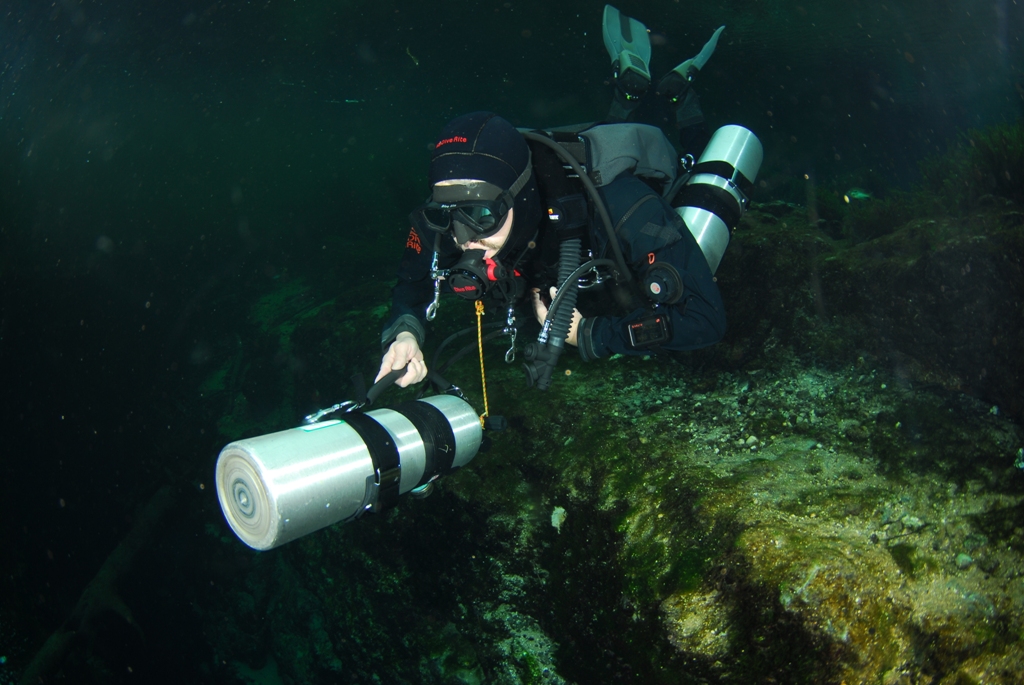
Sidemount is a scuba diving equipment configuration which has scuba sets mounted alongside the diver, below the shoulders and along the hips, instead of on the back of the diver. It originated as a configuration for advanced cave diving, as it facilitates penetration of tight sections of cave, allows easy access to cylinder valves, provides easy and reliable gas redundancy, and tanks can be easily removed when necessary. These benefits for operating in confined spaces were also recognized by divers who conducted technical wreck diving penetrations.
Sidemount diving is now growing in popularity within the technical diving community for general decompression diving, and is becoming an increasingly popular specialty training for recreational diving, with several diver certification agencies offering recreational and technical level sidemount training programs.
Sidemount diving offers some benefits in the flexibility of equipment. Cylinders suitable for sidemount diving are usually freely available for rental, unlike manifolded twin sets for back-mounted use, which allows the traveller to conduct technical or overhead environment dives without having to source twin cylinder sets. When diving in remote locations, the transportation of single diving cylinders, especially by hand, may be less physically taxing. Sidemount harness can be lighter and less bulky than back-mounted alternatives – allowing for easier and cheaper air travel.
Unlike back-mounted cylinders, the sidemount diver has immediate access to, and can see, the regulators and tank valves of their cylinders. This enables quicker and more certain problem identification and resolution, without requiring 'behind the head' shut-down drills that require a higher level of joint and suit flexibility and the ability to identify and correctly operate equipment which is out of sight.
Sidemount diving configuration places the cylinders under the diver's armpits, in line with their body, allowing the diver to pass through smaller restrictions than would be possible with back-mounted cylinders. The ability to remove tanks and push them in front allows the diver to pass through very small passages and holes when penetration diving – being limited only by the bulk of their bodies and diving suits. Streamlining for reduced drag while swimming is not always achieved.
Increased accessibility to regulator first-stages and cylinder valves improves efficiency and speed of critical cylinder shut-down procedures, allows immediate gas-loss identification and provides the diver with quick access to alternative contingency procedures, such as swapping regulators between cylinders, manual operation of a cylinder valve to control gas flow through a regulator which is free-flowing, or to allow breathing directly from the tank valve.
Mounting the cylinders at the diver's sides reduces exposure of valves and regulator first-stages to impact and abrasion damage, or accidental shut-down through roll-off against a ceiling. It also significantly reduces the risk of entanglement behind the diver, where it is most difficult to rectify.
Some divers will testify that sidemount diving configuration offers greater stability and easier-to-attain trim and control in the water. It is also claimed to be less physically tiring to carry, and get into, sidemount equipment than back-mounted doubles – especially when operating from a small boat or a rough shore entry.
Hub AI
Sidemount diving AI simulator
(@Sidemount diving_simulator)
Sidemount diving
Sidemount is a scuba diving equipment configuration which has scuba sets mounted alongside the diver, below the shoulders and along the hips, instead of on the back of the diver. It originated as a configuration for advanced cave diving, as it facilitates penetration of tight sections of cave, allows easy access to cylinder valves, provides easy and reliable gas redundancy, and tanks can be easily removed when necessary. These benefits for operating in confined spaces were also recognized by divers who conducted technical wreck diving penetrations.
Sidemount diving is now growing in popularity within the technical diving community for general decompression diving, and is becoming an increasingly popular specialty training for recreational diving, with several diver certification agencies offering recreational and technical level sidemount training programs.
Sidemount diving offers some benefits in the flexibility of equipment. Cylinders suitable for sidemount diving are usually freely available for rental, unlike manifolded twin sets for back-mounted use, which allows the traveller to conduct technical or overhead environment dives without having to source twin cylinder sets. When diving in remote locations, the transportation of single diving cylinders, especially by hand, may be less physically taxing. Sidemount harness can be lighter and less bulky than back-mounted alternatives – allowing for easier and cheaper air travel.
Unlike back-mounted cylinders, the sidemount diver has immediate access to, and can see, the regulators and tank valves of their cylinders. This enables quicker and more certain problem identification and resolution, without requiring 'behind the head' shut-down drills that require a higher level of joint and suit flexibility and the ability to identify and correctly operate equipment which is out of sight.
Sidemount diving configuration places the cylinders under the diver's armpits, in line with their body, allowing the diver to pass through smaller restrictions than would be possible with back-mounted cylinders. The ability to remove tanks and push them in front allows the diver to pass through very small passages and holes when penetration diving – being limited only by the bulk of their bodies and diving suits. Streamlining for reduced drag while swimming is not always achieved.
Increased accessibility to regulator first-stages and cylinder valves improves efficiency and speed of critical cylinder shut-down procedures, allows immediate gas-loss identification and provides the diver with quick access to alternative contingency procedures, such as swapping regulators between cylinders, manual operation of a cylinder valve to control gas flow through a regulator which is free-flowing, or to allow breathing directly from the tank valve.
Mounting the cylinders at the diver's sides reduces exposure of valves and regulator first-stages to impact and abrasion damage, or accidental shut-down through roll-off against a ceiling. It also significantly reduces the risk of entanglement behind the diver, where it is most difficult to rectify.
Some divers will testify that sidemount diving configuration offers greater stability and easier-to-attain trim and control in the water. It is also claimed to be less physically tiring to carry, and get into, sidemount equipment than back-mounted doubles – especially when operating from a small boat or a rough shore entry.
Recent media