


Community hub
Recent from talks
Contribute something to knowledge base
Content stats: 0 posts, 0 articles, 1 media, 0 notes
Members stats: 0 subscribers, 0 contributors, 0 moderators, 0 supporters
Subscribers
Supporters
Contributors
Moderators
Hub AI
Golf course AI simulator
(@Golf course_simulator)
Hub AI
Golf course AI simulator
(@Golf course_simulator)
Golf course
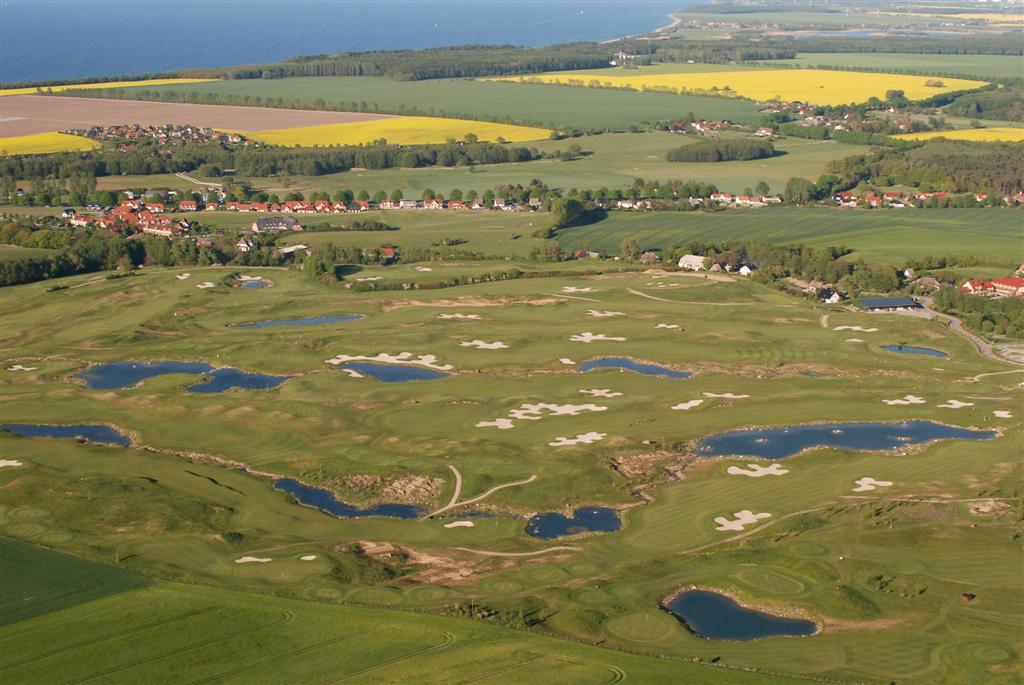
A golf course is the grounds on which the sport of golf is played. It consists of a series of holes, each consisting of a tee box, a fairway, the rough and other hazards, and a green with a cylindrical hole in the ground, known as a "cup". The cup holds a flagstick, known as a "pin". A standard round of golf consists of 18 holes, and as such most courses contain 18 distinct holes; however, there are many 9-hole courses and some that have holes with shared fairways or greens. There are also courses with a non-standard number of holes, such as 12 or 14.
The vast majority of golf courses have holes of varying length and difficulties that are assigned a standard score, known as par, that a proficient player should be able to achieve; this is usually three, four or five strokes. Par-3 courses consist of holes all of which have a par of three. Short courses have gained in popularity; these consist of mostly par 3 holes, but often have some short par 4 holes.
Many older courses are links, often coastal. The first golf courses were based on the topography of sand dunes and dune slacks with a ground cover of grasses, exposed to the wind and sea. Courses are private, public, or municipally owned, and typically feature a pro shop. Many private courses are found at country clubs.
The golf course has its roots dating to the 18th century. The 18-hole course Old Course was established in 1764 at St Andrews, Scotland, and has existed under its name since 1895.
In 2009, Nullarbor Links, the world's longest golf course spanning 1,365 kilometres, was established along the Eyre Highway, in Australia.
In 2023, the golf course at Moundbuilders Country Club, was integrated into the world heritage-listed Hopewell Culture National Historical Park.
Although a specialty within landscape design or landscape architecture, golf course architecture is considered a separate field of study. Some golf course designers become celebrities in their own right, such as Alister MacKenzie; others are professional golfers of high standing and demonstrated appreciation for golf course composition, such as Jack Nicklaus. The field is partially represented by the American Society of Golf Course Architects, the European Institute of Golf Course Architects, and the Society of Australian Golf Course Architects, although many of the finest golf course architects in the world choose not to become members of any such group, as associations of architects are not government-sanctioned licensing bodies, but private groups. While golf courses often follow the original landscape, some modification is unavoidable. This is increasingly the case as new courses are more likely to be sited on less optimal land. Bunkers and sand traps are always built in by architects unless the formation of such items is already in the course's natural terrain.
The layout of a course follows certain traditional principles, such as the number of holes (nine and 18 being most common), their par values, and the number of holes of each par value per course. It is also preferable to arrange greens to be close to the tee box of the next playable hole, to minimize travel distance while playing a round, and to vary the mix of shorter and longer holes. Combined with the need to package all the fairways within what is frequently a compact square or rectangular plot of land, the fairways of a course tend to form an oppositional tiling pattern. In complex areas, two holes may share the same tee box, fairway, or even green. It is also common for separate tee-off points to be positioned for men, women, and amateurs, each one respectively lying closer to the green. Eighteen-hole courses are traditionally broken down into a "front 9" (holes 1–9) and a "back 9" (holes 10–18). On older courses (especially links courses, like the Old Course at St. Andrews), the holes may be laid out in one long loop, beginning and ending at the clubhouse, and thus the front 9 is referred to on the scorecard as "out" (heading out away from clubhouse) and the back 9 as "in" (heading back in toward the clubhouse). More recent courses (and especially inland courses) tend to be routed with the front 9 and the back 9 each constituting a separate loop beginning and ending at the clubhouse. This is partly for the convenience of the players and the club, as then it is easier to play just a 9-hole round, if preferred, or stop at the clubhouse for a snack between the front 9 and the back 9.
Golf course
A golf course is the grounds on which the sport of golf is played. It consists of a series of holes, each consisting of a tee box, a fairway, the rough and other hazards, and a green with a cylindrical hole in the ground, known as a "cup". The cup holds a flagstick, known as a "pin". A standard round of golf consists of 18 holes, and as such most courses contain 18 distinct holes; however, there are many 9-hole courses and some that have holes with shared fairways or greens. There are also courses with a non-standard number of holes, such as 12 or 14.
The vast majority of golf courses have holes of varying length and difficulties that are assigned a standard score, known as par, that a proficient player should be able to achieve; this is usually three, four or five strokes. Par-3 courses consist of holes all of which have a par of three. Short courses have gained in popularity; these consist of mostly par 3 holes, but often have some short par 4 holes.
Many older courses are links, often coastal. The first golf courses were based on the topography of sand dunes and dune slacks with a ground cover of grasses, exposed to the wind and sea. Courses are private, public, or municipally owned, and typically feature a pro shop. Many private courses are found at country clubs.
The golf course has its roots dating to the 18th century. The 18-hole course Old Course was established in 1764 at St Andrews, Scotland, and has existed under its name since 1895.
In 2009, Nullarbor Links, the world's longest golf course spanning 1,365 kilometres, was established along the Eyre Highway, in Australia.
In 2023, the golf course at Moundbuilders Country Club, was integrated into the world heritage-listed Hopewell Culture National Historical Park.
Although a specialty within landscape design or landscape architecture, golf course architecture is considered a separate field of study. Some golf course designers become celebrities in their own right, such as Alister MacKenzie; others are professional golfers of high standing and demonstrated appreciation for golf course composition, such as Jack Nicklaus. The field is partially represented by the American Society of Golf Course Architects, the European Institute of Golf Course Architects, and the Society of Australian Golf Course Architects, although many of the finest golf course architects in the world choose not to become members of any such group, as associations of architects are not government-sanctioned licensing bodies, but private groups. While golf courses often follow the original landscape, some modification is unavoidable. This is increasingly the case as new courses are more likely to be sited on less optimal land. Bunkers and sand traps are always built in by architects unless the formation of such items is already in the course's natural terrain.
The layout of a course follows certain traditional principles, such as the number of holes (nine and 18 being most common), their par values, and the number of holes of each par value per course. It is also preferable to arrange greens to be close to the tee box of the next playable hole, to minimize travel distance while playing a round, and to vary the mix of shorter and longer holes. Combined with the need to package all the fairways within what is frequently a compact square or rectangular plot of land, the fairways of a course tend to form an oppositional tiling pattern. In complex areas, two holes may share the same tee box, fairway, or even green. It is also common for separate tee-off points to be positioned for men, women, and amateurs, each one respectively lying closer to the green. Eighteen-hole courses are traditionally broken down into a "front 9" (holes 1–9) and a "back 9" (holes 10–18). On older courses (especially links courses, like the Old Course at St. Andrews), the holes may be laid out in one long loop, beginning and ending at the clubhouse, and thus the front 9 is referred to on the scorecard as "out" (heading out away from clubhouse) and the back 9 as "in" (heading back in toward the clubhouse). More recent courses (and especially inland courses) tend to be routed with the front 9 and the back 9 each constituting a separate loop beginning and ending at the clubhouse. This is partly for the convenience of the players and the club, as then it is easier to play just a 9-hole round, if preferred, or stop at the clubhouse for a snack between the front 9 and the back 9.
Recent media
Recent media