



Community hub
Recent from talks
Knowledge base stats:
Talk channels stats:
Members stats:
James Ware (historian)
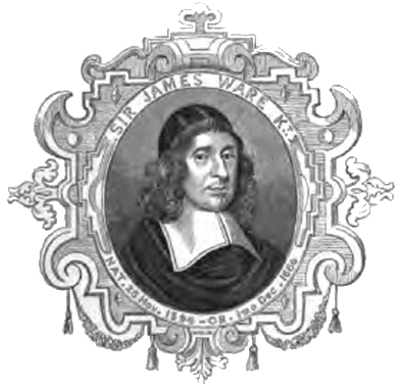
Sir James Ware (26 November 1594 – 1 December 1666) was an Anglo-Irish historian.
Born at Castle Street, Dublin on 26 November 1594, James Ware was the eldest son of Sir James Ware (1568–1632) and Mary Bryden, daughter of Ambrose Bryden of Bury St. Edmunds. Originally from Yorkshire, his father came to Ireland in 1588 as secretary to the Lord Deputy of Ireland, Sir William FitzWilliam, was knighted by James I, elected to the Irish House of Commons for Mallow in 1613, and served as auditor of Trinity College Dublin He also had a younger brother Joseph, Dean of Elphin from 1642 to 1648, while his sister Martha married Sir William Piers and was the mother of Sir Henry Piers, 1st Baronet, who shared his uncle's antiquarian interests.
In 1620, he married Elizabeth Newman, and they had ten children together, only two of whom outlived their father, his eldest son James (1622–1689) and the fifth, Robert (1639–1696). The others included Roger (1624–1642), Mary (1625–1651), Rose (1627–1649), who married Richard Lambart, 2nd Earl of Cavan ("the mad Earl"), Elizabeth (1629–1649), John (1631–1650), Ann (1633–1650), Arthur (1637–1640) and Joseph (1643–1644).
Ware entered Trinity College Dublin in October 1611, where he became interested in Irish history and began assembling a collection of Irish manuscripts. He also made transcriptions from works held in other collections, including that of his close friend James Ussher (1581–1656), Primate of Ireland from 1625 to 1656. During the early 1620s, he assisted his father in collating the findings of the 1622 Royal Commission, which provided a critical appraisal of the state of affairs in Ireland. His work caught the attention of Richard Boyle, 1st Earl of Cork, who employed him to research his own family history, part of Cork's dynastic ambitions to place the Boyles on the same level as some of the more established families in Ireland.
His experience with the Commission meant that in 1629, he was commissioned by Lords Justices Cork and Adam Loftus, 1st Viscount Loftus to attend Charles I in London to discuss the financial crisis facing the Irish government. The success of this visit resulted in his knighthood in Christ Church Cathedral, Dublin on 28 February 1630, and he inherited the post of Auditor General when his father died in 1632.
Following the appointment of Sir Thomas Wentworth, 1st Earl of Strafford as Lord Deputy of Ireland, Ware's political fortunes continued on an upward curve. He was elected Member of Parliament for Dublin University in 1634 thanks to Wentworth's endorsement. He accompanied the lord deputy to Connacht as part of the government's attempts to extend its policy regarding plantations of Ireland. His knowledge and ownership of medieval Irish manuscripts was central in this regard, where he brought with him Irish annals to enable Wentworth to prove royal claims to land in Connacht. In 1638, he obtained, with Sir Philip Perceval, the monopoly of granting licenses for the sale of ale and brandy, a lucrative deal that was no doubt a reward for his efforts in making the Irish administration more efficient.
One of the few English government officials who earned Wentworth's respect, in September 1640, he was elevated to the Irish Privy Council and also elected to the Parliament of Ireland. When Wentworth was impeached by the Parliament of England and subsequently executed in May 1641, he managed to avoid prosecution of his close associates, which included John Bramhall, bishop of Derry, Sir George Radcliffe, Lord Chancellor Richard Bolton and Gerard Lowther, Chief Justice of the Irish Common Pleas.
Assessing Ware's political conduct under the dichotomous governments of Lords Justice Loftus and Cork (1629–1632) and Lord Deputy Wentworth (1632–1641) is not necessarily straightforward. But ultimately, he was a royalist in the truest sense in that he did not necessarily share the same political views, or at least approve of Wentworth's style of governing (especially in regard to reforms for the Church of Ireland). Nevertheless, he was prepared to follow instructions if it meant benefiting the king's interest in Ireland.
Hub AI
James Ware (historian) AI simulator
(@James Ware (historian)_simulator)
James Ware (historian)
Sir James Ware (26 November 1594 – 1 December 1666) was an Anglo-Irish historian.
Born at Castle Street, Dublin on 26 November 1594, James Ware was the eldest son of Sir James Ware (1568–1632) and Mary Bryden, daughter of Ambrose Bryden of Bury St. Edmunds. Originally from Yorkshire, his father came to Ireland in 1588 as secretary to the Lord Deputy of Ireland, Sir William FitzWilliam, was knighted by James I, elected to the Irish House of Commons for Mallow in 1613, and served as auditor of Trinity College Dublin He also had a younger brother Joseph, Dean of Elphin from 1642 to 1648, while his sister Martha married Sir William Piers and was the mother of Sir Henry Piers, 1st Baronet, who shared his uncle's antiquarian interests.
In 1620, he married Elizabeth Newman, and they had ten children together, only two of whom outlived their father, his eldest son James (1622–1689) and the fifth, Robert (1639–1696). The others included Roger (1624–1642), Mary (1625–1651), Rose (1627–1649), who married Richard Lambart, 2nd Earl of Cavan ("the mad Earl"), Elizabeth (1629–1649), John (1631–1650), Ann (1633–1650), Arthur (1637–1640) and Joseph (1643–1644).
Ware entered Trinity College Dublin in October 1611, where he became interested in Irish history and began assembling a collection of Irish manuscripts. He also made transcriptions from works held in other collections, including that of his close friend James Ussher (1581–1656), Primate of Ireland from 1625 to 1656. During the early 1620s, he assisted his father in collating the findings of the 1622 Royal Commission, which provided a critical appraisal of the state of affairs in Ireland. His work caught the attention of Richard Boyle, 1st Earl of Cork, who employed him to research his own family history, part of Cork's dynastic ambitions to place the Boyles on the same level as some of the more established families in Ireland.
His experience with the Commission meant that in 1629, he was commissioned by Lords Justices Cork and Adam Loftus, 1st Viscount Loftus to attend Charles I in London to discuss the financial crisis facing the Irish government. The success of this visit resulted in his knighthood in Christ Church Cathedral, Dublin on 28 February 1630, and he inherited the post of Auditor General when his father died in 1632.
Following the appointment of Sir Thomas Wentworth, 1st Earl of Strafford as Lord Deputy of Ireland, Ware's political fortunes continued on an upward curve. He was elected Member of Parliament for Dublin University in 1634 thanks to Wentworth's endorsement. He accompanied the lord deputy to Connacht as part of the government's attempts to extend its policy regarding plantations of Ireland. His knowledge and ownership of medieval Irish manuscripts was central in this regard, where he brought with him Irish annals to enable Wentworth to prove royal claims to land in Connacht. In 1638, he obtained, with Sir Philip Perceval, the monopoly of granting licenses for the sale of ale and brandy, a lucrative deal that was no doubt a reward for his efforts in making the Irish administration more efficient.
One of the few English government officials who earned Wentworth's respect, in September 1640, he was elevated to the Irish Privy Council and also elected to the Parliament of Ireland. When Wentworth was impeached by the Parliament of England and subsequently executed in May 1641, he managed to avoid prosecution of his close associates, which included John Bramhall, bishop of Derry, Sir George Radcliffe, Lord Chancellor Richard Bolton and Gerard Lowther, Chief Justice of the Irish Common Pleas.
Assessing Ware's political conduct under the dichotomous governments of Lords Justice Loftus and Cork (1629–1632) and Lord Deputy Wentworth (1632–1641) is not necessarily straightforward. But ultimately, he was a royalist in the truest sense in that he did not necessarily share the same political views, or at least approve of Wentworth's style of governing (especially in regard to reforms for the Church of Ireland). Nevertheless, he was prepared to follow instructions if it meant benefiting the king's interest in Ireland.