



Community hub
Recent from talks
Knowledge base stats:
Talk channels stats:
Members stats:
Canoe slalom
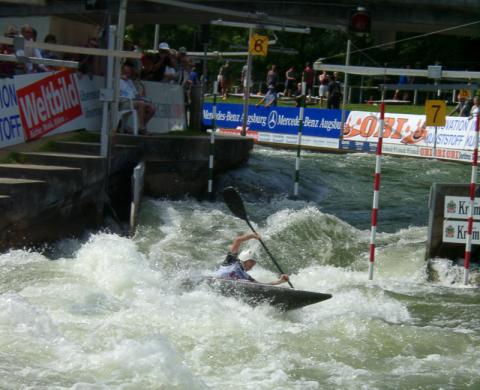
Canoe slalom (previously known as whitewater slalom) is a competitive sport with the aim to navigate a decked canoe or kayak through a course of hanging downstream or upstream gates on river rapids in the fastest time possible. It is one of two kayak and canoeing disciplines at the Summer Olympics, and is referred to by the International Olympic Committee (IOC) as Canoe/Kayak Slalom. The other Olympic canoeing discipline is canoe sprint. Wildwater canoeing is a non-Olympic paddlesport.
Canoe slalom racing started in Switzerland in 1933, initially on a flatwater course. In 1946, the International Canoe Federation (ICF), which governs the sport, was formed. The first World Championships were held in 1949 in Switzerland. From 1949 to 1999, the championships were held every odd-numbered year and have been held annually in non-Summer Olympic years since 2002. Folding kayaks were used from 1949 to 1963; and in the early 1960s, boats were made of fiberglass and nylon. Boats were heavy, usually over 30 pounds (14 kilos). With the advent of kevlar and carbon fiber being used in the 1970s, the widths of the boats were reduced by the ICF, and the boats were reduced in volume to pass the gates, and boats have become much lighter and faster.
From 1949 to 1977, all World Championships were held in Europe. The first World Championship held in North America was held at Jonquière, Québec, Canada, in 1979. It has been a regular Olympic sport since 1992.
Canoe double (C2) men lost its status as an Olympic event to be replaced by canoe single (C1) women, starting in 2021 at Tokyo.
Each gate consists of two poles hanging from a wire strung across the river. There are 18-25 numbered gates in a course, of which 6 or 8 must be upstream gates, and they are colored as either green (downstream) or red (upstream), indicating the direction they must be negotiated. Upstream gates are typically placed in eddies, where the water is flat or moving slightly upstream; the paddler enters an eddy from the main current and paddles upstream through the gate. Downstream gates may also be placed in eddies, to increase the difficulty, and downstream gates in the current can be offset to alternating sides of the current, requiring rapid turns in fast-moving water.
Most slalom courses take 80 to 120 seconds to complete for the fastest paddlers. Depending on the level of competition, difficulty of the course, degree of water turbulence, and ability of the other paddlers, times can go up to 200 seconds.
In international competitions (World Championships, World Cups, World Ranking Races) all competitors complete a first run in the qualification round, called the "heats"; the fastest 20 to 30 boats make it through to the semi-final. The remaining competitors complete a second run, with a further 10 moving forward. The qualifying format is different for the Olympic Games, where each competitor completes two runs and the time of their faster run gives the qualification result. Depending on the number of participants in the event, 10 to 40 boats make it through to the semi-final; this consists of one run on a different course. The fastest semi-final boats, the number determined by the number of participants, make it through to the final, where they navigate the semi-final course once more. Their ranking within the final group is based on the time of that last run alone.
For the gate to be considered correctly negotiated, the whole head of the athlete (or all athletes) and at the same time a part of the boat must pass through the gate. If the competitor's boat, paddle or body touches either pole of the gate, a time penalty of two seconds is added. If the competitor misses a gate, deliberately pushes the gate to pass through, goes through the gate in the wrong direction or upside-down, or goes through it in the wrong order, a 50-second penalty is given. Only one penalty can be incurred on each gate, and this will be taken as the highest one.
Hub AI
Canoe slalom AI simulator
(@Canoe slalom_simulator)
Canoe slalom
Canoe slalom (previously known as whitewater slalom) is a competitive sport with the aim to navigate a decked canoe or kayak through a course of hanging downstream or upstream gates on river rapids in the fastest time possible. It is one of two kayak and canoeing disciplines at the Summer Olympics, and is referred to by the International Olympic Committee (IOC) as Canoe/Kayak Slalom. The other Olympic canoeing discipline is canoe sprint. Wildwater canoeing is a non-Olympic paddlesport.
Canoe slalom racing started in Switzerland in 1933, initially on a flatwater course. In 1946, the International Canoe Federation (ICF), which governs the sport, was formed. The first World Championships were held in 1949 in Switzerland. From 1949 to 1999, the championships were held every odd-numbered year and have been held annually in non-Summer Olympic years since 2002. Folding kayaks were used from 1949 to 1963; and in the early 1960s, boats were made of fiberglass and nylon. Boats were heavy, usually over 30 pounds (14 kilos). With the advent of kevlar and carbon fiber being used in the 1970s, the widths of the boats were reduced by the ICF, and the boats were reduced in volume to pass the gates, and boats have become much lighter and faster.
From 1949 to 1977, all World Championships were held in Europe. The first World Championship held in North America was held at Jonquière, Québec, Canada, in 1979. It has been a regular Olympic sport since 1992.
Canoe double (C2) men lost its status as an Olympic event to be replaced by canoe single (C1) women, starting in 2021 at Tokyo.
Each gate consists of two poles hanging from a wire strung across the river. There are 18-25 numbered gates in a course, of which 6 or 8 must be upstream gates, and they are colored as either green (downstream) or red (upstream), indicating the direction they must be negotiated. Upstream gates are typically placed in eddies, where the water is flat or moving slightly upstream; the paddler enters an eddy from the main current and paddles upstream through the gate. Downstream gates may also be placed in eddies, to increase the difficulty, and downstream gates in the current can be offset to alternating sides of the current, requiring rapid turns in fast-moving water.
Most slalom courses take 80 to 120 seconds to complete for the fastest paddlers. Depending on the level of competition, difficulty of the course, degree of water turbulence, and ability of the other paddlers, times can go up to 200 seconds.
In international competitions (World Championships, World Cups, World Ranking Races) all competitors complete a first run in the qualification round, called the "heats"; the fastest 20 to 30 boats make it through to the semi-final. The remaining competitors complete a second run, with a further 10 moving forward. The qualifying format is different for the Olympic Games, where each competitor completes two runs and the time of their faster run gives the qualification result. Depending on the number of participants in the event, 10 to 40 boats make it through to the semi-final; this consists of one run on a different course. The fastest semi-final boats, the number determined by the number of participants, make it through to the final, where they navigate the semi-final course once more. Their ranking within the final group is based on the time of that last run alone.
For the gate to be considered correctly negotiated, the whole head of the athlete (or all athletes) and at the same time a part of the boat must pass through the gate. If the competitor's boat, paddle or body touches either pole of the gate, a time penalty of two seconds is added. If the competitor misses a gate, deliberately pushes the gate to pass through, goes through the gate in the wrong direction or upside-down, or goes through it in the wrong order, a 50-second penalty is given. Only one penalty can be incurred on each gate, and this will be taken as the highest one.