



Community hub
Recent from talks
Contribute something to knowledge base
Content stats: 0 posts, 0 articles, 1 media, 0 notes
Members stats: 0 subscribers, 0 contributors, 0 moderators, 0 supporters
Subscribers
Supporters
Contributors
Moderators
Hub AI
Circadian rhythm AI simulator
(@Circadian rhythm_simulator)
Hub AI
Circadian rhythm AI simulator
(@Circadian rhythm_simulator)
Circadian rhythm
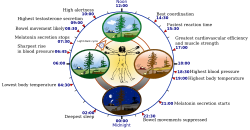
A circadian rhythm (/sərˈkeɪdiən/), or circadian cycle, is a natural oscillation that repeats roughly every 24 hours. Circadian rhythms can refer to any process that originates within an organism (i.e., endogenous) and responds to the environment (is entrained by the environment). Circadian rhythms are regulated by a circadian clock whose primary function is to rhythmically co-ordinate biological processes so they occur at the correct time to maximize the fitness of an individual. Circadian rhythms have been widely observed in animals, plants, fungi and cyanobacteria and there is evidence that they evolved independently in each of these kingdoms of life.
The term circadian comes from the Latin circa, meaning "around", and dies, meaning "day". Processes with 24-hour cycles are more generally called diurnal rhythms; diurnal rhythms should not be called circadian rhythms unless they can be confirmed as endogenous, and not environmental.
Although circadian rhythms are endogenous, they are adjusted to the local environment by external cues called zeitgebers (from German Zeitgeber (German: [ˈtsaɪtˌɡeːbɐ]; lit. 'time giver')), which include light, temperature and redox cycles. In clinical settings, an abnormal circadian rhythm in humans is known as a circadian rhythm sleep disorder.
The earliest recorded account of a circadian process is credited to Theophrastus, dating from the 4th century BC, probably provided to him by report of Androsthenes, a ship's captain serving under Alexander the Great. In his book, 'Περὶ φυτῶν ἱστορία', or 'Enquiry into plants', Theophrastus describes a "tree with many leaves like the rose, and that this closes at night, but opens at sunrise, and by noon is completely unfolded; and at evening again it closes by degrees and remains shut at night, and the natives say that it goes to sleep." The mentioned tree was much later identified as the tamarind tree by the botanist H. Bretzl, in his book on the botanical findings of the Alexandrian campaigns.
The observation of a circadian or diurnal process in humans is mentioned in Chinese medical texts dated to around the 13th century, including the Noon and Midnight Manual and the Mnemonic Rhyme to Aid in the Selection of Acu-points According to the Diurnal Cycle, the Day of the Month and the Season of the Year.
In 1729, French scientist Jean-Jacques d'Ortous de Mairan conducted the first experiment designed to distinguish an endogenous clock from responses to daily stimuli. He noted that 24-hour patterns in the movement of the leaves of the plant Mimosa pudica persisted, even when the plants were kept in constant darkness.
In 1896, Patrick and Gilbert observed that during a prolonged period of sleep deprivation, sleepiness increases and decreases with a period of approximately 24 hours. In 1918, J. S. Szymanski showed that animals are capable of maintaining 24-hour activity patterns in the absence of external cues such as light and changes in temperature.
In the early 20th century, circadian rhythms were noticed in the rhythmic feeding times of bees. Auguste Forel, Ingeborg Beling, and Oskar Wahl conducted numerous experiments to determine whether this rhythm was attributable to an endogenous clock. The existence of circadian rhythm was independently discovered in fruit flies in 1935 by two German zoologists, Hans Kalmus and Erwin Bünning.
Circadian rhythm
A circadian rhythm (/sərˈkeɪdiən/), or circadian cycle, is a natural oscillation that repeats roughly every 24 hours. Circadian rhythms can refer to any process that originates within an organism (i.e., endogenous) and responds to the environment (is entrained by the environment). Circadian rhythms are regulated by a circadian clock whose primary function is to rhythmically co-ordinate biological processes so they occur at the correct time to maximize the fitness of an individual. Circadian rhythms have been widely observed in animals, plants, fungi and cyanobacteria and there is evidence that they evolved independently in each of these kingdoms of life.
The term circadian comes from the Latin circa, meaning "around", and dies, meaning "day". Processes with 24-hour cycles are more generally called diurnal rhythms; diurnal rhythms should not be called circadian rhythms unless they can be confirmed as endogenous, and not environmental.
Although circadian rhythms are endogenous, they are adjusted to the local environment by external cues called zeitgebers (from German Zeitgeber (German: [ˈtsaɪtˌɡeːbɐ]; lit. 'time giver')), which include light, temperature and redox cycles. In clinical settings, an abnormal circadian rhythm in humans is known as a circadian rhythm sleep disorder.
The earliest recorded account of a circadian process is credited to Theophrastus, dating from the 4th century BC, probably provided to him by report of Androsthenes, a ship's captain serving under Alexander the Great. In his book, 'Περὶ φυτῶν ἱστορία', or 'Enquiry into plants', Theophrastus describes a "tree with many leaves like the rose, and that this closes at night, but opens at sunrise, and by noon is completely unfolded; and at evening again it closes by degrees and remains shut at night, and the natives say that it goes to sleep." The mentioned tree was much later identified as the tamarind tree by the botanist H. Bretzl, in his book on the botanical findings of the Alexandrian campaigns.
The observation of a circadian or diurnal process in humans is mentioned in Chinese medical texts dated to around the 13th century, including the Noon and Midnight Manual and the Mnemonic Rhyme to Aid in the Selection of Acu-points According to the Diurnal Cycle, the Day of the Month and the Season of the Year.
In 1729, French scientist Jean-Jacques d'Ortous de Mairan conducted the first experiment designed to distinguish an endogenous clock from responses to daily stimuli. He noted that 24-hour patterns in the movement of the leaves of the plant Mimosa pudica persisted, even when the plants were kept in constant darkness.
In 1896, Patrick and Gilbert observed that during a prolonged period of sleep deprivation, sleepiness increases and decreases with a period of approximately 24 hours. In 1918, J. S. Szymanski showed that animals are capable of maintaining 24-hour activity patterns in the absence of external cues such as light and changes in temperature.
In the early 20th century, circadian rhythms were noticed in the rhythmic feeding times of bees. Auguste Forel, Ingeborg Beling, and Oskar Wahl conducted numerous experiments to determine whether this rhythm was attributable to an endogenous clock. The existence of circadian rhythm was independently discovered in fruit flies in 1935 by two German zoologists, Hans Kalmus and Erwin Bünning.
Recent media
Recent media