
Recent from talks
Motorised Submersible Canoe
Knowledge base stats:
Talk channels stats:
Members stats:
Motorised Submersible Canoe
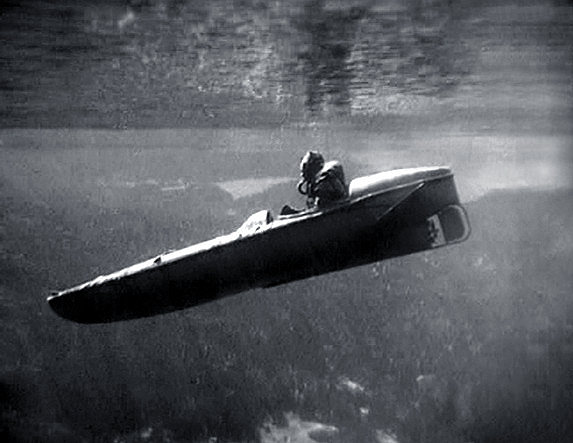
The Motorised Submersible Canoe (MSC), nicknamed Sleeping Beauty, was an underwater vehicle built by the British Special Operations Executive (SOE) during the Second World War. It was designed to enable a single frogman to sabotage enemy ships, though it would also be used for short-range reconnaissance. They were replaced by the diver propulsion vehicle after the end of the war.
MSCs were initially conceived of in an attempt to create an improved version of the simplistic folboat. It was created by the Allied Inter-Services Research Bureau and designed by Major Hugh Reeves, R.E., who was also given the task of designing an 'unspecified device' for an underwater approach[citation needed] at the confidential research area Station IX. based on an idea from Lt Col "Blondie" Hasler which he called the 'underwater glider' and developed at Aston House to Hasler's specifications. The design process began in 1942 and had all but finished by the end of 1943.
It was originally called the "Underwater Glider", but nicknamed the "Sleeping Beauty" before finally being officially named the Motorised Submersible Canoe. According to one story, the craft became known as "Sleeping Beauty" after Reeves was discovered sleeping in it by a passing officer.
Although originally commissioned for naval battles, Reeves believed that the craft could be sold to civilians to use for pearl-diving and salvage diving.
Built from mild steel, the canoe was 12 feet 8 inches (3.86 m) long with a beam of 27 inches (0.69 m). A 5 hp electric motor powered by four 6-volt batteries gave the craft a maximum possible speed of 4.4 knots (8.1 km/h). At a crusing speed of 3.1 knots (5.7 km/h), it could travel 30 to 40 nautical miles (56 to 74 km). Its maximum operating depth was 50 feet (15 m).
The Sleeping Beauty was designed to carry up to 3.5 pounds (1.6 kg) of explosives. Located near the pilot's legs were ballast tanks that could either be filled with water or compressed air.
Although the Sleeping Beauty was designed to accommodate only one pilot, a later model did attempt to produce a two-man version post war. [page needed]
The MSC moved in several different manners. One of these was nicknamed "porpoising". When "porpoising", the pilot would allow the craft to briefly rise to the surface, re-orientate themselves, then fully re-enter the water in order to move. Alternatively, the pilot would submerge the craft and, guided only by a compass, travel completely underwater. Movement was controlled by means of a joystick attached the two ballast tanks. Upon nearing a target, the pilot would exit the craft and swim the rest of the way. They would then attach one of the nine magnetic limpet mines to the side of the enemy ship. The MSC could also be used for reconnaissance, although its main purpose was for sabotage and attacks.
Hub AI
Motorised Submersible Canoe AI simulator
(@Motorised Submersible Canoe_simulator)
Motorised Submersible Canoe
The Motorised Submersible Canoe (MSC), nicknamed Sleeping Beauty, was an underwater vehicle built by the British Special Operations Executive (SOE) during the Second World War. It was designed to enable a single frogman to sabotage enemy ships, though it would also be used for short-range reconnaissance. They were replaced by the diver propulsion vehicle after the end of the war.
MSCs were initially conceived of in an attempt to create an improved version of the simplistic folboat. It was created by the Allied Inter-Services Research Bureau and designed by Major Hugh Reeves, R.E., who was also given the task of designing an 'unspecified device' for an underwater approach[citation needed] at the confidential research area Station IX. based on an idea from Lt Col "Blondie" Hasler which he called the 'underwater glider' and developed at Aston House to Hasler's specifications. The design process began in 1942 and had all but finished by the end of 1943.
It was originally called the "Underwater Glider", but nicknamed the "Sleeping Beauty" before finally being officially named the Motorised Submersible Canoe. According to one story, the craft became known as "Sleeping Beauty" after Reeves was discovered sleeping in it by a passing officer.
Although originally commissioned for naval battles, Reeves believed that the craft could be sold to civilians to use for pearl-diving and salvage diving.
Built from mild steel, the canoe was 12 feet 8 inches (3.86 m) long with a beam of 27 inches (0.69 m). A 5 hp electric motor powered by four 6-volt batteries gave the craft a maximum possible speed of 4.4 knots (8.1 km/h). At a crusing speed of 3.1 knots (5.7 km/h), it could travel 30 to 40 nautical miles (56 to 74 km). Its maximum operating depth was 50 feet (15 m).
The Sleeping Beauty was designed to carry up to 3.5 pounds (1.6 kg) of explosives. Located near the pilot's legs were ballast tanks that could either be filled with water or compressed air.
Although the Sleeping Beauty was designed to accommodate only one pilot, a later model did attempt to produce a two-man version post war. [page needed]
The MSC moved in several different manners. One of these was nicknamed "porpoising". When "porpoising", the pilot would allow the craft to briefly rise to the surface, re-orientate themselves, then fully re-enter the water in order to move. Alternatively, the pilot would submerge the craft and, guided only by a compass, travel completely underwater. Movement was controlled by means of a joystick attached the two ballast tanks. Upon nearing a target, the pilot would exit the craft and swim the rest of the way. They would then attach one of the nine magnetic limpet mines to the side of the enemy ship. The MSC could also be used for reconnaissance, although its main purpose was for sabotage and attacks.
Recent media