
Recent from talks
Speckle (interference)
Knowledge base stats:
Talk channels stats:
Members stats:
Speckle (interference)
Speckle, speckle pattern, or speckle noise designates the granular structure observed in coherent light, resulting from random interference. Speckle patterns are used in a wide range of metrology techniques, as they generally allow high sensitivity and simple setups. They can also be a limiting factor in imaging systems, such as radar, synthetic aperture radar (SAR), medical ultrasound and optical coherence tomography. Speckle is not external noise; rather, it is an inherent fluctuation in diffuse reflections, because the scatterers are not identical for each cell, and the coherent illumination wave is highly sensitive to small variations in phase changes.
Speckle patterns arise when coherent light is randomised. The simplest case of such randomisation is when light reflects off an optically rough surface. Optically rough means that the surface profile contains fluctuations larger than the wavelength. Most common surfaces are rough to visible light, such as paper, wood, or paint.
The vast majority of surfaces, synthetic or natural, are extremely rough on the scale of the wavelength. We see the origin of this phenomenon if we model our reflectivity function as an array of scatterers. Because of the finite resolution, at any time we are receiving from a distribution of scatterers within the resolution cell. These scattered signals add coherently; that is, they add constructively and destructively depending on the relative phases of each scattered waveform. Speckle results from these patterns of constructive and destructive interference shown as bright and dark dots in the image.
Speckle in conventional radar increases the mean grey level of a local area. Speckle in SAR is generally serious, causing difficulties for image interpretation. It is caused by coherent processing of backscattered signals from multiple distributed targets. In SAR oceanography, for example, speckle is caused by signals from elementary scatterers, the gravity-capillary ripples, and manifests as a pedestal image, beneath the image of the sea waves.
The speckle can also represent some useful information, particularly when it is linked to the laser speckle and to the dynamic speckle phenomenon, where the changes of the spatial speckle pattern over time can be used as a measurement of the surface's activity, such as which is useful for measuring displacement fields via digital image correlation.
Although scientists have investigated this phenomenon since the time of Newton, speckles have come into prominence since the invention of the laser.
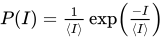
The speckle effect is a result of the interference of many waves of the same frequency, having different phases and amplitudes, which add together to give a resultant wave whose amplitude, and therefore intensity, varies randomly. If we model each wave by a vector, we can then see that if we add a number of vectors with random angles together, the length of the resulting vector can be anything from zero to the sum of the individual vector lengths—a 2-dimensional random walk, sometimes known as a drunkard's walk. In the limit of many interfering waves, and for polarised waves, the distribution of intensities (which go as the square of the vector's length) becomes exponential , where is the mean intensity.

When a surface is illuminated by a light wave, according to diffraction theory, each point on an illuminated surface acts as a source of secondary spherical waves. The light at any point in the scattered light field is made up of waves which have been scattered from each point on the illuminated surface. If the surface is rough enough to create path-length differences exceeding one wavelength, giving rise to phase changes greater than 2π, the amplitude, and hence the intensity, of the resultant light varies randomly.
Hub AI
Speckle (interference) AI simulator
(@Speckle (interference)_simulator)
Speckle (interference)
Speckle, speckle pattern, or speckle noise designates the granular structure observed in coherent light, resulting from random interference. Speckle patterns are used in a wide range of metrology techniques, as they generally allow high sensitivity and simple setups. They can also be a limiting factor in imaging systems, such as radar, synthetic aperture radar (SAR), medical ultrasound and optical coherence tomography. Speckle is not external noise; rather, it is an inherent fluctuation in diffuse reflections, because the scatterers are not identical for each cell, and the coherent illumination wave is highly sensitive to small variations in phase changes.
Speckle patterns arise when coherent light is randomised. The simplest case of such randomisation is when light reflects off an optically rough surface. Optically rough means that the surface profile contains fluctuations larger than the wavelength. Most common surfaces are rough to visible light, such as paper, wood, or paint.
The vast majority of surfaces, synthetic or natural, are extremely rough on the scale of the wavelength. We see the origin of this phenomenon if we model our reflectivity function as an array of scatterers. Because of the finite resolution, at any time we are receiving from a distribution of scatterers within the resolution cell. These scattered signals add coherently; that is, they add constructively and destructively depending on the relative phases of each scattered waveform. Speckle results from these patterns of constructive and destructive interference shown as bright and dark dots in the image.
Speckle in conventional radar increases the mean grey level of a local area. Speckle in SAR is generally serious, causing difficulties for image interpretation. It is caused by coherent processing of backscattered signals from multiple distributed targets. In SAR oceanography, for example, speckle is caused by signals from elementary scatterers, the gravity-capillary ripples, and manifests as a pedestal image, beneath the image of the sea waves.
The speckle can also represent some useful information, particularly when it is linked to the laser speckle and to the dynamic speckle phenomenon, where the changes of the spatial speckle pattern over time can be used as a measurement of the surface's activity, such as which is useful for measuring displacement fields via digital image correlation.
Although scientists have investigated this phenomenon since the time of Newton, speckles have come into prominence since the invention of the laser.
The speckle effect is a result of the interference of many waves of the same frequency, having different phases and amplitudes, which add together to give a resultant wave whose amplitude, and therefore intensity, varies randomly. If we model each wave by a vector, we can then see that if we add a number of vectors with random angles together, the length of the resulting vector can be anything from zero to the sum of the individual vector lengths—a 2-dimensional random walk, sometimes known as a drunkard's walk. In the limit of many interfering waves, and for polarised waves, the distribution of intensities (which go as the square of the vector's length) becomes exponential , where is the mean intensity.
When a surface is illuminated by a light wave, according to diffraction theory, each point on an illuminated surface acts as a source of secondary spherical waves. The light at any point in the scattered light field is made up of waves which have been scattered from each point on the illuminated surface. If the surface is rough enough to create path-length differences exceeding one wavelength, giving rise to phase changes greater than 2π, the amplitude, and hence the intensity, of the resultant light varies randomly.