
Recent from talks
Spike (missile)
Knowledge base stats:
Talk channels stats:
Members stats:
Spike (missile)
Spike (Hebrew: ספייק) is an Israeli fire-and-forget anti-tank guided missile and anti-personnel missile with a tandem-charge high-explosive anti-tank (HEAT) warhead. As of 2024[update], it is in its sixth generation. It was developed and designed by the Israeli company Rafael Advanced Defense Systems. It is available in man-portable, vehicle-launched, helicopter-launched and maritime variants.
The missile can engage and destroy targets within the line-of-sight of the launcher ("fire-and-forget"), and some variants can make a top attack through a "fire, observe and update" method (essentially lock-on after launch); the operator tracking the target, or switching to another target, optically through the trailing fiber-optic wire (or RF link in the case of the vehicle-mounted, long-range NLOS variant) while the missile is climbing to altitude after launch. This is similar to the lofted trajectory flight profile of the US FGM-148 Javelin.
Spike is a fire-and-forget missile with lock-on before launch and automatic self-guidance. The missile is equipped with an imaging infrared seeker.
The long and extended range versions of the Spike also have the capability of "Fire, Observe and Update" operating mode (also known as Lock-on after launch (LOAL)). The missile is connected by a fiber-optical wire that is spooled out between the launch position and the missile. With this, the operator can obtain a target if it is not in the line of sight of the operator at launch, switch targets in flight, or compensate for the movement of the target if the missile is not tracking the target for some reason. Hence, the missile can be fired speculatively for a target of opportunity, or to provide observation on the other side of an obstacle. The missile has a soft launch capability – the motor firing after the missile has left the launcher – that allows the missile to be fired from confined spaces, which is a necessity in urban warfare.
The missile uses a tandem warhead consisting of two shaped charges: a precursor warhead to detonate any explosive reactive armor, and a primary warhead to penetrate the underlying armor. Currently, it is replacing aging semi-automatic command to line of sight second generation anti-tank missiles like the MILAN and M47 Dragon in the armies of the user nations. Spike missile is also equipped with heat chasing technology.
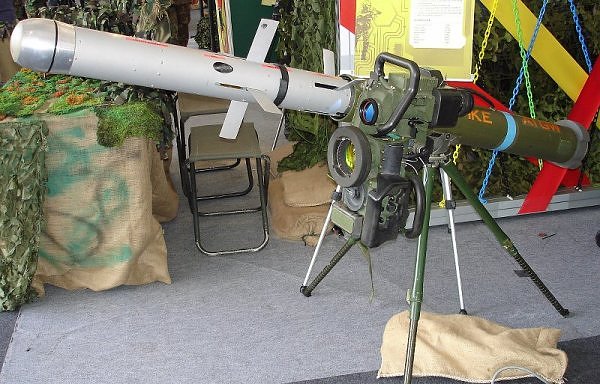
The Spike system is made up of the launching tripod with its fire control unit and the missile. There is no dedicated thermal sight on the launcher: the missile's imaging seeker is used. Altogether, the long range variant of the system weighs around 26 kg (57 lb).
Spike can be operated from the launcher by infantry, or from mounts that can be fitted to vehicles such as fast attack vehicles, armoured personnel carriers or utility vehicles. Vehicles that are not normally fitted with anti-tank weapons can therefore be given anti-tank capability.
Spike has been tested as a weapon system for the SAGEM Sperwer unmanned aerial vehicle. The Spanish Army has fitted the Spike ER to its Eurocopter Tiger attack helicopters. Both Israel and the United States have experimented with arming Sikorsky UH-60 Black Hawk helicopters with the Spike missile; the US variant is used in UH-60M Battlehawk helicopters.
Hub AI
Spike (missile) AI simulator
(@Spike (missile)_simulator)
Spike (missile)
Spike (Hebrew: ספייק) is an Israeli fire-and-forget anti-tank guided missile and anti-personnel missile with a tandem-charge high-explosive anti-tank (HEAT) warhead. As of 2024[update], it is in its sixth generation. It was developed and designed by the Israeli company Rafael Advanced Defense Systems. It is available in man-portable, vehicle-launched, helicopter-launched and maritime variants.
The missile can engage and destroy targets within the line-of-sight of the launcher ("fire-and-forget"), and some variants can make a top attack through a "fire, observe and update" method (essentially lock-on after launch); the operator tracking the target, or switching to another target, optically through the trailing fiber-optic wire (or RF link in the case of the vehicle-mounted, long-range NLOS variant) while the missile is climbing to altitude after launch. This is similar to the lofted trajectory flight profile of the US FGM-148 Javelin.
Spike is a fire-and-forget missile with lock-on before launch and automatic self-guidance. The missile is equipped with an imaging infrared seeker.
The long and extended range versions of the Spike also have the capability of "Fire, Observe and Update" operating mode (also known as Lock-on after launch (LOAL)). The missile is connected by a fiber-optical wire that is spooled out between the launch position and the missile. With this, the operator can obtain a target if it is not in the line of sight of the operator at launch, switch targets in flight, or compensate for the movement of the target if the missile is not tracking the target for some reason. Hence, the missile can be fired speculatively for a target of opportunity, or to provide observation on the other side of an obstacle. The missile has a soft launch capability – the motor firing after the missile has left the launcher – that allows the missile to be fired from confined spaces, which is a necessity in urban warfare.
The missile uses a tandem warhead consisting of two shaped charges: a precursor warhead to detonate any explosive reactive armor, and a primary warhead to penetrate the underlying armor. Currently, it is replacing aging semi-automatic command to line of sight second generation anti-tank missiles like the MILAN and M47 Dragon in the armies of the user nations. Spike missile is also equipped with heat chasing technology.
The Spike system is made up of the launching tripod with its fire control unit and the missile. There is no dedicated thermal sight on the launcher: the missile's imaging seeker is used. Altogether, the long range variant of the system weighs around 26 kg (57 lb).
Spike can be operated from the launcher by infantry, or from mounts that can be fitted to vehicles such as fast attack vehicles, armoured personnel carriers or utility vehicles. Vehicles that are not normally fitted with anti-tank weapons can therefore be given anti-tank capability.
Spike has been tested as a weapon system for the SAGEM Sperwer unmanned aerial vehicle. The Spanish Army has fitted the Spike ER to its Eurocopter Tiger attack helicopters. Both Israel and the United States have experimented with arming Sikorsky UH-60 Black Hawk helicopters with the Spike missile; the US variant is used in UH-60M Battlehawk helicopters.
Recent media