
Recent from talks
Sprint car racing
Knowledge base stats:
Talk channels stats:
Members stats:
Sprint car racing
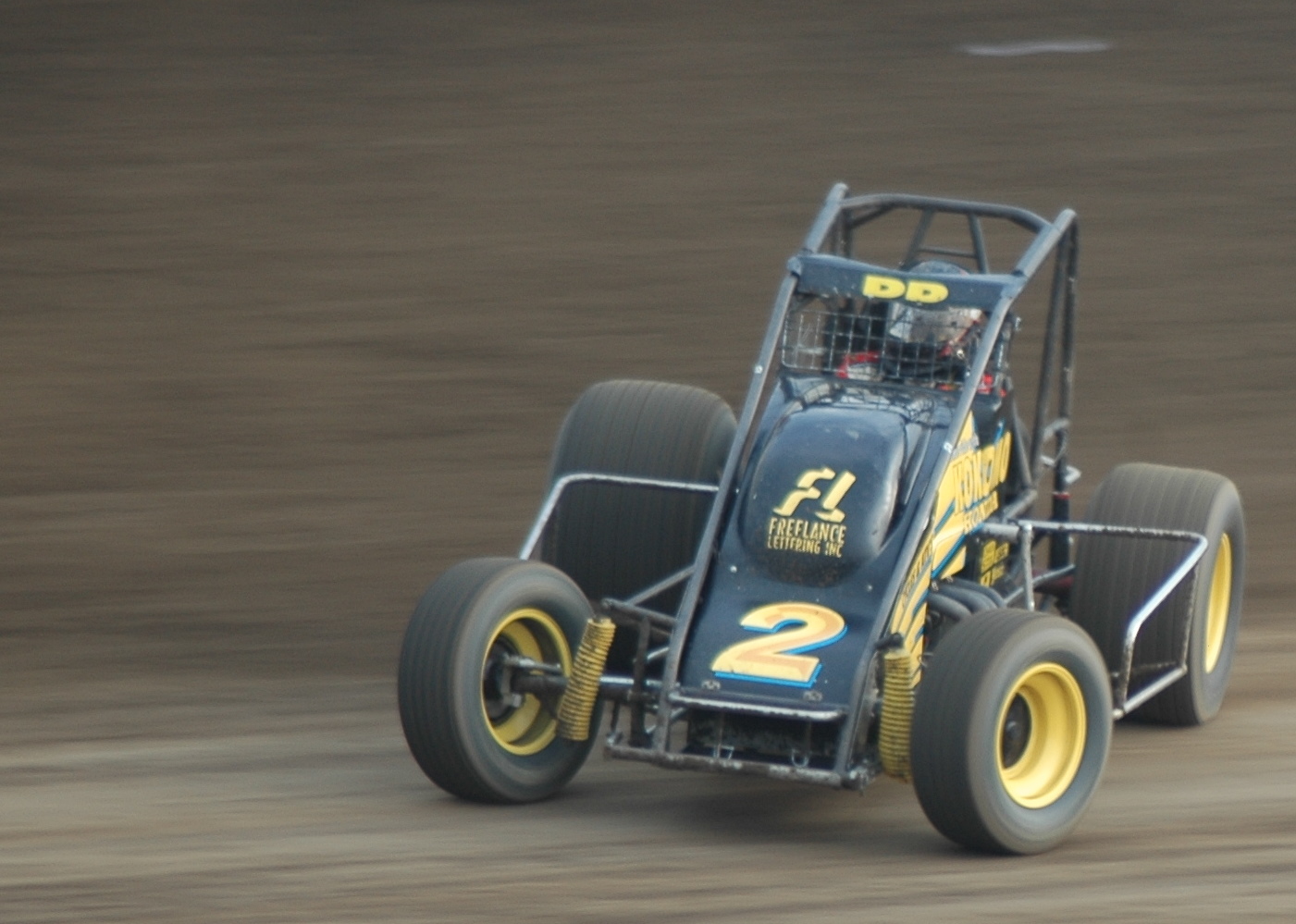
Sprint cars are open-wheel race cars, designed primarily for the purpose of running on short oval, circular dirt or paved tracks. Historically known simply as "big cars," distinguishing them from "midget cars," sprint car racing is popular primarily in the United States and Canada, as well as in Australia, New Zealand, and South Africa.
Sprint cars have very high power-to-weight ratios, with weights of approximately 1,400 pounds (640 kg) (including the driver) and power outputs of over 900 horsepower (670 kW), which give them a power-to-weight ratio besting that of contemporary F1 cars. Typically, they are powered by a naturally aspirated, methanol-injected overhead valve American V8 engine with a displacement of 410 cubic inches (6.7L) and capable of engine speeds of 9000 rpm. Depending on the mechanical setup (engine, gearing, shocks, etc.) and the track layout, these cars can achieve speeds in excess of 160 miles per hour (260 km/h). A lower-budget and very popular class of sprint cars uses 360-cubic-inch (5.9L) engines that produce up to 775 horsepower. Sprint cars do not utilize a transmission but have an in-or-out gearbox and quick-change rear differentials for occasional gearing changes. As a result, they do not have electric starters (or even electrical systems other than a ignition magneto) and require a push to be started. The safety record of sprint car racing in recent years has been greatly improved by the use of roll cages, and, especially on dirt tracks, wings, which increase surface traction to protect the drivers.
Many IndyCar Series and NASCAR drivers used sprint car racing as an intermediate stepping stone on their way to more high-profile divisions, including Indianapolis 500 winners A. J. Foyt, Mario Andretti, Johnny Rutherford, Parnelli Jones, Johnnie Parsons, Al Unser Sr., and Al Unser Jr., as well as NASCAR Cup Series champions Jeff Gordon, Tony Stewart and Kyle Larson.
The National Sprint Car Hall of Fame & Museum, located in Knoxville, Iowa, features exhibits highlighting the history of both winged and wingless sprint cars.
There are several sanctioning bodies for wingless sprint cars. The United States Automobile Club (USAC) became the USAC/California Racing Association (USAC/CRA) after taking over the Sprint Car Racing Association (SCRA). The USAC/CRA remains popular on the West Coast, East Coast and in Indiana. However, historical lack of leadership in much of the US has resulted in a large number of groups and sanctioning bodies supporting wingless sprint cars.
Wingless sprint cars are considered the traditional sprint cars, dating back to the first sprint cars in the 1930s and 1940s. Today, traditional and winged sprint cars are essentially the same vehicle, with many wingless cars having "stub outs" in the frame for attaching wings. They generally use the same 410 cubic inches (6,700 cc) and 360 cubic inches (5,900 cc) aluminum engines as their winged counterparts; many local tracks have rules mandating steel blocks and some 305 cubic inches (5,000 cc) displacements, in order to help control costs. Some newer regional groups, specifically POWRi and Elite have chosen to allow open engines with no limit to engine size. Their tuning and gearing are different for performance at lower RPMs than winged cars. Chassis set ups and tires are also different.
While they do not have the same top speed as a winged car because they lack downforce for improved traction, traditional cars are thought by many to be more entertaining to watch. Their relative lack of grip creates different driving characteristics than their winged counterparts, causing them to be more difficult to control through the corners. This, and the lack of roll-over protection a wing provides, makes them more prone to spectacular accidents.
The world's first small-track winged race car was driven by Jim Cushman at the Columbus Motor Speedway (Ohio) in 1958. Cushman drove with his winged super-modified (wing created by Gene and Floyd Miller) in several races and even won with it, starting a new trend of winged cars in sprint and super-modified racing. By 1959, up to half of the field was racing with a wing at Columbus Motor Speedway. In the early 1970s, many sprint car drivers began to put wings with sideboards on both the front and top of their cars. The added wings increase the downforce generated on the car, with the opposite direction of the sideboards helping to turn the car in the corners. The increased traction makes the car faster and easier to control.
Hub AI
Sprint car racing AI simulator
(@Sprint car racing_simulator)
Sprint car racing
Sprint cars are open-wheel race cars, designed primarily for the purpose of running on short oval, circular dirt or paved tracks. Historically known simply as "big cars," distinguishing them from "midget cars," sprint car racing is popular primarily in the United States and Canada, as well as in Australia, New Zealand, and South Africa.
Sprint cars have very high power-to-weight ratios, with weights of approximately 1,400 pounds (640 kg) (including the driver) and power outputs of over 900 horsepower (670 kW), which give them a power-to-weight ratio besting that of contemporary F1 cars. Typically, they are powered by a naturally aspirated, methanol-injected overhead valve American V8 engine with a displacement of 410 cubic inches (6.7L) and capable of engine speeds of 9000 rpm. Depending on the mechanical setup (engine, gearing, shocks, etc.) and the track layout, these cars can achieve speeds in excess of 160 miles per hour (260 km/h). A lower-budget and very popular class of sprint cars uses 360-cubic-inch (5.9L) engines that produce up to 775 horsepower. Sprint cars do not utilize a transmission but have an in-or-out gearbox and quick-change rear differentials for occasional gearing changes. As a result, they do not have electric starters (or even electrical systems other than a ignition magneto) and require a push to be started. The safety record of sprint car racing in recent years has been greatly improved by the use of roll cages, and, especially on dirt tracks, wings, which increase surface traction to protect the drivers.
Many IndyCar Series and NASCAR drivers used sprint car racing as an intermediate stepping stone on their way to more high-profile divisions, including Indianapolis 500 winners A. J. Foyt, Mario Andretti, Johnny Rutherford, Parnelli Jones, Johnnie Parsons, Al Unser Sr., and Al Unser Jr., as well as NASCAR Cup Series champions Jeff Gordon, Tony Stewart and Kyle Larson.
The National Sprint Car Hall of Fame & Museum, located in Knoxville, Iowa, features exhibits highlighting the history of both winged and wingless sprint cars.
There are several sanctioning bodies for wingless sprint cars. The United States Automobile Club (USAC) became the USAC/California Racing Association (USAC/CRA) after taking over the Sprint Car Racing Association (SCRA). The USAC/CRA remains popular on the West Coast, East Coast and in Indiana. However, historical lack of leadership in much of the US has resulted in a large number of groups and sanctioning bodies supporting wingless sprint cars.
Wingless sprint cars are considered the traditional sprint cars, dating back to the first sprint cars in the 1930s and 1940s. Today, traditional and winged sprint cars are essentially the same vehicle, with many wingless cars having "stub outs" in the frame for attaching wings. They generally use the same 410 cubic inches (6,700 cc) and 360 cubic inches (5,900 cc) aluminum engines as their winged counterparts; many local tracks have rules mandating steel blocks and some 305 cubic inches (5,000 cc) displacements, in order to help control costs. Some newer regional groups, specifically POWRi and Elite have chosen to allow open engines with no limit to engine size. Their tuning and gearing are different for performance at lower RPMs than winged cars. Chassis set ups and tires are also different.
While they do not have the same top speed as a winged car because they lack downforce for improved traction, traditional cars are thought by many to be more entertaining to watch. Their relative lack of grip creates different driving characteristics than their winged counterparts, causing them to be more difficult to control through the corners. This, and the lack of roll-over protection a wing provides, makes them more prone to spectacular accidents.
The world's first small-track winged race car was driven by Jim Cushman at the Columbus Motor Speedway (Ohio) in 1958. Cushman drove with his winged super-modified (wing created by Gene and Floyd Miller) in several races and even won with it, starting a new trend of winged cars in sprint and super-modified racing. By 1959, up to half of the field was racing with a wing at Columbus Motor Speedway. In the early 1970s, many sprint car drivers began to put wings with sideboards on both the front and top of their cars. The added wings increase the downforce generated on the car, with the opposite direction of the sideboards helping to turn the car in the corners. The increased traction makes the car faster and easier to control.
Recent media