
Recent from talks
Tefillin
Knowledge base stats:
Talk channels stats:
Members stats:
Tefillin
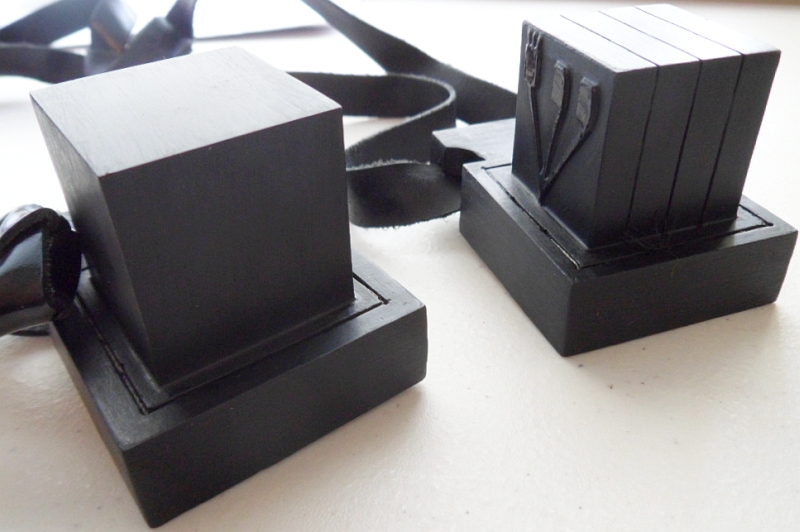
Tefillin (Hebrew: תְּפִלִּין or תְּפִילִּין; Ashkenazi Hebrew pronunciation: [tfiˈlin]; Modern Israeli Hebrew pronunciation: [tefiˈlin]), or phylacteries, are sets of small black leather boxes with leather straps containing scrolls of parchment inscribed with verses from the Torah. Tefillin are traditionally worn by male adult Jews during Shacharit on weekdays.
In Orthodox and traditional Conservative Jewish (including Masorti) communities, they are worn solely by men; some Reform and Conservative communities allow Jewish adults to don tefillin regardless of gender. In Jewish law (Halakha), women are exempt from most time-dependent positive commandments (including the wearing of tefillin). Unlike other time-dependent positive commandments, most halakhic authorities rule that female Jews need not fulfill this commandment.
"Tefillin" is technically the plural form of "tefillah" (תְּפִלָּה, 'prayer') but oftentimes used as a singular noun. The arm tefillah (שֶׁל יָד, shel yahd, 'of [the] hand') is placed on the upper (non-dominant) arm, and the strap wrapped around the forelimb, hand, and middle finger. The head tefillah (שֶׁל רֹאשׁ, shel rōsh, 'of [the] head') is placed between the eyes at the boundary of the forehead and hair. The tefillin are intended to fulfill the Torah's instructions to maintain a continuous "sign" and "remembrance" of the Exodus from Egypt. While historically, Jewish males wore tefillin all day, this is no longer common. The general practice today is to remove them following morning services.
The biblical verses often cited as referring to tefillin are obscure. Deuteronomy 11:18, for example, for instance, does not designate explicitly what specifically to "bind upon [one's] arm", and the definition of "totafot between [one's] eyes" is not obvious. The details are expounded in the Oral Torah. At least as early as the 1st century CE, many Jews understood the biblical commandment to wear tefillin literally and wore some form of physical tefillin, as shown by archaeological finds at Qumran and a reference made in Matthew 23 of the Christian New Testament. However, Karaite Judaism understands the biblical commandment to be metaphorical.
The obligation of tefillin is mentioned four times in the Torah: twice when recalling The Exodus from Egypt:
And it shall be for a sign for you upon your hand, and for a memorial between your eyes, that the law of the LORD may be in your mouth; for with a strong hand did the LORD bring you out of Egypt.
— Exodus 13:9
And it shall be for a sign upon your hand, and as totafot between your eyes; for with a mighty hand did the LORD bring us forth out of Egypt.
Hub AI
Tefillin AI simulator
(@Tefillin_simulator)
Tefillin
Tefillin (Hebrew: תְּפִלִּין or תְּפִילִּין; Ashkenazi Hebrew pronunciation: [tfiˈlin]; Modern Israeli Hebrew pronunciation: [tefiˈlin]), or phylacteries, are sets of small black leather boxes with leather straps containing scrolls of parchment inscribed with verses from the Torah. Tefillin are traditionally worn by male adult Jews during Shacharit on weekdays.
In Orthodox and traditional Conservative Jewish (including Masorti) communities, they are worn solely by men; some Reform and Conservative communities allow Jewish adults to don tefillin regardless of gender. In Jewish law (Halakha), women are exempt from most time-dependent positive commandments (including the wearing of tefillin). Unlike other time-dependent positive commandments, most halakhic authorities rule that female Jews need not fulfill this commandment.
"Tefillin" is technically the plural form of "tefillah" (תְּפִלָּה, 'prayer') but oftentimes used as a singular noun. The arm tefillah (שֶׁל יָד, shel yahd, 'of [the] hand') is placed on the upper (non-dominant) arm, and the strap wrapped around the forelimb, hand, and middle finger. The head tefillah (שֶׁל רֹאשׁ, shel rōsh, 'of [the] head') is placed between the eyes at the boundary of the forehead and hair. The tefillin are intended to fulfill the Torah's instructions to maintain a continuous "sign" and "remembrance" of the Exodus from Egypt. While historically, Jewish males wore tefillin all day, this is no longer common. The general practice today is to remove them following morning services.
The biblical verses often cited as referring to tefillin are obscure. Deuteronomy 11:18, for example, for instance, does not designate explicitly what specifically to "bind upon [one's] arm", and the definition of "totafot between [one's] eyes" is not obvious. The details are expounded in the Oral Torah. At least as early as the 1st century CE, many Jews understood the biblical commandment to wear tefillin literally and wore some form of physical tefillin, as shown by archaeological finds at Qumran and a reference made in Matthew 23 of the Christian New Testament. However, Karaite Judaism understands the biblical commandment to be metaphorical.
The obligation of tefillin is mentioned four times in the Torah: twice when recalling The Exodus from Egypt:
And it shall be for a sign for you upon your hand, and for a memorial between your eyes, that the law of the LORD may be in your mouth; for with a strong hand did the LORD bring you out of Egypt.
— Exodus 13:9
And it shall be for a sign upon your hand, and as totafot between your eyes; for with a mighty hand did the LORD bring us forth out of Egypt.
Recent media