Hubbry Logo
Starter (engine)Starter (engine)Main
Open search
Starter (engine)
Community hub
Starter (engine)
logo
8 pages, 0 posts
0 subscribers
Be the first to start a discussion here.
Starter (engine)
Starter (engine)
from Wikipedia

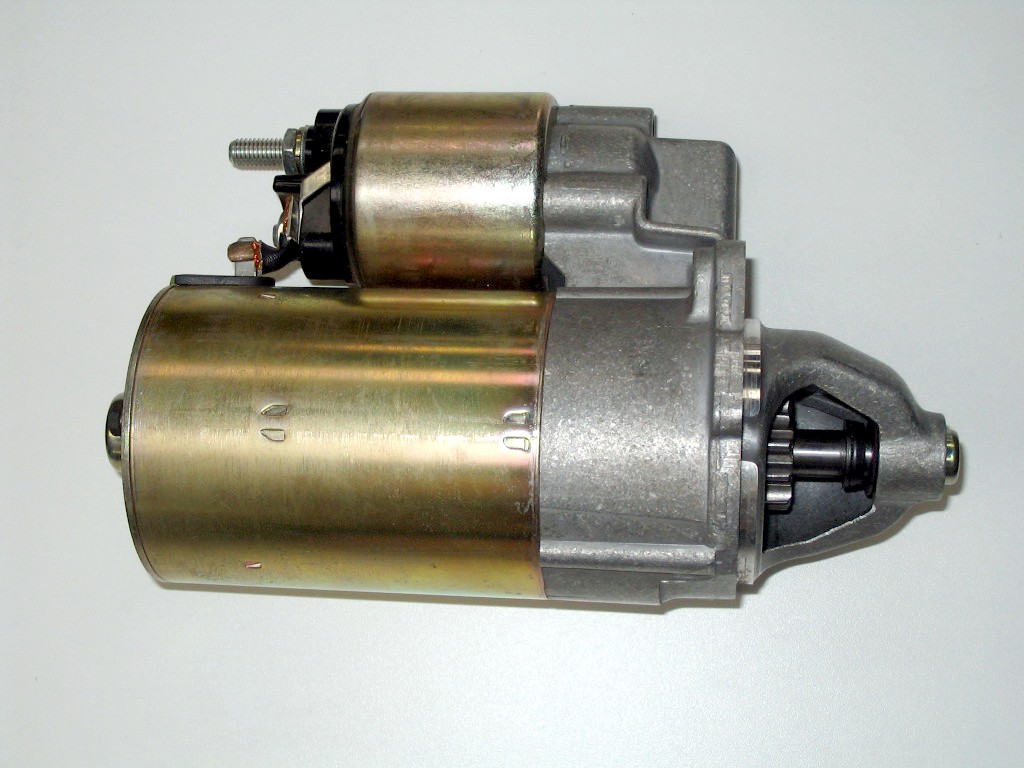
An automobile starter motor (larger cylinder). The smaller object on top is a starter solenoid which controls power to the starter motor and engages the Bendix drive.

A starter (also self-starter, cranking motor, or starter motor) is an apparatus installed in motor vehicles to rotate the crankshaft of an internal combustion engine so as to initiate the engine's combustion cycle. Starters can be electric, pneumatic, or hydraulic. The starter can also be another internal combustion engine in the case, for instance, of very large engines, or diesel engines in agricultural or excavation applications.[1]

Internal combustion engines are feedback systems, which, once started, rely on the inertia from each cycle to initiate the next cycle. In a four-stroke engine, the third stroke releases energy from the fuel, powering the fourth (exhaust) stroke and also the first two (intake, compression) strokes of the next cycle, as well as powering the engine's external load. To start the first cycle at the beginning of any particular session, the first two strokes must be powered in some other way than from the engine itself. The starter motor is used for this purpose and it is not required once the engine starts running and its feedback loop becomes self-sustaining.

Starter ring gear on its flywheel

History

[edit]
A 1920s era electric self-starter for an airship engine
Typical electric starter installed underneath and toward the rear of an automobile engine
The Norbert Riedel-designed, "APU-style" two-stroke starter motor for a Jumo 004 turbojet engine

Before the advent of the starter motor, engines were started by various methods including wind-up springs, gunpowder cylinders, and human-powered techniques such as a removable crank handle which engaged the front of the crankshaft, pulling on an airplane propeller, or pulling a cord that was wound around an open-face pulley.

The hand-crank method was commonly used to start engines, but it was inconvenient, difficult, and dangerous. The behavior of an engine during starting is not always predictable. The engine can kick back, causing sudden reverse rotation. Many manual starters included a one-directional slip or release provision so that once engine rotation began, the starter would disengage from the engine. In the event of a kickback, the reverse rotation of the engine could suddenly engage the starter, causing the crank to unexpectedly and violently jerk, possibly injuring the operator. For cord-wound starters, a kickback could pull the operator towards the engine or machine, or swing the starter cord and handle at high speed around the starter pulley. Even though cranks had an overrun mechanism, when the engine started, the crank could begin to spin along with the crankshaft and potentially strike the person cranking the engine. Additionally, care had to be taken to retard the spark in order to prevent backfiring; with an advanced spark setting, the engine could kick back (run in reverse), pulling the crank with it, because the overrun safety mechanism works in one direction only.

Although users were advised to cup their fingers and thumb under the crank and pull up, it felt natural for operators to grasp the handle with the fingers on one side, the thumb on the other. Even a simple backfire could result in a broken thumb; it was possible to end up with a broken wrist, a dislocated shoulder or worse. Moreover, increasingly larger engines with higher compression ratios made hand cranking a more physically demanding endeavour.

The first electric starter was installed on an Arnold, an adaptation of the Benz Velo, built in 1896 in East Peckham, England, by electrical engineer H. J. Dowsing.[2]

In 1903, Clyde J. Coleman invented and patented the first electric starter in America U.S. patent 0,745,157.[3]

In 1911, Charles F. Kettering, with Henry M. Leland, of Dayton Engineering Laboratories Company (DELCO), invented and filed U.S. patent 1,150,523 for an electric starter in America. (Kettering had replaced the hand crank on NCR's cash registers with an electric motor five years earlier.)

One aspect of the invention lay in the realization that a relatively small motor, driven with higher voltage and current than would be feasible for continuous operation, could deliver enough power to crank the engine for starting. At the voltage and current levels required, such a motor would burn out in a few minutes of continuous operation, but not during the few seconds needed to start the engine. The starters were first installed on the Cadillac Model Thirty in 1912, with the same system being adopted by Lanchester later that year.[4] These starters also worked as generators once the engine was running, a concept that is now being revived in hybrid vehicles.

Although the electric starter motor was to come to dominate the car market, in 1912, there were several competing types of starter,[4] with the Adams, S.C.A.T. and Wolseley cars having direct air starters, and Sunbeam introducing an air starter motor with similar approach to that used for the Delco and Scott-Crossley electrical starter motors (i.e. engaging with a toothed ring on the flywheel). The Star and Adler cars had spring motors (sometimes referred to as clockwork motors), which used the energy stored in a spring driving through a reduction gear. If the car failed to start, the starter handle could be used to wind up the spring for a further attempt.

One of the innovations on the first Dodge car, the Model 30-35 at its introduction in 1914 was an electric starter and electric lighting with a 12-volt system (against the six volts that was usual at the time) as a standard fitment on what was a relatively low-priced car.[5] The Dodge used a combined starter-generator unit, with a direct current dynamo permanently coupled by gears to the engine's crankshaft. A system of electrical relays allowed this to be driven as a motor to rotate the engine for starting, and once the starter button was released the controlling switchgear returned the unit to operation as a generator. Because the starter-generator was directly coupled to the engine it did not need a method of engaging and disengaging the motor drive. It thus suffered negligible mechanical wear and was virtually silent in operation. The starter-generator remained a feature of Dodge cars until 1929. The disadvantage of the design was that, as a dual-purpose device, the unit was limited in both its power as a motor and its output as a generator, which became a problem as engine size and electrical demands on cars increased. Controlling the switch between motor and generator modes required dedicated and relatively complex switchgear which was more prone to failure than the heavy-duty contacts of a dedicated starter motor. While the starter-generator dropped out of favour for cars by the 1930s, the concept was still useful for smaller vehicles and was taken up by the German firm SIBA Elektrik which built similar system intended mostly for use on motorcycles, scooters, economy cars (especially those with small-capacity two-stroke engines), and marine engines. These were marketed under the 'Dynastart' name. Since motorcycles usually had small engines and limited electrical equipment, as well as restricted space and weight, the Dynastart was a useful feature. The windings for the starter-generator were usually incorporated into the engine's flywheel, thus not requiring a separate unit at all.

The Ford Model T relied on hand cranks until 1919; during the 1920s, electric starters became near-universal on most new cars, making it easier for women and elderly people to drive. It was still common for cars to be supplied with starter handles into the 1960s, and this continued much later for some makes (e.g. Citroën 2CV until end of production in 1990). In many cases, cranks were used for setting timing rather than starting the engine as growing displacements and compression ratios made this impractical. Communist bloc cars such as Ladas often still sported crank-starting as late as the 1980s.

For the first examples of production German turbojet engines later in World War II, Norbert Riedel designed a small two-stroke, opposed-twin gasoline engine to start both the Junkers Jumo 004 and BMW 003 aircraft gas turbines as a form of auxiliary power unit to get the central spindle of each engine design rotating — these were usually installed at the very front of the turbojet, and were themselves started by a pull-rope to get them running during the startup procedure for the jet engines they were fitted to.

Before Chrysler's 1949 innovation of the key-operated combination ignition-starter switch,[6] the starter was often operated by the driver pressing a button mounted on the floor or dashboard. Some vehicles had a pedal in the floor that manually engaged the starter drive pinion with the flywheel ring gear, then completed the electrical circuit to the starter motor once the pedal reached the end of its travel. Ferguson tractors from the 1940s, including the Ferguson TE20, had an extra position on the gear lever that engaged the starter switch, ensuring safety by preventing the tractors from being started in gear.[7]

Electric

[edit]
  1. Main housing (yoke)
  2. Freewheel and pinion gear assembly
  3. Armature
  4. Field coils with brushes attached
  5. Brush-carrier
  6. Solenoid
Starter motor diagram

The electric starter motor or cranking motor is the most common type used on gasoline engines and small diesel engines. The modern starter motor is either a permanent-magnet or a series-parallel wound direct current electric motor with a starter solenoid (similar to a relay) mounted on it. When DC power from the starting battery is applied to the solenoid, usually through a key-operated switch (the "ignition switch"), the solenoid engages a lever that pushes out the drive pinion on the starter driveshaft and meshes the pinion with the starter ring gear on the flywheel of the engine.[8]

The solenoid also closes high-current contacts for the starter motor, which begins to turn. Once the engine starts, the key-operated switch is opened, a spring in the solenoid assembly pulls the pinion gear away from the ring gear, and the starter motor stops. The starter's pinion is clutched to its drive shaft through an overrunning sprag clutch which permits the pinion to transmit drive in only one direction. In this manner, drive is transmitted through the pinion to the flywheel ring gear, but if the pinion remains engaged (as for example because the operator fails to release the key as soon as the engine starts, or if there is a short and the solenoid remains engaged), the pinion will spin independently of its drive shaft. This prevents the engine driving the starter, for such backdrive would cause the starter to spin so fast as to fly apart.

The sprag clutch arrangement would preclude the use of the starter as a generator if employed in the hybrid scheme mentioned above, unless modifications were made. The standard starter motor is typically designed for intermittent use, which would preclude its use as a generator. The starter's electrical components are designed only to operate for typically under 30 seconds before overheating (by too-slow dissipation of heat from ohmic losses), to save weight and cost. Most automobile owner manuals instruct the operator to pause for at least ten seconds after each ten or fifteen seconds of cranking the engine, when trying to start an engine that does not start immediately.

This overrunning-clutch pinion arrangement was phased into use beginning in the early 1960s; before that time, a Bendix drive was used. The Bendix system places the starter drive pinion on a helically cut drive shaft. When the starter motor begins turning, the inertia of the drive pinion assembly causes it to ride forward on the helix and thus engage with the ring gear. When the engine starts, backdrive from the ring gear causes the drive pinion to exceed the rotative speed of the starter, at which point the drive pinion is forced back down the helical shaft and thus out of mesh with the ring gear.[9] This has the disadvantage that the gears will disengage if the engine fires briefly but does not continue to run.

Folo-Thru drive

[edit]

An intermediate development between the Bendix drive developed in the 1930s and the overrunning-clutch designs introduced in the 1960s was the Bendix Folo-Thru drive. The standard Bendix drive would disengage from the ring gear as soon as the engine fired, even if it did not continue to run. The Folo-Thru drive contains a latching mechanism and a set of flyweights in the body of the drive unit. When the starter motor begins turning and the drive unit is forced forward on the helical shaft by inertia, it is latched into the engaged position. Only once the drive unit is spun at a speed higher than that attained by the starter motor itself (i.e., it is backdriven by the running engine) will the flyweights pull radially outward, releasing the latch and permitting the overdriven drive unit to be spun out of engagement. In this manner, unwanted starter disengagement is avoided before a successful engine start.

Gear reduction

[edit]

In 1962, Chrysler introduced a starter incorporating a geartrain between the motor and the drive shaft. The motor shaft included integrally cut gear teeth forming a pinion that meshes with a larger adjacent driven gear to provide a gear reduction ratio of 3.75:1. This permitted the use of a higher-speed, lower-current, lighter and more compact motor assembly while increasing cranking torque.[10] Variants of this starter design were used on most rear- and four-wheel-drive vehicles produced by Chrysler Corporation from 1962 through 1987. It makes a unique, distinct sound when cranking the engine, which led to it being nicknamed the "Highland Park Hummingbird"—a reference to Chrysler's headquarters in Highland Park, Michigan.[11]

The Chrysler gear-reduction starter formed the conceptual basis for the gear-reduction starters that now predominate in vehicles on the road. Many Japanese automakers phased in gear reduction starters in the 1970s and 1980s.[citation needed] Light aircraft engines also made extensive use of this kind of starter, because its light weight offered an advantage.

Those starters not employing offset gear trains like the Chrysler unit generally employ planetary epicyclic gear trains instead. Direct-drive starters are almost entirely obsolete owing to their larger size, heavier weight and higher current requirements.[citation needed]

Movable pole shoe

[edit]

Ford issued a nonstandard starter, a direct-drive "movable pole shoe" design that provided cost reduction rather than electrical or mechanical benefits. This type of starter eliminated the solenoid, replacing it with a movable pole shoe and a separate starter relay. This starter operates as follows: The driver turns the key, activating the starter switch. A small electric current flows through the solenoid actuated starter relay, closing the contacts and sending large battery current to the starter motor. One of the pole shoes, hinged at the front, linked to the starter drive, and spring-loaded away from its normal operating position, is swung into position by the magnetic field created by electricity flowing through its field coil. This moves the starter drive forward to engage the flywheel ring gear, and simultaneously closes a pair of contacts supplying current to the rest of the starter motor winding. Once the engine starts and the driver releases the starter switch, a spring retracts the pole shoe, which pulls the starter drive out of engagement with the ring gear.

This starter was used on Ford vehicles from 1973 through 1990, when a gear-reduction unit conceptually similar to the Chrysler unit replaced it.

Inertia starter

[edit]

A variant on the electric starter motor is the inertia starter (not to be confused with the Bendix-type starter described above). Here the starter motor does not turn the engine directly. Instead, when energized, the motor turns a heavy flywheel built into its casing (not the main flywheel of the engine). Once the flywheel/motor unit has reached a constant speed the current to the motor is turned off and the drive between the motor and flywheel is disengaged by a freewheel mechanism. The spinning flywheel is then connected to the main engine and its inertia turns it over to start it. These stages are commonly automated by solenoid switches, with the machine operator using a two-position control switch, which is held in one position to spin the motor and then moved to the other to cut the current to the motor and engage the flywheel to the engine.

The advantage of the inertia starter is that, because the motor is not driving the engine directly, it can be of much lower power than the standard starter for an engine of the same size. This allows for a motor of much lower weight and smaller size, as well as lighter cables and smaller batteries to power the motor. This made the inertia starter a common choice for aircraft with large radial piston engines. The disadvantage is the increased time required to start the engine - spinning up the flywheel to the required speed can take between 10 and 20 seconds. If the engine does not start by the time the flywheel has lost its inertia then the process must be repeated for the next attempt.

Pneumatic

[edit]

Some gas turbine engines and diesel engines, particularly on trucks, use a pneumatic self-starter. In ground vehicles the system consists of a geared turbine, an air compressor and a pressure tank. Compressed air released from the tank is used to spin the turbine, and through a set of reduction gears, engages the ring gear on the flywheel, much like an electric starter. The engine, once running, drives the compressor to recharge the tank.

Aircraft with large gas turbine engines are typically started using a large volume of low-pressure compressed air, supplied from a very small engine referred to as an auxiliary power unit, located elsewhere in the aircraft. Alternatively, aircraft gas turbine engines can be rapidly started using a mobile ground-based pneumatic starting engine, referred to as a start cart or air start cart.

On larger diesel generators found in large shore installations and especially on ships, a pneumatic starting gear is used. The air motor is normally powered by compressed air at pressures of 10–30 bar. The air motor is made up of a center drum about the size of a soup can with four or more slots cut into it to allow for the vanes to be placed radially on the drum to form chambers around the drum. The drum is offset inside a round casing so that the inlet air for starting is admitted at the area where the drum and vanes form a small chamber compared to the others. The compressed air can only expand by rotating the drum, which allows the small chamber to become larger and puts another one of the cambers in the air inlet. The air motor spins much too fast to be used directly on the flywheel of the engine; instead a large gearing reduction, such as a planetary gear, is used to lower the output speed. A Bendix gear is used to engage the flywheel.

A pair of air-starting motors on a 3300 kW diesel standby generator.

Since large trucks typically use air brakes, the system does double duty, supplying compressed air to the brake system. Pneumatic starters have the advantages of delivering high torque, mechanical simplicity and reliability. They eliminate the need for oversized,[quantify] heavy storage batteries in prime mover electrical systems.

Large Diesel generators and almost all Diesel engines used as the prime mover of ships use compressed air acting directly on the cylinder head. This is not ideal for smaller Diesels, as it provides too much cooling on starting. Also, the cylinder head needs to have enough space to support an extra valve for the air start system. The air start system is conceptually very similar to a distributor in a car. There is an air distributor that is geared to the camshaft of the Diesel engine; on the top of the air distributor is a single lobe similar to what is found on a camshaft. Arranged radially around this lobe are roller tip followers for every cylinder. When the lobe of the air distributor hits one of the followers it will send an air signal that acts upon the back of the air start valve located in the cylinder head, causing it to open. Compressed air is provided from a large reservoir that feeds into a header located along the engine. As soon as the air start valve is opened, the compressed air is admitted and the engine will begin turning. It can be used on two-cycle and four-cycle engines and on reversing engines. On large two-stroke engines less than one revolution of the crankshaft is needed for starting.

Hydraulic

[edit]
Hydraulic Starter

Some diesel engines from six to 16 cylinders are started by means of a hydraulic motor. Hydraulic starters and the associated systems provide a sparkless, reliable method of engine starting over a wide temperature range.[12] Typically hydraulic starters are found in applications such as remote generators, lifeboat propulsion engines, offshore fire pumping engines, and hydraulic fracturing rigs. The system used to support the hydraulic starter includes valves, pumps, filters, a reservoir, and piston accumulators. The operator can manually recharge the hydraulic system; this cannot readily be done with electric starting systems, so hydraulic starting systems are favored in applications wherein emergency starting is a requirement.

With various configurations, Hydraulic starters can be fitted on any engine. Hydraulic starters employ the high efficiency of the axial piston motor concept, which provides high torque at any temperature or environment, and guarantees minimal wear of the engine ring gear and the pinion.[13]

Non-motor

[edit]

Spring starter

[edit]
Modern spring starter

A spring starter uses potential energy stored in a spring wound up with a crank to start an engine without a battery or alternator. Turning the crank moves the pinion into mesh with the engine's ring gear, then winds up the spring. Pulling the release lever then applies the spring tension to the pinion, turning the ring gear to start the engine. The pinion automatically disengages from the flywheel after operation. Provision is also made to allow the engine to be slowly turned over by hand for engine maintenance. This is achieved by operating the trip lever just after the pinion has engaged with the flywheel. Subsequent turning of the winding handle during this operation will not load the starter. Spring starters can be found in engine-generators and hydraulic power packs, and on lifeboat engines, with the most common application being backup starting system on seagoing vessels. Many Briggs & Stratton lawn mowers in the 1960s had hand-cranked spring starters.[14]

Fuel-starting

[edit]

Some modern gasoline engines with twelve or more cylinders always have at least one or more pistons at the beginning of its power stroke and are able to start by injecting fuel into that cylinder and igniting it. The same procedure can be applied to engines with fewer cylinders, if the engine happens to be stopped at the correct position. This is one way of starting an engine of a car with stop-start system.[15]

See also

[edit]

References

[edit]
[edit]
Revisions and contributorsEdit on WikipediaRead on Wikipedia
from Grokipedia
A starter motor, also known as an engine starter, is a high-torque that provides the initial rotational force to crank the of an , enabling it to reach the speed necessary for self-sustained operation and ignition of the fuel-air mixture. Powered by the vehicle's battery, it operates for only a few seconds during startup, converting into mechanical through a compact design featuring an armature, brushes, and field windings optimized for short-duration, high-power output. The core function of the starter motor involves engaging a small gear with the larger ring gear on the engine's , which overcomes the engine's initial and compresses the cylinders to initiate cycles. Key components include the , an electromagnetic switch that closes the circuit to the battery and shifts the pinion into engagement, and an overrunning clutch that prevents back-rotation from the engine once it starts, protecting the starter from damage. This system draws significant current—often 100-300 amperes—requiring robust connections and a dedicated battery to ensure reliable performance in various types, from automobiles to heavy-duty trucks. Invented by in 1911 and first introduced on the , the electric starter revolutionized automotive starting by replacing manual hand-cranking methods; Robert Bosch GmbH developed a production version in 1914 based on the sliding-armature Rushmore principle. By the 1950s, electric starters had fully supplanted hand cranks in passenger cars, with later innovations including planetary gear reductions in the 1980s for lighter weight and higher efficiency, as well as permanent magnet integration to reduce size. In contemporary applications as of 2025, advanced starters support start-stop systems, first introduced in 2007, which enable frequent cycling for improved fuel economy and emissions control in hybrid and conventional vehicles.

Overview

Function and Operation

A starter is a device designed to rotate the of an , thereby initiating the combustion process in both and diesel variants. By providing the initial rotation, it overcomes the engine's static friction and compression forces, allowing the pistons to move and draw in the air-fuel mixture or air for compression ignition. The operation commences with an activation signal, typically electrical from a battery or fluid-based for pneumatic and hydraulic systems, which engages a drive mechanism with the engine's flywheel ring gear. This engagement transmits rotational force to the , cranking the engine at a controlled speed until the cycle becomes self-sustaining, at which point the drive disengages automatically to avoid overload. The entire sequence typically lasts a few seconds, ensuring reliable initiation without continuous operation. Key physical principles involve generating sufficient to counteract the resistance from compression and mechanical during cranking, with automotive starters commonly requiring 100-300 Nm to meet these demands. The minimum cranking speed must reach approximately 200-250 RPM to enable proper and fuel delivery, as lower speeds may prevent sustained combustion. is maximal at the onset when overcoming initial , then tapers as speed increases. Gasoline engines generally demand lower torque, such as around 110 Nm for a typical four-cylinder unit during warm starts, due to their lower compression ratios of 8:1 to 12:1. In contrast, diesel engines require significantly higher torque—often exceeding 270 Nm—owing to compression ratios of 14:1 to 25:1, which create greater resistance, alongside similar cranking speeds of 150-250 RPM but with more emphasis on cold-start capability.

Basic Components

The basic components of an electric engine starter system form the core hardware responsible for initiating . These include the armature, field coils or permanent magnets, , pinion gear, and overrunning clutch, which collectively enable engagement, generation, and safe disengagement from the engine's ring gear. Armature: The armature serves as the rotating element within the starter motor, consisting of a laminated core wound with coils that interact with the to produce . In electric starters, it is mounted on a shaft connected to the drive mechanism, converting into mechanical . windings are used for their high conductivity and in current flow, minimizing losses during short-duration operation. Field coils or permanent magnets: These provide the stationary magnetic field essential for armature operation. Traditional field coils are electromagnetic windings around soft iron poles that generate the field when energized, while modern designs increasingly employ permanent magnets for reduced weight and simplified construction without additional power draw. Field coils, made with windings, ensure high density for output in demanding applications. Solenoid: Acting as an electromagnetic switch, the engages the drive with the engine's ring gear upon receiving battery voltage, simultaneously closing the high-current circuit to the motor. It features a that shifts the drive assembly forward, ensuring precise meshing during startup. Pinion gear: This small helical or straight-cut gear, typically with 8 to 12 teeth, transmits rotational force from the armature shaft to the engine's flywheel ring gear. It is splined to allow axial movement for engagement and is constructed from high-strength to withstand high shear stresses during cranking. Overrunning clutch: Integrated with the , this one-way mechanism allows torque transfer from the starter to the but freewheels when engine speed exceeds starter speed, preventing backdrive and potential motor damage. It typically employs rollers in a ramped for durable one-way engagement. The ring gear integrates with these components by providing a toothed interface for meshing, usually featuring 100 to 160 straight-cut or helical teeth on a ring pressed onto the flywheel rim. Automotive applications commonly use a module of 2 to 3 for balanced strength and mesh efficiency, with helical teeth reducing engagement noise in some designs. Safety features in starters include thermal overload protection to prevent overheating from prolonged cranking, such as limiting operation to no more than 10-15 seconds followed by a 1-2 minute cool-down period in automotive applications, and anti-backdrive mechanisms via the to avoid reverse transmission. High-strength is prioritized for gears and housings to endure impact loads, while ensures efficient electrical performance in windings.

History

Early Starting Methods

Prior to the widespread adoption of electric starters in the early , internal combustion engines in automobiles and stationary applications were primarily started using manual methods, with hand cranking being the most common technique from the late onward. The operator inserted a removable crank handle into a socket on the engine's or at the front of the , then rotated it with forceful pulls to turn the pistons and initiate . This demanded considerable physical strength, often requiring multiple attempts, especially for larger engines. Hand cranking posed significant safety risks due to the potential for engine , where premature ignition caused the to reverse direction violently, whipping the crank handle back toward the operator. Such kickbacks frequently resulted in severe injuries, including broken wrists, arms, , and shoulders, and occasionally fatalities. A notable example occurred in December 1908, when automotive engineer Byron Carter suffered a broken while hand cranking a stalled on Belle Isle in ; he died from resulting complications like shortly thereafter. These incidents underscored the method's hazards, particularly for less physically capable individuals, and contributed to the push for automated alternatives. Alternative mechanical approaches emerged in the late , including early experiments with for stationary engines. In the late , early experiments with systems were conducted for stationary engines to rotate the by injecting pressurized air into the cylinders, providing initial rotation without manual effort. This method was particularly suited to larger industrial engines, where hand cranking was impractical due to size and requirements. However, it relied on external air compressors, adding and cost. Despite these innovations, early starting methods shared common limitations: heavy dependence on favorable weather conditions, as cold temperatures stiffened lubricants and reduced fuel volatility, making ignition difficult; the substantial physical exertion required, which deterred widespread use by women and the elderly; and inherent safety concerns from mechanical feedback. These drawbacks highlighted the need for more reliable and user-friendly systems, paving the way for later developments in engine starting technology.

Invention and Adoption of Electric Starters

The invention of the electric starter marked a pivotal advancement in , primarily credited to , an American inventor and engineer. In 1911, Kettering, working at the Dayton Engineering Laboratories Company (Delco), developed a self-starting designed to eliminate the hazards of manual hand-cranking. This system, which integrated an to crank the engine, was patented as U.S. No. 1,150,523 (filed June 15, 1911) on August 17, 1915, following initial demonstrations. Kettering collaborated closely with , the founder of , to refine the technology for practical use in production vehicles, addressing the reliability issues of early battery-powered attempts. The electric starter debuted in production automobiles with the 1912 Cadillac Model Thirty, making it the first commercially successful car to feature this innovation as standard equipment. This implementation revolutionized vehicle operation by replacing the physically demanding and dangerous hand-crank method, which had caused numerous injuries and fatalities from backfires and recoil. The Cadillac's adoption of Kettering's design, powered by a lead-acid battery and a compact electric motor, demonstrated immediate practical benefits, including easier starting in cold weather and broader accessibility for non-expert drivers. Henry Leland's decision to equip all 1912 Cadillacs with the system underscored its perceived value, positioning the brand as a leader in automotive safety and convenience. Prior to Kettering's breakthrough, early attempts at electric starting existed but faced significant limitations. In 1896, British electrical engineer H.J. Dowsing fitted a prototype electric starter—a dynamotor coupled to the —onto an Arnold car, an adaptation of the , marking one of the earliest known efforts. Similarly, in 1903, American inventor Clyde J. Coleman received a (U.S. Patent No. 745,157, filed 1899) for an electric starter system, though it too remained experimental due to battery limitations. However, this design proved ineffective for widespread use due to the inadequate and reliability of batteries available at the time, confining it to experimental status. Competing alternatives to hand-cranking, such as the pneumatic direct air starters used on Adams, S.C.A.T., and vehicles around 1912, offered non-electric solutions but lacked the simplicity and universality of Kettering's , highlighting the need for a more robust electric approach. The adoption of electric starters accelerated rapidly following the introduction, driven by demonstrated safety improvements and manufacturing scalability through Delco's production. This momentum continued into the , when electric starters achieved near-total dominance in the automotive market, becoming standard on virtually all gasoline-powered vehicles and solidifying their role in the mass adoption of personal automobiles. The shift not only reduced starting-related accidents but also contributed to the decline of hand-crank mechanisms, transforming the automobile into a more user-friendly device.

Technological Advancements

In the and , advancements in starter drive mechanisms focused on improving reliability and reducing wear during engine engagement. The inertia drive, pioneered by the , became a key innovation, utilizing a helical gear on the pinion shaft to engage the flywheel through rotational , thereby minimizing direct mechanical stress on the starter components. This design, first implemented in production vehicles like the 1914 Chevrolet but refined and widely adopted in the , addressed early electric starters' issues with tooth slippage and premature disengagement, enhancing overall durability for automotive applications. Bendix's contributions extended to integrating overrunning clutches in later iterations, preventing reverse torque from the engine back to the starter, which further boosted operational reliability. By the 1950s and 1970s, the demand for higher in larger, higher-compression engines led to the development of gear reduction starters, which incorporated planetary gear sets to multiply motor output torque while allowing for smaller, more efficient armatures. introduced the first production gear reduction starter in 1962, enabling reliable cranking of engines with compression ratios exceeding 10:1, a significant improvement over direct-drive designs that struggled with such loads. These units provided up to 50% greater cranking speed and , facilitating easier starts in heavy-duty and vehicles of the era. Complementing this, the 1982 introduction of permanent magnet fields replaced traditional wound field coils, eliminating copper windings and reducing starter weight by approximately 30-40% while improving efficiency and compactness. Material innovations during this period shifted starter housings from heavy to lightweight aluminum alloys, beginning in the mid-20th century to achieve better and reduce overall without compromising structural integrity. Aluminum die-cast housings, which conduct more effectively than iron, became standard in gear reduction and permanent magnet designs by the , contributing to a 20-30% reduction in complete assemblies. Concurrently, brush materials evolved from basic carbon compositions to advanced carbon-copper alloys with enhanced formulations, extending operational life to over 100,000 cycles in demanding applications by minimizing arcing, , and wear. Standardization efforts culminated in SAE specifications for mounting interfaces, such as J542, which defined dimensions and bolt patterns to ensure interchangeability across manufacturers. Automotive starters adopted standardized sizes like 10MT (for 10-horsepower equivalents) and 12MT (for 12-horsepower), featuring two- or three-bolt mounts with precise geometries, facilitating easier installation on diverse engine blocks from the onward. These norms, developed in collaboration with industry leaders like Delco Remy, supported the modular integration of starters in mass-produced vehicles, streamlining production and maintenance up to the late .

Electric Starters

Inertia Starters

Inertia starters, commonly employing the mechanism, represent an early design of electric starter where engagement with the engine's ring gear relies on the rotational inertia of the pinion gear rather than direct mechanical pushing. The pinion gear is mounted on a helical or threaded spline along the starter motor's armature shaft, allowing it to slide freely when at rest. This configuration enables the starter to remain compact while facilitating automatic meshing during operation. When the starter motor is activated by the , it rapidly spins the armature shaft, but the gear's inertia causes it to lag behind, prompting it to thread forward along the helical spline until it meshes with the engine's ring gear. An integrated ensures unidirectional transfer, preventing the running engine from back-driving the starter motor. Once the engine fires and accelerates beyond starter speed, the is flung rearward by , disengaging from the ring gear and retracting via return springs to its idle position. This process protects the starter from overload while allowing the motor to spin freely if needed. The design's primary advantages include its mechanical simplicity, low manufacturing cost, and compact size, which made it ideal for small-displacement engines in early automobiles. Invented by and patented in 1915, the mechanism first appeared in production vehicles like the 1914 Chevrolet "" and became widespread in the U.S. by the late , remaining in use through the for applications such as the early after its 1919 electric starter introduction. However, the inertia-driven often results in abrupt and violent meshing, leading to accelerated wear on the and ring gear teeth over time. Additional drawbacks include susceptibility to failure from dirt accumulation on the splines or weakened return springs, with engagement issues particularly pronounced in cold starts where lubricants thicken and impede pinion movement. These limitations contributed to the gradual replacement of inertia starters by more robust designs in later decades.

Pre-Engaged Starters

Pre-engaged starters represent a type of electric starter motor where the pinion gear is shifted into mesh with the engine's ring gear prior to the activation of the starter motor itself, ensuring smooth and reliable engagement. This design integrates a solenoid actuator that first moves an engagement lever to push the pinion forward via a screwing motion, followed by the application of full electrical current to the motor only after meshing is complete. The solenoid operates in two stages, utilizing a pull-in winding to generate a strong initial magnetic field for rapid plunger movement and engagement, and a hold-in winding to sustain the position with lower current during the cranking phase. An overrunning clutch is incorporated to prevent the starter from being driven at excessive speeds once the engine fires. The operation begins when the energizes the , causing the plunger to pull the lever and engage the with the at rest, thereby avoiding rotational speed differences. Once meshed, the starter motor activates to crank the engine, with the 's hold-in winding maintaining position throughout. In designs featuring the Folo-Thru drive, a latching mechanism locks the pinion in the extended position during cranking; from flyweights disengages it only after the engine reaches approximately 400-500 RPM, providing continuous hold without relying solely on power. These starters offer significant advantages over earlier inertia-driven types, including reduced gear clash and wear due to stationary engagement, quieter operation, and greater suitability for larger or higher-compression engines requiring robust transmission. Planetary gear reduction in many units further amplifies while minimizing motor size and power draw. Pre-engaged mechanisms became common in luxury vehicles during and gained widespread adoption by the early , serving as the foundational design for most modern automotive starters until the . A prominent example is ' Delco-Remy 10MT series, a positive-shift pre-engaged starter introduced in the mid-1950s for Chevrolet and GMC trucks, featuring a solenoid-mounted that enhanced reliability in heavy-duty applications.

Gear Reduction and High-Torque Designs

Gear reduction designs in electric starters incorporate planetary gear sets located between the armature shaft and the gear, typically achieving a 3-4:1 reduction ratio. This configuration enables the use of compact, high-speed electric motors that operate at lower torque levels, while the gearing amplifies the output to meet cranking requirements. The consists of a central sun gear driven by the motor, multiple planet gears orbiting around it, and an outer ring gear, all housed within a compact carrier that transmits the reduced-speed, high-torque rotation to the . During operation, the starter motor spins at high RPM to produce initial low , which the planetary gears multiply for effective engine turnover. The relationship is governed by : Tout=Tin×r×ηT_{\text{out}} = T_{\text{in}} \times r \times \eta where ToutT_{\text{out}} is the output torque at the , TinT_{\text{in}} is the motor's input , rr is the gear reduction (e.g., 3-4:1), and η\eta represents the system's , typically approximately 90% due to minimal frictional losses in the planetary arrangement. This multiplication allows reliable cranking even under high load, such as in cold starts or with viscous lubricants. Key advantages of these designs include reduced weight over traditional direct-drive starters, facilitating easier installation and contributing to overall vehicle efficiency, alongside lower current draw for reduced electrical system strain. They also deliver higher cranking speeds—up to 30% faster than competitors—enhancing starting performance and durability in demanding scenarios. Gear reduction starters were first introduced for in the 1960s, with adopting them in for V8 engines to handle increased displacement and needs. In contemporary applications, these starters are prevalent in heavy-duty trucks and off-highway vehicles, where they support engines up to 15 liters, as well as modern passenger cars with direct injection systems that demand elevated cranking due to higher compression ratios. Examples include the Delco Remy 39MT series for robust commercial use and DENSO's gear-reduction units, which serve as benchmarks for reliability in fleet operations. These designs integrate seamlessly with pre-engaged or inertia-based mechanisms to ensure precise pinion-to-flywheel contact.

Specialized Armature Variants

Specialized armature variants in electric starters feature unique winding and field configurations tailored to enhance delivery and during engine cranking. These designs optimize the interaction between the armature windings and the , prioritizing high initial while minimizing size and power draw. The series-wound configuration connects the armature winding in series with the field winding, ensuring the full starting current passes through both. This produces a strength proportional to the current, yielding exceptionally high at low speeds—critical for overcoming engine compression—though it offers limited speed control once the fires. Series-wound armatures dominate traditional electric starters due to their simplicity and robust performance in short-duration, high-load applications like automotive and industrial . Compound-wound armatures incorporate both series and shunt field windings alongside the armature. The series field delivers the peak starting similar to a pure series , while the shunt field—connected in parallel—provides a magnetic flux for improved speed regulation and reduced as the armature accelerates. This hybrid approach balances the high-torque demands of starting with better operational stability, making it suitable for heavier-duty or variable-load starters. Permanent magnet variants replace the wound field coils with fixed permanent magnets on the , leaving the armature winding unchanged but benefiting from a constant, current-independent . Introduced in starter motors in 1982, this design significantly reduces overall weight and volume by eliminating field windings and their excitation current, enabling more compact integration in modern vehicles while maintaining comparable output. These variants became widespread in the late , offering advantages in and reliability for passenger cars and light trucks. The movable pole shoe design represents a specialized stator-armature interaction where one field pole shoe is hinged and movable, linked to the starter drive mechanism. Upon activation, electromagnetic force shifts the pole shoe to engage the gear with the , simultaneously completing the electrical circuit to energize the armature. Developed by Ford in the mid-20th century, this direct-drive variant provided cost-effective engagement without a separate , enhancing reliability in various applications through streamlined closure.

Pneumatic and Hydraulic Starters

Pneumatic Starters

Pneumatic starters employ to provide the rotational force needed to crank internal combustion engines, offering a reliable alternative in environments where electrical ignition sources are prohibited. These devices are particularly valued in heavy-duty applications due to their ability to deliver substantial without generating sparks. The design of pneumatic starters typically involves , vane, or motors powered by at pressures ranging from 3 to 30 bar. In the geared type, air enters through inlet nozzles and impinges on radial vanes attached to a high-speed rotor, which spins at 25,000 to 40,000 rpm; a planetary gearbox then reduces this speed while multiplying to drive a pinion gear. Vane types use sliding vanes in a rotor for rotary motion, while variants utilize multi-cylinder configurations, where alternately drives connected to a , generating rotational output without requiring external . Both designs incorporate robust materials like or aluminum to withstand harsh conditions. Operation begins when a opens, admitting pressurized air into the motor chambers to expand and rotate the shaft; the then engages the engine's ring gear via an to crank the to starting speed. Once the fires and self-sustains, the automatically disengages to prevent back-rotation, and the air exhausts through dedicated ports, which can be piped away for safety. This process ensures efficient air usage, with models consuming as little as 25% less than predecessors while maintaining rapid cranking cycles. Key advantages include inherent explosion-proof operation, as they produce no electrical sparks and comply with ATEX standards for hazardous areas like oil platforms and mines. They deliver high breakaway —up to 338 Nm in advanced models—enabling starts of large diesel engines, including marine units up to 30,000 kW or larger with appropriate configurations, where electric alternatives might fail due to power limitations. Additionally, their lightweight construction and resistance to extreme temperatures, , and humidity enhance reliability and reduce needs. Applications span trucks, ships, and stationary power generation, where quick recharging of air reservoirs—often in minutes—supports frequent starts. For instance, Ingersoll Rand's geared starters are widely used in marine and offshore diesel engines for their durability and efficiency in demanding conditions.

Hydraulic Starters

Hydraulic starters employ pressurized fluid to crank internal combustion engines, particularly in demanding environments where electrical systems may falter. These systems typically utilize axial piston motors of the swashplate type, which convert hydraulic pressure into rotational force. The motors are powered by hydraulic pumps operating at pressures ranging from 20 to 100 bar, allowing seamless integration with a vehicle's existing hydraulic infrastructure, such as power take-off (PTO) driven pumps for recharging. In operation, is directed from a through control valves to the axial piston motor, where it drives a series of arranged around a . This fluid flow causes the pistons to reciprocate, rotating an output shaft connected to a gear that engages the engine's or . Once the engine starts, the fluid flow ceases, and the system disengages, with the fluid returning to the for recirculation; this process is self-lubricating and often includes accumulators for stored pressure to enable rapid starts. Key advantages of hydraulic starters include their high , which enables compact designs delivering substantial —up to 1000 Nm—without relying on batteries, thus eliminating electrical dependencies and reducing vulnerability to cold weather or . They also offer spark-free operation, making them suitable for hazardous areas, and provide faster starting times with higher and speed compared to alternatives in extreme conditions. These starters find primary applications in heavy-duty off-road and extreme-condition vehicles, such as construction equipment, mining machinery, and military vehicles, where their resilience to dust, humidity, and temperature extremes proves invaluable. They are rarely used in passenger cars due to added system complexity and cost.

Non-Motor Starters

Spring Starters

Spring starters are mechanical devices that store in a compressed spring to provide the needed to crank an . The design typically features a heavy-duty housed in a canister, connected via or a drive mechanism to the engine's or . To operate, the spring is wound using a hand crank or a small auxiliary motor, storing that is then released by a trigger mechanism to rotate the engine at starting speed, usually 50-100 rpm for smaller engines. Advantages include independence from electrical or pneumatic power sources, making them ideal for remote or hazardous environments like equipment, marine applications, and emergency generators where batteries may fail. They are compact, require minimal , and provide consistent performance in extreme temperatures. Drawbacks involve the physical effort required for manual winding (which can take 1-2 minutes for larger springs), limitation to engines up to about 15 liters displacement, and the need for periodic lubrication of the spring mechanism. Historically, spring starters date back to the early and were commonly used in industrial diesel engines before widespread . Examples include systems by manufacturers like Jikon or IPU for stationary engines in and .

Fuel-Starting Systems

Fuel-starting systems utilize a secondary process to generate the torque required to crank the main engine , bypassing traditional electric or pneumatic motors. These systems typically involve either a small auxiliary geared directly to the main or a pyrotechnic cartridge that burns a charge to produce expanding gases driving a or mechanism linked to the engine. The auxiliary engine design, often called a pony motor, consists of a compact gasoline-powered unit that is started independently and then engaged via a or gear to rotate the larger diesel until self-sustaining occurs in the main engine. In cartridge-based designs, a propellant-filled shell, such as those containing , is loaded into a breech assembly connected to a and . Upon ignition—via electrical or percussion—the charge combusts rapidly, generating high-pressure gas (up to 3,000 psi) that propels a within the starter unit. This , linked through helical splines, gears, or a to the main engine's flywheel ring gear, imparts rotational force to the , typically achieving 150-250 rpm necessary for the main engine to fire. Safety features, like rupture disks, prevent , and exhaust gases are vented through dedicated tubes. Systems like the Breeze starter use summer ("102") or winter ("104") cartridges optimized for temperature variations. Operation is generally one-shot per cartridge, providing a burst of cranking power sufficient for startup, though multi-cartridge magazines allow for retries. The combustion also helps clear carbon deposits from the starter cylinder. For instance, the Coffman starter, patented in 1942 and first applied in 1936 to the diesel, employed 4-gauge shells fired in a breech to engage the , enabling quick starts in radial piston engines. These systems excel in reliability under extreme conditions, including sub-zero temperatures where batteries lose capacity or in electrically isolated environments, as they require no external power beyond a small ignition source. They found widespread use in military contexts during , such as starting diesel engines in U.S. tanks like the M3 Medium and light variants (M2A4, M3A1), as well as aircraft engines in fighters like the and . While largely supplanted by electric and air starters in contemporary applications, fuel-starting systems remain rare but viable in specialized settings, such as certain historical or remote diesel locomotives where consistent performance in harsh climates is critical.

Modern Developments

Start-Stop Systems

Start-stop systems represent an evolution of traditional electric starters, optimized for frequent engagement to enhance in vehicles. These systems employ enhanced starter motors engineered for exceptional , capable of withstanding 150,000 to 300,000 start cycles without significant degradation, far exceeding the typical 30,000 cycles of conventional starters. Integration with the (ECU) enables precise monitoring of vehicle conditions, such as speed below a threshold (typically 5-8 km/h), pedal application, and stable idling, triggering automatic engine shutdown to eliminate wasteful fuel consumption during temporary stops. In operation, the ECU commands the to cease and halt rotation at optimal positions when the comes to a complete stop, such as at traffic lights or in congested urban driving. Upon detecting driver intent to proceed—typically via release or accelerator input—the reinforced starter engages rapidly, achieving cranking times under 0.3 seconds to ensure seamless restarts with minimal perceptible delay or . This process relies on the basic principles of electric starting but incorporates sensors for accessory loads, battery state-of-charge, and conditions to prevent unintended shutdowns or stalls. Advancements in start-stop technology include belt-driven starter-generator (BSG) variants, which replace discrete starter and components with a single belt-integrated unit mounted on the engine's accessory drive. These designs reduce mechanical noise and harshness during restarts by avoiding the gear-meshing "clunk" of traditional engagement, while also enabling regenerative during deceleration. BSG systems gained traction in the late , with Mazda pioneering its i-stop technology in production models like the 2009 Axela (Mazda3) for , and Volkswagen achieving widespread implementation around 2007 through partnerships like Bosch's mass-produced solutions. The primary benefits of start-stop systems lie in their contribution to fuel economy, yielding 5-10% savings in city driving cycles where idling predominates, alongside proportional reductions in CO2 emissions. For instance, vehicles equipped with BSG variants have demonstrated up to 9% urban fuel improvements through combined start-stop and mild boosting functions. However, the high-frequency cycling imposes substantial strain on the electrical system, particularly the battery, which must deliver repeated high-current bursts for cranking; this challenge is mitigated by adopting absorbed glass mat (AGM) batteries, which provide superior deep-cycle resilience and faster recharging compared to standard lead-acid types.

Integrated Starter-Generators

Integrated starter-generators (ISGs) are compact, multifunctional electromechanical devices that integrate the roles of engine starter motors and alternators into a single unit, enabling seamless hybridization in modern vehicles. These systems replace traditional separate components, reducing weight, complexity, and cost while supporting advanced power management. Primarily deployed in electric vehicles (MHEVs) and full hybrids, ISGs facilitate energy recuperation and electric torque assistance without requiring extensive modifications. As of 2025, annual production of 48V systems, including ISGs, exceeds 10 million units, driven by global emissions regulations. In design, ISGs are typically mounted on the engine's belt drive (P0 topology) or , operating at elevated voltages like 48V to deliver higher power outputs. The core is a permanent magnet (PMSM), which offers high density—e.g., up to 180 Nm in advanced designs—and compact axial dimensions for integration into existing accessory spaces. A dedicated 48V battery (0.5–1 kWh capacity) and DC/DC converter supply the 12V onboard systems, with the unit replacing the conventional 12V to minimize belt modifications. Operationally, the ISG initiates engine cranking silently and vibration-free, achieving start times under 0.4 seconds, then transitions to generator mode to charge the battery and power auxiliaries at efficiencies exceeding 95%. During , it provides power assist—up to 12–15 kW—to the , enhancing low-RPM performance, while captures for up to 15 kW recuperation. This dual-mode functionality supports smooth coasting and idle stop-start, optimizing fuel use without disengaging from the . Advancements in ISG technology accelerated post-2010, building on implementations like BMW's 48V system introduced in 2019, which integrated ISGs for enhanced . By 2025, production exceeds 10 million units annually, driven by regulatory demands for emissions reduction, with efficiencies over 90% enabling 15–25% fuel savings and CO₂ cuts in . Applications span passenger cars, light commercial vehicles, and some full hybrids like the variants (at higher voltages), where integrated starter-generators eliminate separate starters and enable scalable hybridization across topologies from P0 to P4.

References

Add your contribution
Related Hubs
User Avatar
No comments yet.