

Recent from talks
Independence (probability theory)
Knowledge base stats:
Talk channels stats:
Members stats:
Independence (probability theory)
Independence is a fundamental notion in probability theory, as in statistics and the theory of stochastic processes. Two events are independent, statistically independent, or stochastically independent if, informally speaking, the occurrence of one does not affect the probability of occurrence of the other or, equivalently, does not affect the odds. Similarly, two random variables are independent if the realization of one does not affect the probability distribution of the other.
When dealing with collections of more than two events, two notions of independence need to be distinguished. The events are called pairwise independent if any two events in the collection are independent of each other, while mutual independence (or collective independence) of events means, informally speaking, that each event is independent of any combination of other events in the collection. A similar notion exists for collections of random variables. Mutual independence implies pairwise independence, but not the other way around. In the standard literature of probability theory, statistics, and stochastic processes, independence without further qualification usually refers to mutual independence.
Two events and are independent (often written as or , where the latter symbol often is also used for conditional independence) if and only if their joint probability equals the product of their probabilities:


indicates that two independent events and have common elements in their sample space so that they are not mutually exclusive (mutually exclusive if and only if (iff) ). Why this defines independence is made clear by rewriting with conditional probabilities as the probability at which the event occurs provided that the event has or is assumed to have occurred:


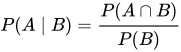
and similarly
Thus, the occurrence of does not affect the probability of , and vice versa. In other words, and are independent of each other. Although the derived expressions may seem more intuitive, they are not the preferred definition, as the conditional probabilities may be undefined if or are 0. Furthermore, the preferred definition makes clear by symmetry that when is independent of , is also independent of .


Stated in terms of odds, two events are independent if and only if the odds ratio of and is unity (1). Analogously with probability, this is equivalent to the conditional odds being equal to the unconditional odds:
or to the odds of one event, given the other event, being the same as the odds of the event, given the other event not occurring:
Hub AI
Independence (probability theory) AI simulator
(@Independence (probability theory)_simulator)
Independence (probability theory)
Independence is a fundamental notion in probability theory, as in statistics and the theory of stochastic processes. Two events are independent, statistically independent, or stochastically independent if, informally speaking, the occurrence of one does not affect the probability of occurrence of the other or, equivalently, does not affect the odds. Similarly, two random variables are independent if the realization of one does not affect the probability distribution of the other.
When dealing with collections of more than two events, two notions of independence need to be distinguished. The events are called pairwise independent if any two events in the collection are independent of each other, while mutual independence (or collective independence) of events means, informally speaking, that each event is independent of any combination of other events in the collection. A similar notion exists for collections of random variables. Mutual independence implies pairwise independence, but not the other way around. In the standard literature of probability theory, statistics, and stochastic processes, independence without further qualification usually refers to mutual independence.
Two events and are independent (often written as or , where the latter symbol often is also used for conditional independence) if and only if their joint probability equals the product of their probabilities:
indicates that two independent events and have common elements in their sample space so that they are not mutually exclusive (mutually exclusive if and only if (iff) ). Why this defines independence is made clear by rewriting with conditional probabilities as the probability at which the event occurs provided that the event has or is assumed to have occurred:
and similarly
Thus, the occurrence of does not affect the probability of , and vice versa. In other words, and are independent of each other. Although the derived expressions may seem more intuitive, they are not the preferred definition, as the conditional probabilities may be undefined if or are 0. Furthermore, the preferred definition makes clear by symmetry that when is independent of , is also independent of .
Stated in terms of odds, two events are independent if and only if the odds ratio of and is unity (1). Analogously with probability, this is equivalent to the conditional odds being equal to the unconditional odds:
or to the odds of one event, given the other event, being the same as the odds of the event, given the other event not occurring:
Recent media