
Recent from talks
Sydney steam tram motor
Knowledge base stats:
Talk channels stats:
Members stats:
Sydney steam tram motor
The Sydney Steam Motor Trams were built for and operated by the New South Wales Government Tramways of Australia.
Steam trams were introduced when four steam tram motors imported to Sydney as a temporary transport for the International Exhibition of 1879. It was built at the Baldwin Locomotive Works, Philadelphia, United States and hauled double decker trailers conveying passengers from the Redfern railway terminus to near the Botanic Gardens.
A Beyer, Peacock & Company steam tram of 1885 was sent to Australia in 1886 as a trial unit by the New South Wales Government Tramways (NSWGT) for comparison against the Baldwin steam tram. The Baldwin design prevailed and this engine returned to England in 1889 to become Beyer Peacock works shunter No. 2. The engine was rumoured to have fallen into the sea on its return voyage, but it survived and is still in working order and known as 'John Bull'. Some sources show it as numbered '47' in Sydney, but number 47 had already been allocated around 1883.
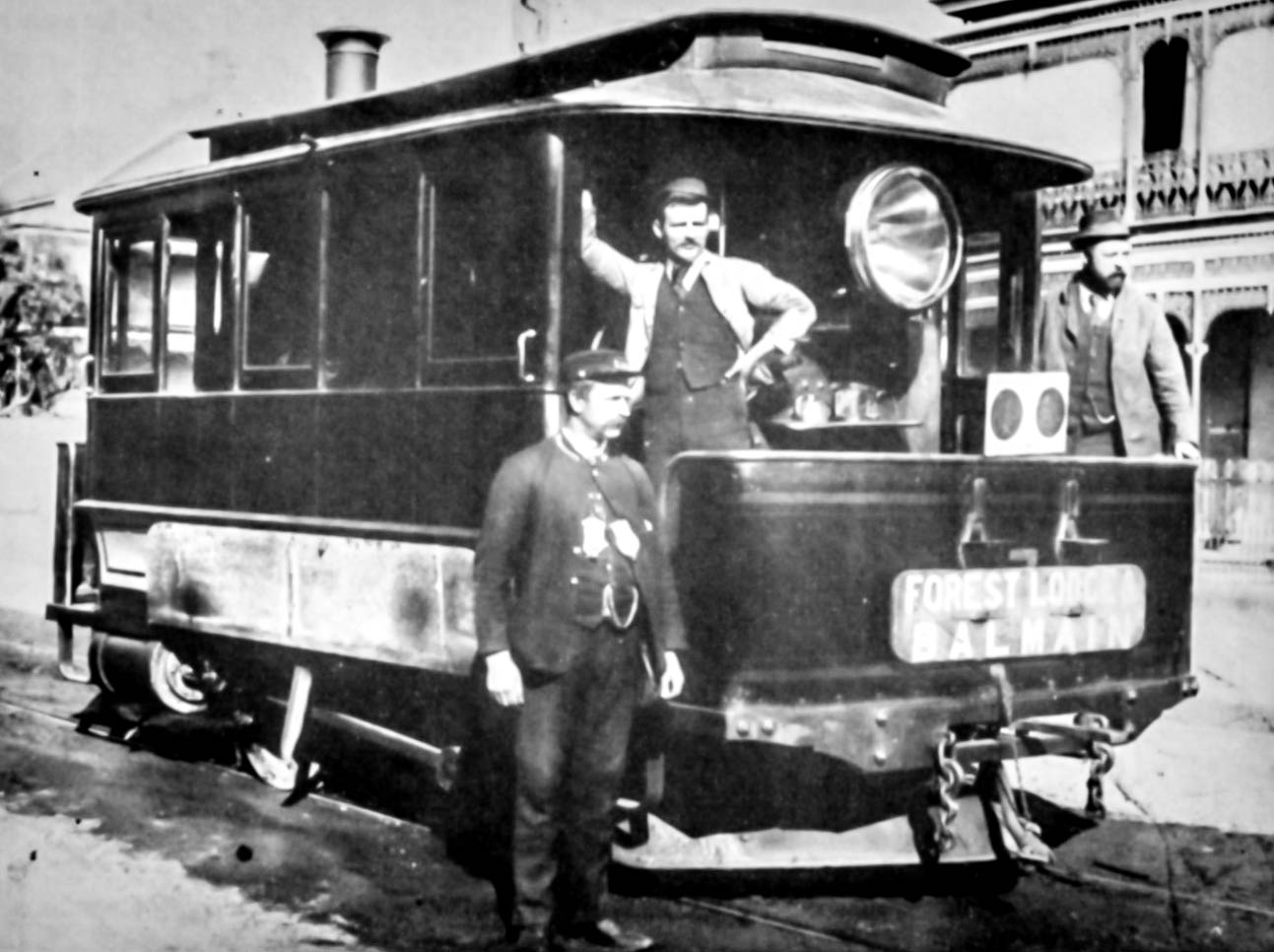
The steam tram motor is essentially a small 0-4-0 saddle tank locomotive with a wooden cab enclosing the frame, with five windows along each side. Access to the cab is through doors from either the front or back platform. The tram is powered by an orthodox locomotive type boiler, American bar type framing, conventional "D" type slide valves and spring suspension. Coke and later coal was carried in a bunker on the rear platform and water in the semi-circular saddle tank.
Typical specifications for an 11" Baldwin steam tram motor:
The Redfern to Botanic Gardens tramway was planned to operate for the duration of the exhibition. It was so popular that an extension to Randwick was opened in 1880. The peak of steam working was reached in 1894, when the tramway's length reached 40 mi (64 km) with over 100 steam trams in service. In 1905-6 steam routes were electrified, with the tram motors gradually relegated to outer suburbs.
Government tram lines in Sydney that weren't electrified were the Kogarah to San Souci line, the Arncliffe to Bexley line, the Sutherland to Cronulla line, and the line from Parramatta to Castle Hill. There was also a privately operated line from Parramatta Park to Redbank Wharf, which only operated using steam tram motors, until it closed in 1943.
Steam trams also operated on regional New South Wales tramways at Newcastle, Maitland, and Broken Hill. Steam tram motors, with railway contour wheels, were used on the East Maitland–Morpeth railway line, between 1895 and 1915.
Hub AI
Sydney steam tram motor AI simulator
(@Sydney steam tram motor_simulator)
Sydney steam tram motor
The Sydney Steam Motor Trams were built for and operated by the New South Wales Government Tramways of Australia.
Steam trams were introduced when four steam tram motors imported to Sydney as a temporary transport for the International Exhibition of 1879. It was built at the Baldwin Locomotive Works, Philadelphia, United States and hauled double decker trailers conveying passengers from the Redfern railway terminus to near the Botanic Gardens.
A Beyer, Peacock & Company steam tram of 1885 was sent to Australia in 1886 as a trial unit by the New South Wales Government Tramways (NSWGT) for comparison against the Baldwin steam tram. The Baldwin design prevailed and this engine returned to England in 1889 to become Beyer Peacock works shunter No. 2. The engine was rumoured to have fallen into the sea on its return voyage, but it survived and is still in working order and known as 'John Bull'. Some sources show it as numbered '47' in Sydney, but number 47 had already been allocated around 1883.
The steam tram motor is essentially a small 0-4-0 saddle tank locomotive with a wooden cab enclosing the frame, with five windows along each side. Access to the cab is through doors from either the front or back platform. The tram is powered by an orthodox locomotive type boiler, American bar type framing, conventional "D" type slide valves and spring suspension. Coke and later coal was carried in a bunker on the rear platform and water in the semi-circular saddle tank.
Typical specifications for an 11" Baldwin steam tram motor:
The Redfern to Botanic Gardens tramway was planned to operate for the duration of the exhibition. It was so popular that an extension to Randwick was opened in 1880. The peak of steam working was reached in 1894, when the tramway's length reached 40 mi (64 km) with over 100 steam trams in service. In 1905-6 steam routes were electrified, with the tram motors gradually relegated to outer suburbs.
Government tram lines in Sydney that weren't electrified were the Kogarah to San Souci line, the Arncliffe to Bexley line, the Sutherland to Cronulla line, and the line from Parramatta to Castle Hill. There was also a privately operated line from Parramatta Park to Redbank Wharf, which only operated using steam tram motors, until it closed in 1943.
Steam trams also operated on regional New South Wales tramways at Newcastle, Maitland, and Broken Hill. Steam tram motors, with railway contour wheels, were used on the East Maitland–Morpeth railway line, between 1895 and 1915.
Recent media