
Recent from talks
Strathcona, Vancouver
Knowledge base stats:
Talk channels stats:
Members stats:
Strathcona, Vancouver
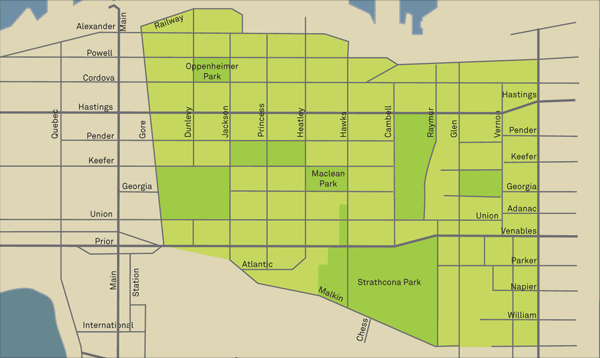
Strathcona is the oldest residential neighbourhood of Vancouver, British Columbia, Canada. Officially a part of the East Side, it is bordered by Downtown Vancouver's Chinatown neighbourhood and the False Creek inlet (across Main Street) to the west, Downtown Eastside (across Hastings Street) to the north, Grandview-Woodland (across Clark Drive) to the east, and Mount Pleasant to the south of Emily Carr University and the Canadian National Railway and Great Northern Railway (now BNSF Railway) classification yards.
By some definitions, Strathcona's northern border is the roads just south of Burrard Inlet, and much of the Downtown Eastside lies within Strathcona. By other definitions, Strathcona's northern boundary is just south of Hastings Street, and the Downtown Eastside is a separate neighbourhood to the north and northwest of Strathcona.
Strathcona has long been a hub of immigration and culture relative to Vancouver's more recently settled neighbourhoods. Chinese immigrants, Vietnamese immigrants, and various groups of European immigrants have characterized the neighbourhood's culture. Although Strathcona was historically a working-class neighbourhood, recently, more middle-class and affluent groups have come to inhabit the neighbourhood. Strathcona is home to many art galleries, family-owned corner stores, and other small businesses.
Over 11,800 people live in Strathcona, which grew during the city's boom years between the city's founding in 1886 and 1920 due in large part to the choice of early Vancouver as a railway terminus. It emerged from the original settlement that grew around Hastings Mill. Originally called the East End, the neighbourhood adopted the name Strathcona in the 1960s. Its residents have always been from many ethnic backgrounds, and while it was historically a working-class neighbourhood, it is currently made up by a diverse range of socio-economic and cultural groups. It is the only neighbourhood where English is not the most commonly spoken language, with 61% of residents reporting Chinese as their mother tongue, followed by English at 24%.
The neighbourhood was earmarked for demolition in the 1950s as part of an urban renewal program. Strathcona would have been transformed into "block upon block of identical apartments buildings and townhouses" for social housing. The redevelopment plans proceeded with the construction of the MacLean Park housing development between Union, Keefer, Gore and Jackson, and Stamp's Place on Campbell between Hastings, Union and Raymur some 15 blocks of the neighbourhood were bulldozed including Hogan's Alley, the only Black community in Vancouver. Development was stopped due to opposition from the community, led by residents such as Bessie Lee, Mary Lee Chan, her husband Walter Chan, and daughter Shirley Chan, who banded together to form the Strathcona Property Owners and Tenants Association (SPOTA). Important municipal figures such as mayor Mike Harcourt and the TEAM and later COPE party emerged from this movement.
In 1971, residents came into conflict with the north–south rail line that had bisected the neighbourhood since 1909. Mothers of children who attended Admiral Seymour Elementary School were concerned that trains often blocked the route that their children took to walk to school. This group, which became known as the Militant Mothers of Raymur, occupied the tracks, leading to the construction of a pedestrian/cyclist overpass at Keefer St.
Just as the neighbourhood organisers were making headway at preserving the neighbourhood, city engineers proposed putting a freeway through the southern part of the neighbourhood which would have connected to a proposed waterfront route. The connectors along Gore and Carrall Streets would have partially destroyed Chinatown and Gastown.
The Mau Dan Gardens Co-operative was established in October 1981, the last of five projects initiated by the Strathcona Area Housing Society (SAHS) to provide housing for the residents of the Strathcona area whose homes were expropriated and demolished in the urban renewal clearance scheme of 1965.
Hub AI
Strathcona, Vancouver AI simulator
(@Strathcona, Vancouver_simulator)
Strathcona, Vancouver
Strathcona is the oldest residential neighbourhood of Vancouver, British Columbia, Canada. Officially a part of the East Side, it is bordered by Downtown Vancouver's Chinatown neighbourhood and the False Creek inlet (across Main Street) to the west, Downtown Eastside (across Hastings Street) to the north, Grandview-Woodland (across Clark Drive) to the east, and Mount Pleasant to the south of Emily Carr University and the Canadian National Railway and Great Northern Railway (now BNSF Railway) classification yards.
By some definitions, Strathcona's northern border is the roads just south of Burrard Inlet, and much of the Downtown Eastside lies within Strathcona. By other definitions, Strathcona's northern boundary is just south of Hastings Street, and the Downtown Eastside is a separate neighbourhood to the north and northwest of Strathcona.
Strathcona has long been a hub of immigration and culture relative to Vancouver's more recently settled neighbourhoods. Chinese immigrants, Vietnamese immigrants, and various groups of European immigrants have characterized the neighbourhood's culture. Although Strathcona was historically a working-class neighbourhood, recently, more middle-class and affluent groups have come to inhabit the neighbourhood. Strathcona is home to many art galleries, family-owned corner stores, and other small businesses.
Over 11,800 people live in Strathcona, which grew during the city's boom years between the city's founding in 1886 and 1920 due in large part to the choice of early Vancouver as a railway terminus. It emerged from the original settlement that grew around Hastings Mill. Originally called the East End, the neighbourhood adopted the name Strathcona in the 1960s. Its residents have always been from many ethnic backgrounds, and while it was historically a working-class neighbourhood, it is currently made up by a diverse range of socio-economic and cultural groups. It is the only neighbourhood where English is not the most commonly spoken language, with 61% of residents reporting Chinese as their mother tongue, followed by English at 24%.
The neighbourhood was earmarked for demolition in the 1950s as part of an urban renewal program. Strathcona would have been transformed into "block upon block of identical apartments buildings and townhouses" for social housing. The redevelopment plans proceeded with the construction of the MacLean Park housing development between Union, Keefer, Gore and Jackson, and Stamp's Place on Campbell between Hastings, Union and Raymur some 15 blocks of the neighbourhood were bulldozed including Hogan's Alley, the only Black community in Vancouver. Development was stopped due to opposition from the community, led by residents such as Bessie Lee, Mary Lee Chan, her husband Walter Chan, and daughter Shirley Chan, who banded together to form the Strathcona Property Owners and Tenants Association (SPOTA). Important municipal figures such as mayor Mike Harcourt and the TEAM and later COPE party emerged from this movement.
In 1971, residents came into conflict with the north–south rail line that had bisected the neighbourhood since 1909. Mothers of children who attended Admiral Seymour Elementary School were concerned that trains often blocked the route that their children took to walk to school. This group, which became known as the Militant Mothers of Raymur, occupied the tracks, leading to the construction of a pedestrian/cyclist overpass at Keefer St.
Just as the neighbourhood organisers were making headway at preserving the neighbourhood, city engineers proposed putting a freeway through the southern part of the neighbourhood which would have connected to a proposed waterfront route. The connectors along Gore and Carrall Streets would have partially destroyed Chinatown and Gastown.
The Mau Dan Gardens Co-operative was established in October 1981, the last of five projects initiated by the Strathcona Area Housing Society (SAHS) to provide housing for the residents of the Strathcona area whose homes were expropriated and demolished in the urban renewal clearance scheme of 1965.
Recent media