
Recent from talks
Stratton, Cornwall
Knowledge base stats:
Talk channels stats:
Members stats:
Stratton, Cornwall
Stratton (Cornish: Strasnedh) is a town in the parish of Bude-Stratton, in Cornwall, England. It is situated near the coastal town of Bude and the market town of Holsworthy. Stratton gave its name to one of the ten ancient hundreds of Cornwall. The Battle of Stratton during the English Civil War took place here on 16 May 1643. In 2022 it had an estimated population of 2044.
The earliest form of the name in Old English is Strætneat deriving from the original Cornish "Strad-Neth", with Strad meaning "The flat-bottomed valley of the River" and Neth being the name of the river itself.
In common with most hydronymy in Western Europe, the name Neth is known to be Celtic or Pre-Celtic; however, the etymology of the name remains uncertain. A meaning of shining or brilliant has been suggested, as has a link to the older Indo-European root *-nedi (simply meaning river). Today, the river is commonly referred to as the Strat in English, from an erroneous back formation of Stratton ("town on the Strat").
The town likely shares its etymology with the river and town of Neath in South Wales and the River Nidd in Northern England. The river is known as both the River Neet and the River Strat.
The earliest known references to Stratton are found in King Alfred's Will of c. 880 and the Domesday survey of 1086. (For the Stratton Hundred: see under Government below.)
At the time of the Domesday Survey the manor of Stratton had land for 30 ploughs. There were 30 villeins, 20 smallholders and 20 slaves. There were 10 salt houses, 20 acres of woodland, 200 acres of pasture, 30 cattle and 300 sheep. Before the conquest the manor had been held by Bishop Osbern and Alfred the Marshal; its value in 1086 was £35-18-4d. Stratton Manor House on Diddies Road has now been converted into apartments.
The town has given its name to a traditional folk ballad, "The Stratton Carol".
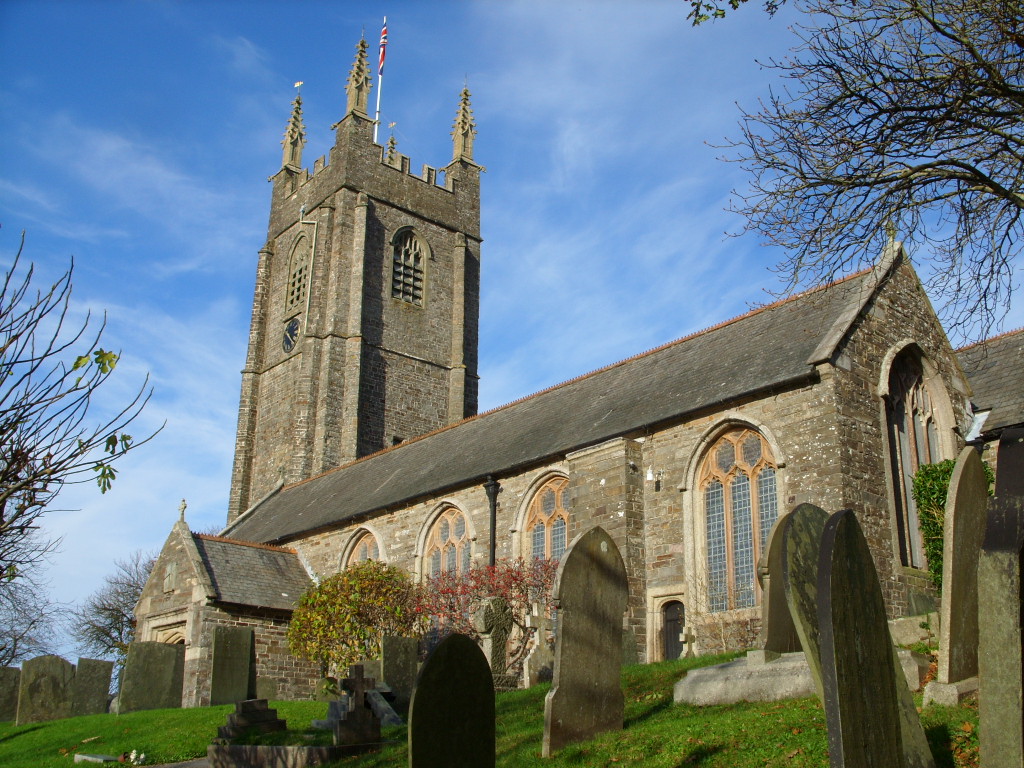
One of the most prominent buildings in Stratton is the 12th-century Norman church dedicated to Saint Andrew which holds a central and elevated position within the town. It is a Grade I listed building and contains a brass to Admiral Sir John Arundell of Trerice, 1561.
Hub AI
Stratton, Cornwall AI simulator
(@Stratton, Cornwall_simulator)
Stratton, Cornwall
Stratton (Cornish: Strasnedh) is a town in the parish of Bude-Stratton, in Cornwall, England. It is situated near the coastal town of Bude and the market town of Holsworthy. Stratton gave its name to one of the ten ancient hundreds of Cornwall. The Battle of Stratton during the English Civil War took place here on 16 May 1643. In 2022 it had an estimated population of 2044.
The earliest form of the name in Old English is Strætneat deriving from the original Cornish "Strad-Neth", with Strad meaning "The flat-bottomed valley of the River" and Neth being the name of the river itself.
In common with most hydronymy in Western Europe, the name Neth is known to be Celtic or Pre-Celtic; however, the etymology of the name remains uncertain. A meaning of shining or brilliant has been suggested, as has a link to the older Indo-European root *-nedi (simply meaning river). Today, the river is commonly referred to as the Strat in English, from an erroneous back formation of Stratton ("town on the Strat").
The town likely shares its etymology with the river and town of Neath in South Wales and the River Nidd in Northern England. The river is known as both the River Neet and the River Strat.
The earliest known references to Stratton are found in King Alfred's Will of c. 880 and the Domesday survey of 1086. (For the Stratton Hundred: see under Government below.)
At the time of the Domesday Survey the manor of Stratton had land for 30 ploughs. There were 30 villeins, 20 smallholders and 20 slaves. There were 10 salt houses, 20 acres of woodland, 200 acres of pasture, 30 cattle and 300 sheep. Before the conquest the manor had been held by Bishop Osbern and Alfred the Marshal; its value in 1086 was £35-18-4d. Stratton Manor House on Diddies Road has now been converted into apartments.
The town has given its name to a traditional folk ballad, "The Stratton Carol".
One of the most prominent buildings in Stratton is the 12th-century Norman church dedicated to Saint Andrew which holds a central and elevated position within the town. It is a Grade I listed building and contains a brass to Admiral Sir John Arundell of Trerice, 1561.
Recent media