
Recent from talks
Strongsville, Ohio
Knowledge base stats:
Talk channels stats:
Members stats:
Strongsville, Ohio
Strongsville is a city in Cuyahoga County, Ohio, United States, and a suburb of Cleveland. As of the 2020 census, its population was 46,491.
The city's nickname, Crossroads of the Nation, originated from the intersection between the Baltimore and Ohio Railroad and Southwestern Electric Line that connected Cleveland and Wooster, Ohio. As the railroad line ceased operation in 1931, the motto and city seal have been adapted to reflect the modern-day intersection of Interstate 71 and the Ohio Turnpike.
Founded by settlers arriving in the newly purchased Connecticut Western Reserve, the city was named after John Stoughton Strong, the group's leader. He brought his oldest son, Emory Strong, his brother-in-law Elijah Lyman Sr., and Guilford Whitney, another relative of the Strongs. Along with Whitney came his daughter, her husband John Hilliard, and their daughter. Other pioneers in the group included William Fuller Jr., Obadiah Church, Zachariah Goodale, and George Fox Gilbert. They arrived in 1816 and cleared enough land to construct log cabins. The 25-square-mile area of land was surveyed and divided into lots for John Stoughton Strong to sell off by agreement with Oliver Ellsworth of Hartford, Connecticut. Strongsville officially became Township No. 5, 14th range on February 25, 1818. Strongsville then became a village in 1923 and was ultimately designated a city in 1961.
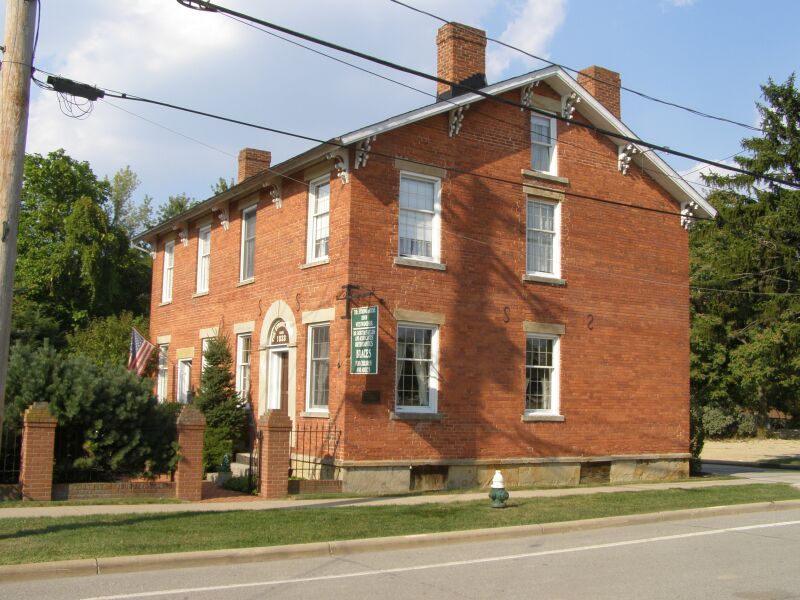
John Stoughton Strong, originally from Vermont, was instrumental in Strongsville's establishment and early growth. He drew in settlers from New York, Pennsylvania, and New England by driving cattle that he obtained to markets in those states. In the following years, he oversaw the development of settlements, roads, businesses, schools, and churches. He had the first mill built in 1820 on the Rocky River in Albion. While it is no longer standing, the dam and foundation still exist in what is now Bonnie Park. He also brought in settlers with specialized skills, such as Dr. William Baldwin as the town doctor. The John Stoughton Strong House was added to the National Register of Historic Places on November 24, 1980.
Many of the main streets in the city are named after other principal figures and landowners from the city's history, e.g. Howe, Drake, Shurmer, and Whitney.
The Pomeroy House, built in 1847, was known as the Homestead for over a century. Alanson Pomeroy, the homeowner and prominent Strongsville resident, hosted members of the Congregational Church of which he was an active member, and opened his spare room to travelers. During the Civil War, the Homestead became a stop on the Underground Railroad, where he concealed runaway slaves on his property. From this residence in Strongsville, the runaway slaves were taken to boats on the Rocky River for passage to Canada. The Alanson Pomeroy House was added to the National Register of Historic Places in June 1975. After a few years of renovation, it opened as Don's Pomeroy House Restaurant & Pub in 1980. Guests can dine in the library, the old dining room, the study, or the parlor. The pub is located downstairs and the upstairs bedrooms now serve as private dining rooms.
In 1853, John D. Rockefeller's family moved to Strongsville. At the time, Rockefeller was only a child.
On April 11, 1965, an F4 tornado hit Strongsville; it was part of the 1965 Palm Sunday tornado outbreak.
Hub AI
Strongsville, Ohio AI simulator
(@Strongsville, Ohio_simulator)
Strongsville, Ohio
Strongsville is a city in Cuyahoga County, Ohio, United States, and a suburb of Cleveland. As of the 2020 census, its population was 46,491.
The city's nickname, Crossroads of the Nation, originated from the intersection between the Baltimore and Ohio Railroad and Southwestern Electric Line that connected Cleveland and Wooster, Ohio. As the railroad line ceased operation in 1931, the motto and city seal have been adapted to reflect the modern-day intersection of Interstate 71 and the Ohio Turnpike.
Founded by settlers arriving in the newly purchased Connecticut Western Reserve, the city was named after John Stoughton Strong, the group's leader. He brought his oldest son, Emory Strong, his brother-in-law Elijah Lyman Sr., and Guilford Whitney, another relative of the Strongs. Along with Whitney came his daughter, her husband John Hilliard, and their daughter. Other pioneers in the group included William Fuller Jr., Obadiah Church, Zachariah Goodale, and George Fox Gilbert. They arrived in 1816 and cleared enough land to construct log cabins. The 25-square-mile area of land was surveyed and divided into lots for John Stoughton Strong to sell off by agreement with Oliver Ellsworth of Hartford, Connecticut. Strongsville officially became Township No. 5, 14th range on February 25, 1818. Strongsville then became a village in 1923 and was ultimately designated a city in 1961.
John Stoughton Strong, originally from Vermont, was instrumental in Strongsville's establishment and early growth. He drew in settlers from New York, Pennsylvania, and New England by driving cattle that he obtained to markets in those states. In the following years, he oversaw the development of settlements, roads, businesses, schools, and churches. He had the first mill built in 1820 on the Rocky River in Albion. While it is no longer standing, the dam and foundation still exist in what is now Bonnie Park. He also brought in settlers with specialized skills, such as Dr. William Baldwin as the town doctor. The John Stoughton Strong House was added to the National Register of Historic Places on November 24, 1980.
Many of the main streets in the city are named after other principal figures and landowners from the city's history, e.g. Howe, Drake, Shurmer, and Whitney.
The Pomeroy House, built in 1847, was known as the Homestead for over a century. Alanson Pomeroy, the homeowner and prominent Strongsville resident, hosted members of the Congregational Church of which he was an active member, and opened his spare room to travelers. During the Civil War, the Homestead became a stop on the Underground Railroad, where he concealed runaway slaves on his property. From this residence in Strongsville, the runaway slaves were taken to boats on the Rocky River for passage to Canada. The Alanson Pomeroy House was added to the National Register of Historic Places in June 1975. After a few years of renovation, it opened as Don's Pomeroy House Restaurant & Pub in 1980. Guests can dine in the library, the old dining room, the study, or the parlor. The pub is located downstairs and the upstairs bedrooms now serve as private dining rooms.
In 1853, John D. Rockefeller's family moved to Strongsville. At the time, Rockefeller was only a child.
On April 11, 1965, an F4 tornado hit Strongsville; it was part of the 1965 Palm Sunday tornado outbreak.
Recent media