
Successor ordinal
View on WikipediaIn set theory, the successor of an ordinal number α is the smallest ordinal number greater than α. An ordinal number that is a successor is called a successor ordinal. The ordinals 1, 2, and 3 are the first three successor ordinals and the ordinals ω+1, ω+2 and ω+3 are the first three infinite successor ordinals.
Properties
[edit]Every ordinal other than 0 is either a successor ordinal or a limit ordinal.[1]
In Von Neumann's model
[edit]Using von Neumann's ordinal numbers (the standard model of the ordinals used in set theory), the successor S(α) of an ordinal number α is given by the formula[1]

Since the ordering on the ordinal numbers is given by α < β if and only if α ∈ β, it is immediate that there is no ordinal number between α and S(α), and it is also clear that α < S(α).
Ordinal addition
[edit]The successor operation can be used to define ordinal addition rigorously via transfinite recursion as follows:


and for a limit ordinal λ
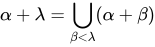
In particular, S(α) = α + 1. Multiplication and exponentiation are defined similarly.
Topology
[edit]The successor points and zero are the isolated points of the class of ordinal numbers, with respect to the order topology.[2]
See also
[edit]References
[edit]- ^ a b Cameron, Peter J. (1999), Sets, Logic and Categories, Springer Undergraduate Mathematics Series, Springer, p. 46, ISBN 9781852330569.
- ^ Devlin, Keith (1993), The Joy of Sets: Fundamentals of Contemporary Set Theory, Undergraduate Texts in Mathematics, Springer, Exercise 3C, p. 100, ISBN 9780387940946.