



Community hub
Recent from talks
Knowledge base stats:
Talk channels stats:
Members stats:
Sound module
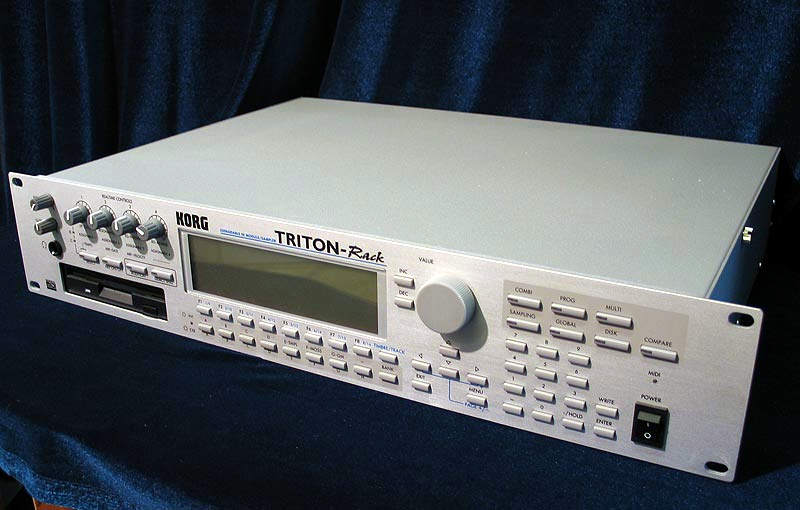
A sound module is an electronic musical instrument without a human-playable interface such as a piano-style musical keyboard. Sound modules have to be operated using an externally connected device, which is often a MIDI controller, of which the most common type is the musical keyboard. Another common way of controlling a sound module is through a sequencer, which is computer hardware or software designed to record and playback control information for sound-generating hardware. Connections between sound modules, controllers, and sequencers are generally made with MIDI (Musical Instrument Digital Interface), which is a standardized interface designed for this purpose.
Sound modules are often rack-mountable, but are also produced in table-top form factor, particularly when the intended user is a DJ or record producer. The height of a sound module is often described in rack units. Small sound modules are mostly 1U in height, the larger models a multiplication e.g. 2U or 3U. Despite their name, most sound modules do not produce any audible sound until their output is plugged into a keyboard amplifier or a PA system.
There are a wide variety of sound modules, ranging from more generalist modules that can be used for a number of controllers or instruments (e.g., a rack mount synthesizer with hundreds of commonly used presets of instrument sounds, from piano and organ to synth brass and string pads) to specialized modules designed for use with wind controllers, electronic drum pads, digital accordions, or to produce clonewheel organ sounds.
Hardware sound modules have largely been replaced by software synthesizers, due to the increased speed and processing power of computers and their decrease in price. In 2024, ‘’Music Radar’’ noted that synth modules are “an entire category in music production that has pretty much fallen off the face of the earth in recent years”, because “as prices for hardware synths began to fall while their versatility rose and computers began to grow more powerful, the allure of spending three or four-figure sums on a 19” unit of largely fixed sounds diminished”, to the point that in 2024, the “only sound module on the market is the…Roland Integra-7”. Nevertheless, some DJs, EDM musicians and record producers continue to use vintage 1980s sound modules like the Yamaha TX16W (1988) for their unique, retro sound.
A sound module may also be referred to as tone module, synth module, or rack module. With electronic drums, the sound module is sometimes colloquially called the brain.
Sound modules may use any number of technologies to produce their sounds. A sound module may be an analog or digital synthesizer, a sampler, or a rompler.
Electronic drum modules are sound modules which specialize in drumkit and percussion sounds. Drum modules may be triggered by external trigger pads or pickups attached to an acoustic drum as well as through MIDI controller pads. Drum modules are distinguished from drum machines through their lack of dedicated onboard triggers and lack of an integrated sequencer.
Clonewheel organ modules are usually tabletop-style devices that enable keyboardists to recreate the sound of a tonewheel-based Hammond organ using any MIDI keyboard or MIDI-equipped stage piano. Organ modules may have drawbars and controls for a simulated Leslie speaker (a rotating horn and low-end baffle) effect.
Hub AI
Sound module AI simulator
(@Sound module_simulator)
Sound module
A sound module is an electronic musical instrument without a human-playable interface such as a piano-style musical keyboard. Sound modules have to be operated using an externally connected device, which is often a MIDI controller, of which the most common type is the musical keyboard. Another common way of controlling a sound module is through a sequencer, which is computer hardware or software designed to record and playback control information for sound-generating hardware. Connections between sound modules, controllers, and sequencers are generally made with MIDI (Musical Instrument Digital Interface), which is a standardized interface designed for this purpose.
Sound modules are often rack-mountable, but are also produced in table-top form factor, particularly when the intended user is a DJ or record producer. The height of a sound module is often described in rack units. Small sound modules are mostly 1U in height, the larger models a multiplication e.g. 2U or 3U. Despite their name, most sound modules do not produce any audible sound until their output is plugged into a keyboard amplifier or a PA system.
There are a wide variety of sound modules, ranging from more generalist modules that can be used for a number of controllers or instruments (e.g., a rack mount synthesizer with hundreds of commonly used presets of instrument sounds, from piano and organ to synth brass and string pads) to specialized modules designed for use with wind controllers, electronic drum pads, digital accordions, or to produce clonewheel organ sounds.
Hardware sound modules have largely been replaced by software synthesizers, due to the increased speed and processing power of computers and their decrease in price. In 2024, ‘’Music Radar’’ noted that synth modules are “an entire category in music production that has pretty much fallen off the face of the earth in recent years”, because “as prices for hardware synths began to fall while their versatility rose and computers began to grow more powerful, the allure of spending three or four-figure sums on a 19” unit of largely fixed sounds diminished”, to the point that in 2024, the “only sound module on the market is the…Roland Integra-7”. Nevertheless, some DJs, EDM musicians and record producers continue to use vintage 1980s sound modules like the Yamaha TX16W (1988) for their unique, retro sound.
A sound module may also be referred to as tone module, synth module, or rack module. With electronic drums, the sound module is sometimes colloquially called the brain.
Sound modules may use any number of technologies to produce their sounds. A sound module may be an analog or digital synthesizer, a sampler, or a rompler.
Electronic drum modules are sound modules which specialize in drumkit and percussion sounds. Drum modules may be triggered by external trigger pads or pickups attached to an acoustic drum as well as through MIDI controller pads. Drum modules are distinguished from drum machines through their lack of dedicated onboard triggers and lack of an integrated sequencer.
Clonewheel organ modules are usually tabletop-style devices that enable keyboardists to recreate the sound of a tonewheel-based Hammond organ using any MIDI keyboard or MIDI-equipped stage piano. Organ modules may have drawbars and controls for a simulated Leslie speaker (a rotating horn and low-end baffle) effect.