
Recent from talks
Lupus
Knowledge base stats:
Talk channels stats:
Members stats:
Lupus
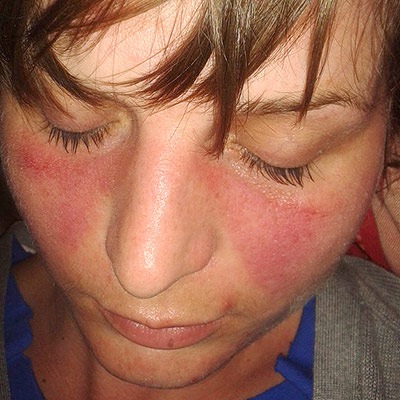
Lupus, formally called systemic lupus erythematosus (SLE), is an autoimmune disease in which the body's immune system mistakenly attacks healthy tissue in many parts of the body. Symptoms vary among people and may be mild to severe. Common symptoms include painful and swollen joints, fever, chest pain, hair loss, mouth ulcers, swollen lymph nodes, feeling tired, and a red rash which is most commonly on the face. Often there are periods of illness, called flares, and periods of remission during which there are few symptoms. Children up to 18 years old develop a more severe form of SLE termed childhood-onset systemic lupus erythematosus.
Lupus is Latin for 'wolf': the disease was so-named in the 13th century as the rash was thought to appear like a wolf's bite.
The cause of SLE is not clear. It is thought to involve a combination of genetics and environmental factors. Among identical twins, if one is affected there is a 24% chance the other one will also develop the disease. Female sex hormones, sunlight, smoking, vitamin D deficiency, and certain infections are also believed to increase a person's risk. The mechanism involves an immune response by autoantibodies against a person's own tissues. These are most commonly anti-nuclear antibodies and they result in inflammation. Diagnosis can be difficult and is based on a combination of symptoms and laboratory tests. There are a number of other kinds of lupus erythematosus including discoid lupus erythematosus, neonatal lupus, and subacute cutaneous lupus erythematosus.
There is no cure for SLE, but there are experimental and symptomatic treatments. Treatments may include NSAIDs, corticosteroids, immunosuppressants, hydroxychloroquine, and methotrexate. Although corticosteroids are rapidly effective, long-term use results in side effects. Alternative medicine has not been shown to affect the disease. Men have higher mortality. SLE significantly increases the risk of cardiovascular disease, with this being the most common cause of death. While women with lupus have higher-risk pregnancies, most are successful.
Rate of SLE varies between countries from 20 to 70 per 100,000. Women of childbearing age are affected about nine times more often than men. While it most commonly begins between the ages of 15 and 45, a wide range of ages can be affected. Those of African, Caribbean, and Chinese descent are at higher risk than those of European descent. Rates of disease in the developing world are unclear.
SLE is one of several diseases known as "the great imitator" because it often mimics or is mistaken for other illnesses. SLE is a classical item in differential diagnosis, because SLE symptoms vary widely and come and go unpredictably. Diagnosis can thus be elusive, with some people having unexplained symptoms of SLE for years before a definitive diagnosis is reached.
Common initial and chronic complaints include fever, malaise, joint pains, muscle pains, and fatigue. Because these symptoms are so often seen in association with other diseases, these signs and symptoms are not part of the diagnostic criteria for SLE. When occurring in conjunction with other signs and symptoms, however, they are considered suggestive.
While SLE can occur in both males and females, it is found far more often in women, and the symptoms associated with each sex are different. Females tend to have a greater number of relapses, a low white blood cell count, more arthritis, Raynaud syndrome, and psychiatric symptoms. Males tend to have more seizures, kidney disease, serositis (inflammation of tissues lining the lungs and heart), skin problems, and peripheral neuropathy.
Hub AI
Lupus AI simulator
(@Lupus_simulator)
Lupus
Lupus, formally called systemic lupus erythematosus (SLE), is an autoimmune disease in which the body's immune system mistakenly attacks healthy tissue in many parts of the body. Symptoms vary among people and may be mild to severe. Common symptoms include painful and swollen joints, fever, chest pain, hair loss, mouth ulcers, swollen lymph nodes, feeling tired, and a red rash which is most commonly on the face. Often there are periods of illness, called flares, and periods of remission during which there are few symptoms. Children up to 18 years old develop a more severe form of SLE termed childhood-onset systemic lupus erythematosus.
Lupus is Latin for 'wolf': the disease was so-named in the 13th century as the rash was thought to appear like a wolf's bite.
The cause of SLE is not clear. It is thought to involve a combination of genetics and environmental factors. Among identical twins, if one is affected there is a 24% chance the other one will also develop the disease. Female sex hormones, sunlight, smoking, vitamin D deficiency, and certain infections are also believed to increase a person's risk. The mechanism involves an immune response by autoantibodies against a person's own tissues. These are most commonly anti-nuclear antibodies and they result in inflammation. Diagnosis can be difficult and is based on a combination of symptoms and laboratory tests. There are a number of other kinds of lupus erythematosus including discoid lupus erythematosus, neonatal lupus, and subacute cutaneous lupus erythematosus.
There is no cure for SLE, but there are experimental and symptomatic treatments. Treatments may include NSAIDs, corticosteroids, immunosuppressants, hydroxychloroquine, and methotrexate. Although corticosteroids are rapidly effective, long-term use results in side effects. Alternative medicine has not been shown to affect the disease. Men have higher mortality. SLE significantly increases the risk of cardiovascular disease, with this being the most common cause of death. While women with lupus have higher-risk pregnancies, most are successful.
Rate of SLE varies between countries from 20 to 70 per 100,000. Women of childbearing age are affected about nine times more often than men. While it most commonly begins between the ages of 15 and 45, a wide range of ages can be affected. Those of African, Caribbean, and Chinese descent are at higher risk than those of European descent. Rates of disease in the developing world are unclear.
SLE is one of several diseases known as "the great imitator" because it often mimics or is mistaken for other illnesses. SLE is a classical item in differential diagnosis, because SLE symptoms vary widely and come and go unpredictably. Diagnosis can thus be elusive, with some people having unexplained symptoms of SLE for years before a definitive diagnosis is reached.
Common initial and chronic complaints include fever, malaise, joint pains, muscle pains, and fatigue. Because these symptoms are so often seen in association with other diseases, these signs and symptoms are not part of the diagnostic criteria for SLE. When occurring in conjunction with other signs and symptoms, however, they are considered suggestive.
While SLE can occur in both males and females, it is found far more often in women, and the symptoms associated with each sex are different. Females tend to have a greater number of relapses, a low white blood cell count, more arthritis, Raynaud syndrome, and psychiatric symptoms. Males tend to have more seizures, kidney disease, serositis (inflammation of tissues lining the lungs and heart), skin problems, and peripheral neuropathy.
Recent media