
Recent from talks
T-10 tank
Knowledge base stats:
Talk channels stats:
Members stats:
T-10 tank
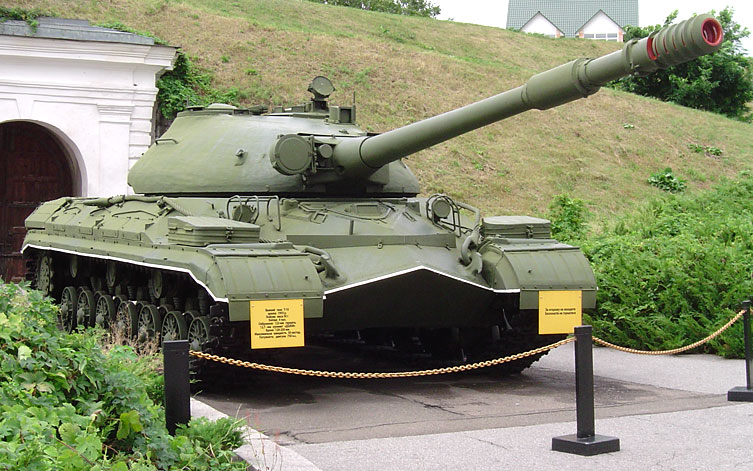
The T-10 (also known as Object 730 or IS-8) was a Soviet heavy tank of the Cold War, the final development of the IS tank series. During development, it was called Object 730. It was accepted into production in 1953 as the IS-8 (Iosif Stalin, Russian form of Joseph Stalin), but due to the political climate in the wake of Stalin's death in 1953, it was renamed T-10.
The biggest differences from its direct ancestor, the IS-3, were a longer hull, seven pairs of road wheels instead of six, a larger turret mounting a new gun with fume extractor, an improved diesel engine, and increased armour. General performance was similar, although the T-10 could carry more ammunition, from 28 rounds to 30 rounds.
T-10s (like the IS tanks they replaced) were deployed in independent tank regiments belonging to armies, and independent tank battalions belonging to divisions. These independent tank units could be attached to mechanized units, to support infantry operations and perform breakthroughs.
In 1948 the Soviets had three different kinds of heavy tanks in service sharing little except for road wheels and guns: The IS-2 was the most mechanically reliable, but was becoming obsolete with Western countries such as United States and the United Kingdom fielding newer heavy tanks. The IS-3 was plagued with construction and mechanical problems, and the IS-4 was too heavy to cross bridges in Europe and relegated to the Russian Far East region as result. Kotin personally led a design team to work on project Object 730 to meet the GBTU (Main Armored Vehicle Directorate) requirements for a new heavy tank: it had to be better than the IS-2 and weigh no more than 50 metric tons.
The T-10 features a cast hull divided into three compartments, with the driver at the front, the fighting in the center and the engine at the rear. The hull floor features a stamped steel plate in a shallow V shape. The driver sits on the center of the hull and is provided with a hatch cover while the hatch itself features an integral periscope that can be replaced with an infrared one for night driving. The turret is made of rolled steel with the commander and gunner on the left and the loader on the right. Both the commander and loader are provided with hatch covers. A ventilation dome is mounted forward of the two hatch covers.
The T-10 uses the same engine of the IS-4, and reportedly was difficult to replace in the field. According to Sewell the engine was more stressed in comparison to the IS-3. Stowage boxes are mounted on the sides of the hull above the tracks and additional fuel tanks can be fitted at the rear to increase the tank operational range.
The torsion bar suspension consists of seven road wheels with six shock absorbers fitted to each side. A 12.7 mm DShK machine gun is mounted coaxially and an additional DShK was mounted on the loader's hatch ring for anti-aircraft defence.
In 1955 the T-54 tank (designed by the Morozov Design Bureau) and the T-10 were fitted with stabilizers to allow them to fire on the move. While earlier Soviet stabilizers made it unnecessary for the gunner to wait until the gun stopped wobbling before engaging his targets, they didn't provide the ability of accurately hitting targets on the move. The T-54 would eventually receive the STP-2 "Tsiklon" (Cyclone) stabilizer while the T-10 was fitted with the PUOT-2 "Grom" (Thunder) stabilizer. While a T-54 gunner only needed to point and fire the gun once he had a stable picture of the target on his sights, the T-10 gunner had to wait for the gun and sight to be stabilized together, slowing down the firing rate.
Hub AI
T-10 tank AI simulator
(@T-10 tank_simulator)
T-10 tank
The T-10 (also known as Object 730 or IS-8) was a Soviet heavy tank of the Cold War, the final development of the IS tank series. During development, it was called Object 730. It was accepted into production in 1953 as the IS-8 (Iosif Stalin, Russian form of Joseph Stalin), but due to the political climate in the wake of Stalin's death in 1953, it was renamed T-10.
The biggest differences from its direct ancestor, the IS-3, were a longer hull, seven pairs of road wheels instead of six, a larger turret mounting a new gun with fume extractor, an improved diesel engine, and increased armour. General performance was similar, although the T-10 could carry more ammunition, from 28 rounds to 30 rounds.
T-10s (like the IS tanks they replaced) were deployed in independent tank regiments belonging to armies, and independent tank battalions belonging to divisions. These independent tank units could be attached to mechanized units, to support infantry operations and perform breakthroughs.
In 1948 the Soviets had three different kinds of heavy tanks in service sharing little except for road wheels and guns: The IS-2 was the most mechanically reliable, but was becoming obsolete with Western countries such as United States and the United Kingdom fielding newer heavy tanks. The IS-3 was plagued with construction and mechanical problems, and the IS-4 was too heavy to cross bridges in Europe and relegated to the Russian Far East region as result. Kotin personally led a design team to work on project Object 730 to meet the GBTU (Main Armored Vehicle Directorate) requirements for a new heavy tank: it had to be better than the IS-2 and weigh no more than 50 metric tons.
The T-10 features a cast hull divided into three compartments, with the driver at the front, the fighting in the center and the engine at the rear. The hull floor features a stamped steel plate in a shallow V shape. The driver sits on the center of the hull and is provided with a hatch cover while the hatch itself features an integral periscope that can be replaced with an infrared one for night driving. The turret is made of rolled steel with the commander and gunner on the left and the loader on the right. Both the commander and loader are provided with hatch covers. A ventilation dome is mounted forward of the two hatch covers.
The T-10 uses the same engine of the IS-4, and reportedly was difficult to replace in the field. According to Sewell the engine was more stressed in comparison to the IS-3. Stowage boxes are mounted on the sides of the hull above the tracks and additional fuel tanks can be fitted at the rear to increase the tank operational range.
The torsion bar suspension consists of seven road wheels with six shock absorbers fitted to each side. A 12.7 mm DShK machine gun is mounted coaxially and an additional DShK was mounted on the loader's hatch ring for anti-aircraft defence.
In 1955 the T-54 tank (designed by the Morozov Design Bureau) and the T-10 were fitted with stabilizers to allow them to fire on the move. While earlier Soviet stabilizers made it unnecessary for the gunner to wait until the gun stopped wobbling before engaging his targets, they didn't provide the ability of accurately hitting targets on the move. The T-54 would eventually receive the STP-2 "Tsiklon" (Cyclone) stabilizer while the T-10 was fitted with the PUOT-2 "Grom" (Thunder) stabilizer. While a T-54 gunner only needed to point and fire the gun once he had a stable picture of the target on his sights, the T-10 gunner had to wait for the gun and sight to be stabilized together, slowing down the firing rate.
Recent media