



Community hub
Recent from talks
Knowledge base stats:
Talk channels stats:
Members stats:
Tabernacle
According to the Hebrew Bible, the tabernacle (Hebrew: מִשְׁכָּן, romanized: miškān, lit. 'residence, dwelling place'), also known as the Tent of the Congregation (Hebrew: אֹהֶל מוֹעֵד, romanized: ʔohel mōʕēḏ, also Tent of Meeting), was the portable earthly dwelling of God used by the Israelites from the Exodus until the conquest of Canaan. Moses was instructed at Mount Sinai to construct and transport the tabernacle with the Israelites on their journey through the wilderness and their subsequent conquest of the Promised Land. After 440 years, Solomon's Temple in Jerusalem superseded it as the dwelling-place of God.
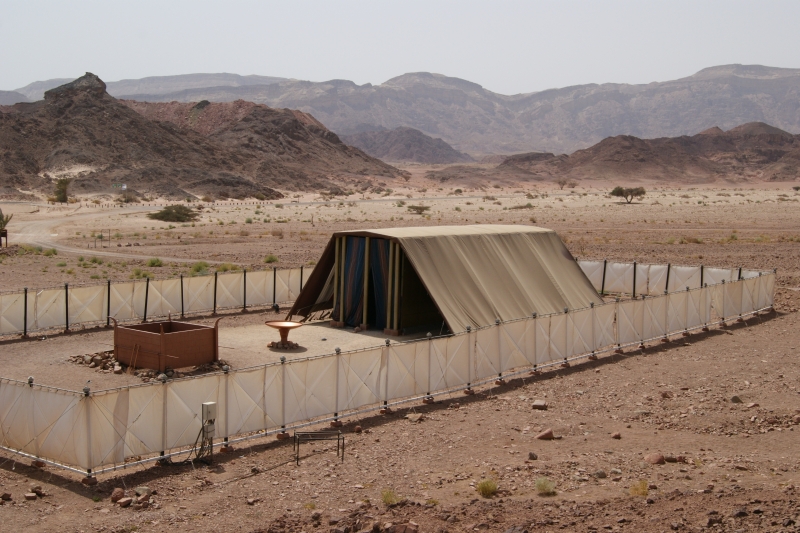
The main source describing the tabernacle is the biblical Book of Exodus, specifically Exodus 25–31 and 35–40. Those passages describe an inner sanctuary, the Holy of Holies, created by the veil suspended by four pillars. This sanctuary contained the Ark of the Covenant, with its cherubim-covered mercy seat. An outer sanctuary (the "Holy Place") contained a gold lamp-stand or candlestick. On the north side stood a table, on which lay the showbread. On the south side was the Menorah, holding seven oil lamps to give light. On the west side, just before the veil, was the golden altar of incense. It was constructed of 4 woven layers of curtains and 48 4.6 m (15 ft) tall standing wood boards overlaid in gold and held in place by its bars and silver sockets and was richly furnished with valuable materials taken from Egypt at God's command.
Historically, according to scholars like Mark S. Smith, William G. Dever and archaeological discoveries, the tabernacle is based on similar tent shrines from other cultures in the ancient near-east, such as the Canaanites, Babylonians and Egyptians. These portable shrines would house respective deities, with this custom both predating and surrounding the ancient Israelites.
The English word tabernacle derives from the Latin tabernāculum (meaning "tent" or "hut"), which in ancient Roman religion was a ritual structure. The Hebrew word mishkan implies "dwell", "rest", or "to live in". In Greek, including the Septuagint, the Hebrew is translated σκηνή (skēnē), itself a Semitic loanword meaning "tent".
Biblical scholar Michael B. Hundley argues that the Priestly source uses the terms "tabernacle" and "tent of meeting" in a complementary way to emphasize the sacred tent’s dual function as a divine dwelling place on earth and a place where the resident deity meets with his people.
Dr. Hacham Isaac S. D. Sassoon argued that the Priestly source’s focus on the Tabernacle, rather than the Temple, serves as a post-exilic critique of the idea of rebuilding a stationary Temple, presenting the mobile Tabernacle as a divinely-ordained permanent structure for the Israelites.
A detailed description of a tabernacle, located in Exodus chapters 25–27 and Exodus chapters 35–40, refers to an inner shrine, the Holy of Holies, housing the ark, and an outer chamber with the six-branch seven-lamp Temple menorah, table for showbread, and an altar of incense. An enclosure containing the sacrificial altar and bronze laver for the priests to wash surrounded these chambers.
Traditional scholars contend that it describes an actual tabernacle used in the time of Moses and thereafter. This view is based on the existence of significant parallels between the biblical Tabernacle and similar structures from ancient Egypt during the Late Bronze Age.
Hub AI
Tabernacle AI simulator
(@Tabernacle_simulator)
Tabernacle
According to the Hebrew Bible, the tabernacle (Hebrew: מִשְׁכָּן, romanized: miškān, lit. 'residence, dwelling place'), also known as the Tent of the Congregation (Hebrew: אֹהֶל מוֹעֵד, romanized: ʔohel mōʕēḏ, also Tent of Meeting), was the portable earthly dwelling of God used by the Israelites from the Exodus until the conquest of Canaan. Moses was instructed at Mount Sinai to construct and transport the tabernacle with the Israelites on their journey through the wilderness and their subsequent conquest of the Promised Land. After 440 years, Solomon's Temple in Jerusalem superseded it as the dwelling-place of God.
The main source describing the tabernacle is the biblical Book of Exodus, specifically Exodus 25–31 and 35–40. Those passages describe an inner sanctuary, the Holy of Holies, created by the veil suspended by four pillars. This sanctuary contained the Ark of the Covenant, with its cherubim-covered mercy seat. An outer sanctuary (the "Holy Place") contained a gold lamp-stand or candlestick. On the north side stood a table, on which lay the showbread. On the south side was the Menorah, holding seven oil lamps to give light. On the west side, just before the veil, was the golden altar of incense. It was constructed of 4 woven layers of curtains and 48 4.6 m (15 ft) tall standing wood boards overlaid in gold and held in place by its bars and silver sockets and was richly furnished with valuable materials taken from Egypt at God's command.
Historically, according to scholars like Mark S. Smith, William G. Dever and archaeological discoveries, the tabernacle is based on similar tent shrines from other cultures in the ancient near-east, such as the Canaanites, Babylonians and Egyptians. These portable shrines would house respective deities, with this custom both predating and surrounding the ancient Israelites.
The English word tabernacle derives from the Latin tabernāculum (meaning "tent" or "hut"), which in ancient Roman religion was a ritual structure. The Hebrew word mishkan implies "dwell", "rest", or "to live in". In Greek, including the Septuagint, the Hebrew is translated σκηνή (skēnē), itself a Semitic loanword meaning "tent".
Biblical scholar Michael B. Hundley argues that the Priestly source uses the terms "tabernacle" and "tent of meeting" in a complementary way to emphasize the sacred tent’s dual function as a divine dwelling place on earth and a place where the resident deity meets with his people.
Dr. Hacham Isaac S. D. Sassoon argued that the Priestly source’s focus on the Tabernacle, rather than the Temple, serves as a post-exilic critique of the idea of rebuilding a stationary Temple, presenting the mobile Tabernacle as a divinely-ordained permanent structure for the Israelites.
A detailed description of a tabernacle, located in Exodus chapters 25–27 and Exodus chapters 35–40, refers to an inner shrine, the Holy of Holies, housing the ark, and an outer chamber with the six-branch seven-lamp Temple menorah, table for showbread, and an altar of incense. An enclosure containing the sacrificial altar and bronze laver for the priests to wash surrounded these chambers.
Traditional scholars contend that it describes an actual tabernacle used in the time of Moses and thereafter. This view is based on the existence of significant parallels between the biblical Tabernacle and similar structures from ancient Egypt during the Late Bronze Age.