



Community hub
Recent from talks
Knowledge base stats:
Talk channels stats:
Members stats:
Renfe Class 102
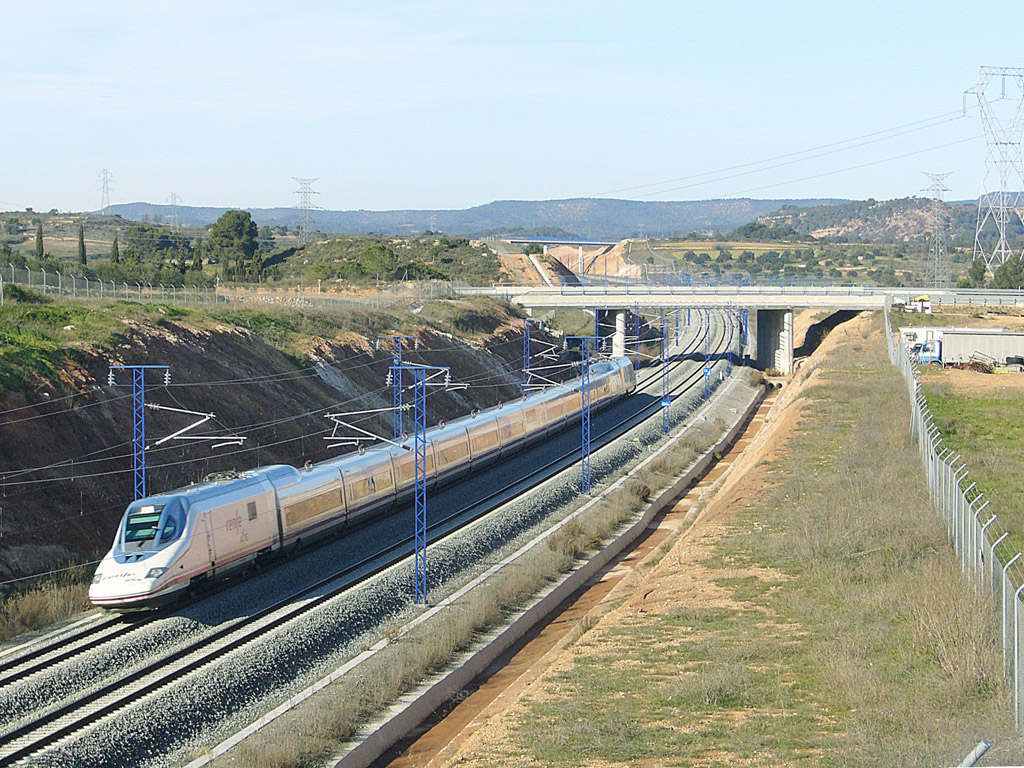
The Renfe Class 102 or S-102 (nicknamed "Pato" in Spanish, because of its nose that looks like the beak of a duck) is a push-pull high-speed train used for the AVE service and operated in Spain by the state-run railway company Renfe, and based on Bombardier Transportation's power car technology. Outside AVE service, Talgo markets this train as the Talgo 350.
Further production of closely related trains, differing in seating arrangement, resulted in the S-112.
The AVE Class 102 was constructed by Talgo with Adtranz (later Bombardier Transportation) providing the power car technology. It was primarily designed for the Madrid-Barcelona line.
The trainsets consist of Talgo passenger cars modified in order to allow speeds of up to 350 km/h (220 mph) with power cars at each end. However, its certified maximum operating speed is 330 km/h (210 mph) due to the limits of its eight 1,000 kW (1,300 hp) motors. The trainsets can consist of up to 12 Talgo series VII coaches.
The train is nicknamed Pato, Spanish for duck, due to the aerodynamic design of the power cars resembling a beak. The beak design reduces noise created by air resistance at top speeds.
The series trains were intended for a top speed of 330 km/h (210 mph). This top speed was supposed to be enough to fulfill the tender condition of a two-and-a-half-hour travel time between Madrid and Barcelona. Experts ascribe this reduction compared to original plans to budgetary reasons, which derive from the strongly increased power requirements at even higher speeds.
Renfe's original order in 2004 was for 16 series units, delivery of which began in 2004. A follow-up order for 30 similar trains to be delivered in 2008-2010 and designated as class 112 (S-112). The first production unit was unveiled in June 2010.
In trials with the prototype unit (later used by track authority ADIF as test train Class 330), on 11 October 2002, 362 km/h (225 mph) was achieved.
Hub AI
Renfe Class 102 AI simulator
(@Renfe Class 102_simulator)
Renfe Class 102
The Renfe Class 102 or S-102 (nicknamed "Pato" in Spanish, because of its nose that looks like the beak of a duck) is a push-pull high-speed train used for the AVE service and operated in Spain by the state-run railway company Renfe, and based on Bombardier Transportation's power car technology. Outside AVE service, Talgo markets this train as the Talgo 350.
Further production of closely related trains, differing in seating arrangement, resulted in the S-112.
The AVE Class 102 was constructed by Talgo with Adtranz (later Bombardier Transportation) providing the power car technology. It was primarily designed for the Madrid-Barcelona line.
The trainsets consist of Talgo passenger cars modified in order to allow speeds of up to 350 km/h (220 mph) with power cars at each end. However, its certified maximum operating speed is 330 km/h (210 mph) due to the limits of its eight 1,000 kW (1,300 hp) motors. The trainsets can consist of up to 12 Talgo series VII coaches.
The train is nicknamed Pato, Spanish for duck, due to the aerodynamic design of the power cars resembling a beak. The beak design reduces noise created by air resistance at top speeds.
The series trains were intended for a top speed of 330 km/h (210 mph). This top speed was supposed to be enough to fulfill the tender condition of a two-and-a-half-hour travel time between Madrid and Barcelona. Experts ascribe this reduction compared to original plans to budgetary reasons, which derive from the strongly increased power requirements at even higher speeds.
Renfe's original order in 2004 was for 16 series units, delivery of which began in 2004. A follow-up order for 30 similar trains to be delivered in 2008-2010 and designated as class 112 (S-112). The first production unit was unveiled in June 2010.
In trials with the prototype unit (later used by track authority ADIF as test train Class 330), on 11 October 2002, 362 km/h (225 mph) was achieved.