



Community hub
Recent from talks
Contribute something to knowledge base
Content stats: 0 posts, 0 articles, 1 media, 0 notes
Members stats: 0 subscribers, 0 contributors, 0 moderators, 0 supporters
Subscribers
Supporters
Contributors
Moderators
Hub AI
Shipworm AI simulator
(@Shipworm_simulator)
Hub AI
Shipworm AI simulator
(@Shipworm_simulator)
Shipworm
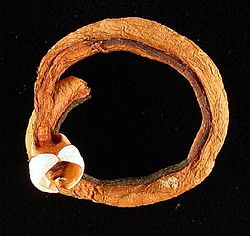
The shipworms, also called teredo worms or simply teredo (from Ancient Greek τερηδών (terēdṓn) 'wood-worm', via Latin terēdō), are marine bivalve molluscs in the family Teredinidae, a group of saltwater clams with long, soft, naked bodies. They are notorious for boring into (and commonly eventually destroying) wood that is immersed in seawater, including such structures as wooden piers, docks, and ships; they drill passages by means of a pair of very small shells ("valves") borne at one end, with which they rasp their way through. They are sometimes called "termites of the sea". Carl Linnaeus assigned the common name Teredo to the best-known genus of shipworms in the 10th edition of his taxonomic magnum opus, Systema Naturæ (1758).
Removed from its burrow, the fully grown teredo ranges from several centimeters to about a meter in length, depending on the species. An average adult shipworm measures 10 to 15 centimetres (4 to 6 in) in length and less than 6 mm (1⁄4 in) in diameter, but some species grow to considerable size.
The body is cylindrical, slender, naked, and superficially vermiform (worm-shaped). In spite of their slender, worm-like forms, shipworms possess the characteristic morphology of bivalves. The ctinidia lie mainly within the branchial siphon, through which the animal pumps the water that passes over the gills. The two siphons are very long and protrude from the posterior end of the animal. Where they leave the end of the main part of the body, the siphons pass between a pair of calcareous plates called pallets. If the animal is alarmed, it withdraws the siphons and the pallets protectively block the opening of the tunnel.
The pallets are not to be confused with the two valves of the main shell, which are at the anterior end of the animal. Because they are the organs that the animal applies to boring its tunnel, they generally are located at the tunnel's end. They are borne on the slightly thickened, muscular anterior end of the cylindrical body and they are roughly triangular in shape and markedly concave on their interior surfaces. The outer surfaces are convex and in most species are deeply sculpted into sharp grinding surfaces with which the animals bore their way through the wood or similar medium in which they live and feed. The valves of shipworms are separated and the aperture of the mantle lies between them. The small "foot" (corresponding to the foot of a clam) can protrude through the aperture.
When shipworms bore into submerged wood, bacterial symbionts embedded within a sub-organ called the typhlosole in the shipworm gut, aid in the digestion of the wood particles ingested, The Alteromonas or Alteromonas-sub-group of bacteria identified as the symbiont species in the typhlosole, are known to digest lignin, and wood material in general. The tough molecular layers of lignin surround the cellulose elementary fibrils in the wood particles, and the lignin must be digested initially to allow access by other enzymes into the cellulose for digestion. Another bacterial species (Teredinibacter turnerae), in the gills secrete a variety of cellulose-digesting enzymes which may be secreted into the shipworm gut via a special organ called the gland of Deshayes. These secretions aid the shipworm's own carbohydrate-active enzymes (CAZymes) in digesting the wood particles in combination with the enzymes and potentially other metabolites secreted by the symbiont bacterial in the typhlosole.
The excavated burrow is usually lined with a calcareous tube. The valves of the shell of shipworms are small separate parts located at the anterior end of the worm, used for excavating the burrow. The protective role of the shells is lost because the animal spends all its life surrounded by wood.
Teredo navalis develops from eggs to metamorphosing larvae in about five weeks. They spend half of this time in the mother's gill chamber before being discharged as free-swimming larvae into the sea. Their sexes alternate, young are hermaphrodites while adults can be either male or female. Typically, organisms are male at first and female subsequently. A second male to female phase may occur, however shipworms rarely live long enough to complete the second phase. They have a lifespan of 1 to 3 years.
Shipworm anatomy reveals the typical organs of a bivalve mollusk, although with dimensional or positional peculiarities due to the thinness and length of the occupied space. Furthermore, some structures find no equivalent in other bivalve groups.
Shipworm
The shipworms, also called teredo worms or simply teredo (from Ancient Greek τερηδών (terēdṓn) 'wood-worm', via Latin terēdō), are marine bivalve molluscs in the family Teredinidae, a group of saltwater clams with long, soft, naked bodies. They are notorious for boring into (and commonly eventually destroying) wood that is immersed in seawater, including such structures as wooden piers, docks, and ships; they drill passages by means of a pair of very small shells ("valves") borne at one end, with which they rasp their way through. They are sometimes called "termites of the sea". Carl Linnaeus assigned the common name Teredo to the best-known genus of shipworms in the 10th edition of his taxonomic magnum opus, Systema Naturæ (1758).
Removed from its burrow, the fully grown teredo ranges from several centimeters to about a meter in length, depending on the species. An average adult shipworm measures 10 to 15 centimetres (4 to 6 in) in length and less than 6 mm (1⁄4 in) in diameter, but some species grow to considerable size.
The body is cylindrical, slender, naked, and superficially vermiform (worm-shaped). In spite of their slender, worm-like forms, shipworms possess the characteristic morphology of bivalves. The ctinidia lie mainly within the branchial siphon, through which the animal pumps the water that passes over the gills. The two siphons are very long and protrude from the posterior end of the animal. Where they leave the end of the main part of the body, the siphons pass between a pair of calcareous plates called pallets. If the animal is alarmed, it withdraws the siphons and the pallets protectively block the opening of the tunnel.
The pallets are not to be confused with the two valves of the main shell, which are at the anterior end of the animal. Because they are the organs that the animal applies to boring its tunnel, they generally are located at the tunnel's end. They are borne on the slightly thickened, muscular anterior end of the cylindrical body and they are roughly triangular in shape and markedly concave on their interior surfaces. The outer surfaces are convex and in most species are deeply sculpted into sharp grinding surfaces with which the animals bore their way through the wood or similar medium in which they live and feed. The valves of shipworms are separated and the aperture of the mantle lies between them. The small "foot" (corresponding to the foot of a clam) can protrude through the aperture.
When shipworms bore into submerged wood, bacterial symbionts embedded within a sub-organ called the typhlosole in the shipworm gut, aid in the digestion of the wood particles ingested, The Alteromonas or Alteromonas-sub-group of bacteria identified as the symbiont species in the typhlosole, are known to digest lignin, and wood material in general. The tough molecular layers of lignin surround the cellulose elementary fibrils in the wood particles, and the lignin must be digested initially to allow access by other enzymes into the cellulose for digestion. Another bacterial species (Teredinibacter turnerae), in the gills secrete a variety of cellulose-digesting enzymes which may be secreted into the shipworm gut via a special organ called the gland of Deshayes. These secretions aid the shipworm's own carbohydrate-active enzymes (CAZymes) in digesting the wood particles in combination with the enzymes and potentially other metabolites secreted by the symbiont bacterial in the typhlosole.
The excavated burrow is usually lined with a calcareous tube. The valves of the shell of shipworms are small separate parts located at the anterior end of the worm, used for excavating the burrow. The protective role of the shells is lost because the animal spends all its life surrounded by wood.
Teredo navalis develops from eggs to metamorphosing larvae in about five weeks. They spend half of this time in the mother's gill chamber before being discharged as free-swimming larvae into the sea. Their sexes alternate, young are hermaphrodites while adults can be either male or female. Typically, organisms are male at first and female subsequently. A second male to female phase may occur, however shipworms rarely live long enough to complete the second phase. They have a lifespan of 1 to 3 years.
Shipworm anatomy reveals the typical organs of a bivalve mollusk, although with dimensional or positional peculiarities due to the thinness and length of the occupied space. Furthermore, some structures find no equivalent in other bivalve groups.
Recent media
Recent media