Hubbry Logo
Tateyama, ChibaTateyama, ChibaMain
Open search
Tateyama, Chiba
Community hub
Tateyama, Chiba
logo
8 pages, 0 posts
0 subscribers
Be the first to start a discussion here.
Tateyama, Chiba
Tateyama, Chiba
from Wikipedia
Tateyama City Hall

Key Information

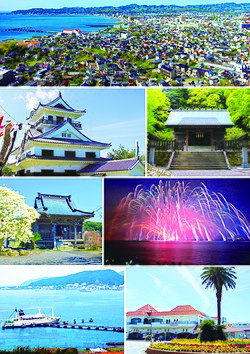
Cape Sunosaki and Tateyama City
Views of Tateyama from Daifuku-ji, 2017

Tateyama (館山市, Tateyama-shi) is a city located in Chiba Prefecture, Japan. As of 1 November 2020, the city had an estimated population of 44,865 in 20,558 households and a population density of 410 persons per km2.[3] The total area of the city is 110.05 square kilometres (42.49 sq mi).

Geography

[edit]

Tateyama is located at the far southern tip of the Bōsō Peninsula, facing the Pacific Ocean to the east and south, and the entrance to Tokyo Bay on the west. It is about 70 kilometers from the prefectural capital at Chiba, and within 70 to 80 kilometers from central Tokyo.

Neighboring municipalities

[edit]

Chiba Prefecture

Climate

[edit]

Tateyama has a humid subtropical climate (Köppen Cfa) characterized by warm summers and cool winters with light to no snowfall. The average annual temperature in Tateyama is 16.2 °C (61.2 °F). The average annual rainfall is 1,845.9 mm (72.67 in) with October as the wettest month. The temperatures are highest on average in August, at around 26.7 °C (80.1 °F), and lowest in January, at around 6.4 °C (43.5 °F).[4]

Climate data for Tateyama (1991−2020 normals, extremes 1968−present)
Month Jan Feb Mar Apr May Jun Jul Aug Sep Oct Nov Dec Year
Record high °C (°F) 23.2
(73.8)
22.7
(72.9)
24.9
(76.8)
26.4
(79.5)
29.7
(85.5)
34.2
(93.6)
36.3
(97.3)
36.6
(97.9)
34.5
(94.1)
30.9
(87.6)
26.2
(79.2)
23.7
(74.7)
36.6
(97.9)
Mean daily maximum °C (°F) 11.3
(52.3)
11.9
(53.4)
14.6
(58.3)
19.0
(66.2)
22.8
(73.0)
25.2
(77.4)
28.9
(84.0)
30.8
(87.4)
27.8
(82.0)
23.0
(73.4)
18.4
(65.1)
13.9
(57.0)
20.6
(69.1)
Daily mean °C (°F) 6.4
(43.5)
7.0
(44.6)
10.1
(50.2)
14.5
(58.1)
18.5
(65.3)
21.5
(70.7)
25.2
(77.4)
26.7
(80.1)
23.7
(74.7)
18.6
(65.5)
13.7
(56.7)
8.9
(48.0)
16.2
(61.2)
Mean daily minimum °C (°F) 1.2
(34.2)
1.8
(35.2)
5.1
(41.2)
9.7
(49.5)
14.5
(58.1)
18.4
(65.1)
22.4
(72.3)
23.7
(74.7)
20.3
(68.5)
14.6
(58.3)
8.9
(48.0)
3.8
(38.8)
12.0
(53.7)
Record low °C (°F) −6.7
(19.9)
−6.5
(20.3)
−5.7
(21.7)
−1.2
(29.8)
4.3
(39.7)
8.5
(47.3)
9.3
(48.7)
15.2
(59.4)
10.0
(50.0)
4.0
(39.2)
−1.5
(29.3)
−6.4
(20.5)
−6.7
(19.9)
Average precipitation mm (inches) 85.9
(3.38)
81.9
(3.22)
160.9
(6.33)
155.7
(6.13)
153.2
(6.03)
211.5
(8.33)
179.2
(7.06)
103.4
(4.07)
222.0
(8.74)
257.5
(10.14)
143.5
(5.65)
91.2
(3.59)
1,845.9
(72.67)
Average snowfall cm (inches) trace 1
(0.4)
0
(0)
0
(0)
0
(0)
0
(0)
0
(0)
0
(0)
0
(0)
0
(0)
0
(0)
0
(0)
1
(0.4)
Average precipitation days (≥ 1.0 mm) 6.4 6.7 10.7 10.1 9.8 11.7 8.9 6.2 10.8 11.2 9.2 6.9 108.6
Average snowy days (≥ 1 cm) 0.1 0.2 0 0 0 0 0 0 0 0 0 0 0.3
Average relative humidity (%) 63 64 68 73 77 83 84 82 81 78 74 67 75
Mean monthly sunshine hours 176.8 155.2 164.5 179.1 185.0 135.3 179.2 216.2 152.5 137.0 146.5 164.0 1,991.7
Source: Japan Meteorological Agency[5][4]

Demographics

[edit]

Per Japanese census data,[6] the population of Tateyama has declined in recent decades.

Historical population
YearPop.±%
1920 45,657—    
1930 48,145+5.4%
1940 46,542−3.3%
1950 59,424+27.7%
1960 57,643−3.0%
1970 55,236−4.2%
1980 56,257+1.8%
1990 54,575−3.0%
2000 51,412−5.8%
2010 49,290−4.1%
2020 45,153−8.4%

History

[edit]

The area of present-day Tateyama was part of ancient Awa Province, dominated by the Satomi clan during the Sengoku period, who ruled from Tateyama Castle. After the Edo period, most of the territory was part of the feudal domain of Tateyama Domain (館山藩, Tateyama-han). After the start of the Meiji period, Tateyama Town (in Awa District), Chiba Prefecture was proclaimed on April 1, 1889 with the creation of the modern municipalities system. Tateyama annexed neighboring Toyosu Village on April 1, 1914, and merged with Hōjō Town to form Tateyamahōjō Town on April 18, 1933.

The city of Tateyama was proclaimed on November 3, 1939, with the merger of Tateyamahōjō with Nago and Funagata towns. The city was a base for the Imperial Japanese Navy Air Service as well as a Naval Gunnery School until the end of World War II. Tateyama expanded on May 3, 1954 by annexing six surrounding villages.

Government

[edit]

Tateyama has a mayor-council form of government with a directly elected mayor and a unicameral city council of 18 members. Tateyama contributes one member to the Chiba Prefectural Assembly. In terms of national politics, the city is part of Chiba 12th district of the lower house of the Diet of Japan.

Economy

[edit]

The economy of Tateyama is based on commercial fishing, horticulture and summer tourism. The population of Tateyama surges during much of the summer. Tateyama is a popular destination for vacationing due to its proximity to Tokyo and its reputation as a "beach" or "surf town". There are numerous resort and holiday hotels dotting the coastline. Every August, tens of thousands of people gather on Hōjō Beach for the annual fireworks display.

Japan's first same-sex reality dating show called The Boyfriend (Japanese: ボーイフレンド, Hepburn: Bōifurendo) was produced by Netflix in Tateyama.[7][8][9]

Education

[edit]

Tateyama has ten public elementary schools and three public middle schools operated by the city government, and three public high schools operated by the Chiba Prefectural Board of Education. The prefecture also operates four special education school for the handicapped. The National Tateyama Maritime Poly-technical School is located in Tateyama.

Transportation

[edit]

Sister cities

[edit]

Local attractions

[edit]

Notable people

[edit]
[edit]

The popular television drama Beach Boys, which originally aired on Japanese television in the summer of 1997, although with a plot set in the Shōnan region, was filmed largely in Tateyama.

Notes

[edit]
[edit]
Revisions and contributorsEdit on WikipediaRead on Wikipedia
from Grokipedia
Tateyama (館山市, Tateyama-shi) is a city located at the southern tip of the in , , approximately 100 km from central . As of the national , it had a population of 45,153 residents across an area of 110.05 square kilometers, yielding a density of about 410 persons per square kilometer. The city enjoys a temperate maritime with an annual average temperature exceeding 16 °C, fostering year-round floral blooms that earn it recognition as a "town of flowers," alongside sandy coastlines influenced by the suitable for , , and diving amid diverse reefs. Its economy centers on commercial fishing—particularly for fresh seafood used in local Bōshū —horticulture, and seasonal drawn to historical landmarks like Tateyama Castle and Awa Shrine, natural parks, and events such as summer fireworks over Tateyama Bay. Historically part of ancient Awa Province under feudal lords like the Satomi clan, Tateyama developed as a resort area leveraging its mild weather and scenic bays, with modern accessibility enhanced by rail and road links to the metropolitan region.

Geography

Topography and Location

Tateyama occupies the southern tip of the Bōsō Peninsula in Chiba Prefecture, Japan, approximately 100 kilometers southeast of Tokyo. The city borders the Pacific Ocean along its southern and eastern coasts and the Uraga Channel, leading to Tokyo Bay, on the west. Its geographic coordinates center around 34.99° N latitude and 139.87° E longitude. The municipality spans 110.05 square kilometers, encompassing diverse terrain from low-lying coastal zones to inland hills. Elevations range from near at 10 meters in coastal areas to a maximum of 300 meters in the interior highlands. The topography includes flat northern farmlands comprising over 50% of the land, which transition southward into steeper slopes and promontories like Cape Sunosaki, shaped by the peninsula's tectonic and erosional . This varied relief supports a mix of agricultural plains and forested uplands, with the coastal fringe featuring bays and headlands conducive to maritime activities.

Climate and Natural Environment

Tateyama exhibits a mild maritime climate influenced by the warm Kuroshio Current, with an annual average temperature exceeding 16 °C. Winters are cool, with January highs averaging 10.6 °C and lows around 3.3 °C, while summers are warm and humid, peaking in August with highs of 29.4 °C and lows of 23.9 °C. Precipitation occurs throughout the year, totaling approximately 1,532 mm annually, with the wettest month being September at 193 mm and the driest January at 64 mm. The natural environment of Tateyama encompasses green hills, expansive fields, and a rugged coastline forming part of the Southern Bōsō Quasi-National Park. Sandy beaches such as Hojo and Heisaura support activities like surfing and diving, while the surrounding waters host over 20 species of reef-building corals, representing the northern extent of such formations in Japan. Flora thrives due to the temperate conditions, featuring seasonal blooms including poppies, rape blossoms in spring, cherry blossoms, azaleas, and camellias prominent in winter and early spring, earning the city its designation as a "town of flowers." Inland areas include preserved woodlands like the 22-hectare Chiba Prefectural Tateyama Wild Bird Forest, which maintains trails and habitats for diverse avian species.

Neighboring Municipalities

Tateyama City shares land borders exclusively with Minamibōsō City to its north, east, and south, forming a compact urban-rural interface within the southern of . This adjacency reflects historical administrative consolidations, as Minamibōsō encompasses former towns and villages that once surrounded Tateyama prior to mergers in 2005 and 2006, which streamlined regional governance while preserving geographic continuity. The shared boundary spans approximately 40 kilometers, facilitating cooperative infrastructure projects such as road networks and emergency services, though Tateyama maintains distinct urban density compared to Minamibōsō's more dispersed agricultural and coastal communities. To the west, Tateyama abuts Tateyama Bay, precluding terrestrial neighbors in that direction, while southern coastal segments directly interface with the , emphasizing the city's peninsular isolation. No cross-prefectural or overseas borders exist, limiting administrative interactions to intra-Chiba collaborations, including joint environmental management of coastal ecosystems and promotion along the shared shoreline. Population flows between the two municipalities are notable, with Minamibōsō residents often relying on Tateyama for commercial and medical facilities, as evidenced by commuting patterns exceeding 20% in recent surveys. This interdependence underscores regional economic ties without formal inter-municipal mergers since Tateyama's last expansion in 1933.

Demographics

As of the 2020 Japanese national , Tateyama City had a recorded of 45,153 residents. This marked a 4.9% decline from the 2015 figure of 47,464, reflecting ongoing demographic contraction typical of rural Japanese municipalities. More recent prefectural data indicate further reduction to 42,267 residents, with a monthly net loss of 48 individuals (-0.11%) as of the latest reported period. Historical trends show Tateyama's population peaking at 59,424 in amid reconstruction, followed by a sharp decline during Japan's high-growth due to out-migration to urban industrial centers. By 1980, the figure had fallen to 56,257, with stabilization giving way to accelerated decrease post-1995 as natural turned negative—births consistently below deaths owing to low fertility and an aging demographic structure. Social factors, including youth exodus for and jobs with limited return migration, have compounded this, yielding a pattern of sustained net loss averaging over 1% annually in recent decades. The following table summarizes key and estimate points:
YearPopulation
195059,424
198056,257
201547,464
202045,153
Latest42,267
Sources: Projections by Japan's National Institute of Population and Social Security Research anticipate further erosion to roughly 35,000 by 2040 and 25,694 by 2060 under medium- assumptions, driven by persistent low birth rates (below replacement level) and demographic aging, where over 30% of residents exceed 65 years old. Local strategies in the 's population vision seek to counteract this through incentives for higher (targeting 2.10 children per woman by 2030) and migration inflows, aiming to stabilize at 30,013, though empirical evidence from similar regions suggests limited efficacy without broader economic revitalization.

Ethnic and Social Composition

Tateyama's population is predominantly ethnically Japanese, with Japanese nationals accounting for 99.4% of residents based on citizenship data from the 2020 census. Foreign residents constitute a small minority of approximately 0.6%, reflecting Japan's overall demographic homogeneity in smaller municipalities like Tateyama, where detailed ethnic breakdowns beyond nationality are not systematically tracked by official statistics. The social composition features a high proportion of elderly individuals, with 41.3% of the population aged 65 or older as of 2020, indicative of rural depopulation trends and low birth rates common in Chiba Prefecture's coastal areas. This aging structure supports -oriented social networks, including local volunteer groups and the Tateyama International Exchange Society, which facilitates limited intercultural activities among residents and a modest focused on exchanges. Socioeconomic homogeneity prevails, with most households engaged in fisheries, , or tourism-related services, fostering tight-knit familial and neighborhood ties rather than pronounced class divisions.

History

Ancient and Feudal Periods

The region encompassing modern Tateyama formed part of ancient Awa Province, with archaeological evidence indicating human activity dating to the (c. 14,000–300 BCE), facilitated by tectonic uplift that exposed former coastal settlements now inland. Shell middens and artifacts from these communities reflect reliance on amid a temperate maritime environment. Transitioning to the (c. 300 BCE–300 CE), wet-rice emerged, as evidenced by skeletal remains from the Sano Cave site in Tateyama, dated through radiocarbon analysis to early Yayoi phases and indicating population continuity with continental influences via migration. Awa Shrine, located near Tateyama, preserves traditions tracing back over three millennia, underscoring early practices tied to local worship in the proto-historic era. During the feudal era, particularly the (1467–1603), the Satomi clan dominated Awa Province, establishing control through naval prowess and alliances after rising from minor origins in the late (1185–1333) as a branch of the Nitta lineage. Satomi Yoshiyori constructed Tateyama Castle in 1580 atop a hill overlooking , serving as a strategic stronghold to defend against incursions and as the clan's final residence, completed amid ongoing conflicts with rivals like the Later Hōjō. The castle's fortifications, including watchtowers and moats, symbolized the clan's autonomy in the until their submission to in the late 16th century.

Edo Period and Meiji Restoration

During the Edo period (1603–1868), the region encompassing modern Tateyama formed the core of Tateyama Domain (Tateyama-han), a minor feudal holding in Awa Province under the Tokugawa shogunate. The domain, assessed at 10,000 koku of rice yield, was classified as fudai—loyal to the shogunate—and administered from an office south of the ruins of Tateyama Castle, which had been dismantled in 1614 following the Satomi clan's loss of favor with Tokugawa Ieyasu. Governance emphasized coastal defense along Tokyo Bay and agricultural oversight, with the area serving as a strategic outpost amid the shogunate's sankin-kōtai system requiring daimyo attendance in Edo. The Inaba clan, a fudai lineage originating from , assumed control of the domain in 1781 under Inaba Masaaki and held it through ten generations until the end of the shogunate. Unlike larger domains, Tateyama's modest scale limited its military and economic influence, focusing instead on local taxation and maritime vigilance; the clan's residence and temple affiliations underscored its integration into the Tokugawa administrative hierarchy. During the era of instability leading to the shogunate's collapse, the Inaba lords navigated pressures from pro-imperial forces, though no major battles or uprisings are recorded in the domain. The of 1868 marked the abrupt end of Tateyama Domain's autonomy, as Emperor Meiji's initiated the abolition of feudal privileges nationwide. In line with the 1871 hanseki hōkan policy, the domain was formally dissolved, converting its lands into prefectural holdings under the new central government. Administrative reorganization culminated in the proclamation of Tateyama Town in Awa District, , on April 1, 1889, establishing modern municipal boundaries through mergers with adjacent villages like . This transition shifted focus from rule to bureaucratic governance, laying groundwork for infrastructural modernization amid Japan's rapid industrialization.

World War II and Military Role

During , Tateyama served as a key hub for the due to its strategic position at the entrance to , facilitating defense of the capital region. The Tateyama Naval Air Squadron, established in 1930 as the fifth operational air corps of the navy, operated from the area until Japan's surrender in 1945, supporting air operations and training. The base hosted various aircraft squadrons and contributed to coastal defense efforts against Allied advances in the Pacific theater. Captain Motoharu Okamura, commander at Tateyama Naval Air Base, proposed the concept of organized suicide attacks by pilots in late 1943 or early 1944, predating the formal program; he advocated using volunteer pilots to crash into enemy ships when conventional missions failed, influencing subsequent tactics amid mounting aircraft losses. This idea gained traction as faced intensified U.S. naval pressure, with Tateyama's facilities aiding in preparations for special attack units, though the base itself was not a primary launch site for late-war operations. Additionally, the Tateyama Naval Gunnery School operated in the city, training naval personnel in and related skills; it functioned through at least early 1945, with records noting officer assignments there as late as February. Following Japan's capitulation on September 2, 1945, U.S. forces secured the installations as part of the occupation; Company L, landed at the same day to relieve Japanese guards and control key facilities. The unit was soon replaced by elements of the on September 3, which maintained occupation duties until deactivation on January 17, 1946. These landings ensured rapid Allied control over the site's airfields and arsenals, preventing potential amid the transition to postwar administration.

Postwar Expansion and Recent Events

Following , Tateyama transitioned its military infrastructure to peacetime uses under Allied occupation, with the former Air Base at Tateyama repurposed as a (JMSDF) facility, evolving into the JMSDF's largest helicopter base by the late 20th century. This shift supported local employment and logistics while demilitarization efforts dismantled wartime fortifications, as documented in postwar exhibitions highlighting the area's role in defenses. Municipal expansion occurred on May 3, 1954, when Tateyama annexed six surrounding villages, increasing its administrative territory and integrating rural agricultural lands into the city's framework. The postwar economic boom facilitated infrastructure improvements, including enhanced rail and road connections via National Route 127 and the Uchibō Line, promoting Tateyama's growth as a southern resort destination focused on fisheries, flower cultivation, and coastal . expanded during Japan's high-growth era (1950s–1970s), reflecting national trends of and , though Tateyama's figures stabilized around 50,000–60,000 residents by the before gradual decline in line with rural depopulation patterns. Local economy diversified beyond agriculture into hospitality, with developments like port expansions at Tateyama Harbor aiding seafood processing and visitor access. In recent decades, Tateyama has faced natural challenges, including severe damage from on September 9, 2019, which caused widespread flooding, infrastructure disruptions, and economic losses estimated in billions of yen across , prompting recovery efforts centered on resilient coastal defenses. initiatives persisted, with annual events like the Tateyama Sea Town Festa emphasizing marine activities and to bolster the sector amid Japan's aging demographics. By 2020, the city's stood at 45,153, underscoring ongoing efforts to mitigate shrinkage through international ties, such as sister-city agreements, and policies.

Government and Administration

Municipal Governance

Tateyama City employs Japan's typical municipal governance model, with a directly elected serving as the executive head responsible for administering city policies and services, supported by appointed officials. The legislative branch consists of a unicameral city council (館山市議会) that deliberates ordinances, approves budgets, and oversees the executive. The city council comprises 18 members, each serving four-year terms, with held periodically to fill all seats. The most recent council took place on April 23, 2023, following the expiration of the prior term on April 30, 2023. As of October 2025, Shoichi Mori serves as , having issued statements on local events such as the cancellation of a traditional event due to safety concerns related to high sea temperatures. In response to ongoing discussions about efficiency amid , the city council installed a special reform committee in March 2025 to examine the fixed number of seats, meeting procedures, and other structural adjustments, with deliberations continuing non-publicly to avoid .

Administrative Divisions and Policies

Tateyama City Hall, located at 1145-1 Hojo, serves as the central administrative facility for the municipality. The city operates under Japan's standard local government framework, featuring an elected mayor responsible for executive administration and a unicameral city assembly that deliberates on ordinances and budgets. Unlike larger metropolitan cities, Tateyama lacks formal wards (ku) and is instead divided into neighborhoods (chō and machi) such as Hojo, Komoguchi, Sakai, and Sakadaru for purposes of local services, postal distribution, and community management. These areas facilitate targeted delivery of public services without hierarchical subdivisions. Key administrative departments include the Crisis Management Department and Citizen Collaboration Division, which coordinate emergency response and public participation initiatives. Local policies prioritize disaster preparedness, providing residents with specialized guides, maps, and support information for events like typhoons. Additionally, the city fosters international relations through sister city partnerships, such as with Bellingham, Washington, to promote cultural exchange and economic ties. Urban planning efforts emphasize sustainable development aligned with Chiba Prefecture's regional goals, focusing on coastal preservation and community resilience amid natural hazards.

Economy

Primary Sectors: Agriculture and Fisheries

Tateyama's agricultural sector centers on and vegetable production, leveraging the warm climate of the southern for diverse crops. Notable outputs include corn varieties prized for raw consumption, , soybeans, , rape blossoms, and summer vegetables such as and bell peppers, as cultivated at farms like Anzai Farm. Tropical fruits, including passion fruit, are also grown commercially, with operations like RYO'S FARM producing fresh fruit and value-added products such as lilikoi butter. The fisheries sector forms a of Tateyama's primary , sustained by proximity to and the Pacific Ocean's nutrient-rich waters influenced by the , enabling year-round operations. The city hosts multiple harbors—Funakata, Tomisaki, Ito, Kawana, Sunosaki, Sakaenoura, Banda, and Hasama—supporting with vessels and fixed-net systems. Traditional methods, deploying over seven large nets, dominate catches, emphasizing immediate quality assessment and icing for freshness to supply local markets and establishments. Key species landed include , , gurnard, , grunt, parrot bass, girella, striped beakfish, , red bigeye, auxis, and sweetlip, contributing to specialties like namerou (minced ) and sanga-yaki (grilled fish patties). This sector underpins a dense concentration of sushi restaurants, claimed to be the highest per capita in , reflecting deep-rooted processing traditions.

Tourism and Hospitality

Tateyama's tourism centers on its coastal landscapes, historical sites, and natural features along the Bōsō Peninsula's southern tip. Key attractions include Shiroyama Park, which features seasonal flowers, panoramic views, a , and a replica of Tateyama Castle. Beaches such as Ōki no Shima draw visitors for swimming and relaxation, noted for their scenic white sands and clear waters. Religious and cultural sites contribute significantly to the appeal, with Awa Jinja shrine offering historical architecture and festivals, and Daifukuji Temple (Gake Kannon) renowned for its cliffside location and panoramic vistas. provides coastal views and hiking opportunities, while nearby features like and flower parks such as Bōsō Flower Line enhance nature-based . The Minato Oasis Nagisanoeki serves as a hub with an aquarium, museum annex, and tourist information, facilitating access to seafood markets and local experiences. Hospitality in Tateyama emphasizes traditional Japanese accommodations, including ryokans with rooms and hot springs like Nansō Shiroyama Onsen Satomi no Yu. Resort hotels such as offer modern amenities alongside garden views and public baths, catering to both domestic and international guests seeking relaxation amid natural surroundings. The sector supports fresh dining and seasonal events, including at Tateyama Port, which attract crowds for evening displays. Options range from family-oriented inns to upscale properties, with emphasis on local cuisine and proximity to attractions.

Industrial Development and Challenges

Tateyama's industrial development has been limited relative to northern , where heavy clusters around , , and machinery. efforts focused on attracting and precision industries to leverage the city's coastal location and proximity to , culminating in the establishment of a fabrication facility in the 1990s. Originally linked to Semiconductor, the plant was acquired by Taiwan's (UMC), operating as UMC Japan with a monthly capacity of 20,000 eight-inch wafers by 2009. This facility briefly positioned Tateyama as a niche player in Japan's sector, employing hundreds and contributing to local economic diversification amid national pushes for high-tech growth. The plant's operations highlighted early successes in cost efficiencies and yield improvements under foreign management, contrasting with broader Japanese industry struggles. However, sustaining such ventures proved challenging due to Japan's high labor and costs, a strong yen eroding competitiveness, and intense global rivalry from lower-cost Asian producers. UMC Japan reported ongoing losses, prompting the fab's suspension in after fulfilling final orders, resulting in its dissolution and liquidation. Broader industrial challenges in Tateyama include demographic decline and geographic isolation from major industrial belts, exacerbating difficulties in attracting new manufacturers. The city's aging population and shrinking workforce mirror national trends, limiting labor availability for capital-intensive sectors. Additionally, vulnerability to —such as the 2011 Tōhoku earthquake's ripple effects on supply chains—has deterred , while the absence of dedicated industrial parks hinders development. These factors have reinforced Tateyama's reliance on , fisheries, and , with remaining underdeveloped despite port expansions aimed at regional since 1953.

Education

Primary and Secondary Education

Tateyama maintains ten public elementary schools under municipal administration, serving for children aged 6 to 12. These schools are: Funagata Elementary School, Nago Elementary School, Hojo Elementary School, Tateyama Elementary School, Tamano Elementary School, Kokonohe Elementary School, Kamiyo Elementary School, Toyofusa Elementary School, Bonan Elementary School, and Yonerai Elementary School. Enrollment varies significantly across these institutions, reflecting rural depopulation trends, with smaller schools like Kamiyo Elementary reporting as few as 19 students across four classes as of recent local data. Secondary education at the junior high level is provided through three public operated by the : Tateyama Junior High , Daiichi Junior High , and Bonan Junior High . Tateyama Junior High, the largest, enrolls approximately 744 students in 26 classes, while Daiichi Junior High has around 173 students. Attendance zones for both elementary and are delineated by the , assigning districts such as Funagata and Kawana to Funagata Elementary and Daiichi Junior High, or central Tateyama areas to Tateyama Elementary and Tateyama Junior High. In response to persistent enrollment declines driven by Japan's low birth rates, the Tateyama City formulated a reorganization plan in November 2024. This initiative targets consolidating the ten elementary schools into four by 2027, with further reduction to three or four thereafter, and merging the three junior high schools into a single institution by 2031. The plan prioritizes maintaining educational quality amid shrinking pupil numbers, which have fallen to levels necessitating multi-grade classes in some rural elementary schools.

Higher Education and Vocational Training

Tateyama hosts no four-year universities or junior colleges, with local residents often commuting to institutions in Chiba City, such as Chiba University, or further to Tokyo for undergraduate and graduate studies. Post-secondary education emphasizes vocational specialized training colleges (senmon gakko), which in Japan function as higher education equivalents for practical skills development, particularly in healthcare and maritime sectors aligned with the city's coastal economy and aging population. The Anbo Medical Welfare Specialized School (安房医療福祉専門学校), situated in the Kosigoe district, delivers a three-year program targeting individuals seeking certification as licensed practical nurses or registered nurses upon completion and national exams. Established to address regional healthcare demands, it enrolls students post-high school graduation or equivalent, with curricula integrating clinical practice, anatomy, and patient care fundamentals. Vocational maritime training occurs at the National Tateyama Maritime Technical School (国立館山海上技術学校), operated by the Independent Administrative Agency for Maritime Education under the Ministry of Land, Infrastructure, Transport and Tourism. Aimed at junior high graduates, its three-year curriculum mirrors high school general while specializing in and , yielding high school equivalency credentials alongside entry-level sea technician licenses (e.g., for officers or engine crew). Practical components include onboard training via affiliated vessels, fostering skills for commercial shipping and fisheries support roles. Enrollment stands at approximately 104 students as of , with most residing in on-campus dormitories. However, the institution suspended new admissions for 2026 onward and will cease operations by September 2028, citing chronic shortages of qualified instructors.

Transportation

Railway Networks

The primary railway serving Tateyama is the Uchibō Line, operated by the East Japan Railway Company (JR East). This line connects Soga Station in Chiba City to Awa-Kamogawa Station in Kamogawa, facilitating regional travel along the western shore of the Bōsō Peninsula. Tateyama City features three stations on the Uchibō Line: Kokonoe Station, Tateyama Station, and Nakofunakata Station, with these positioned sequentially from north to south along the route. Tateyama Station functions as the city's main rail hub, accommodating local, rapid, and trains, including the Sazanami service that originates from via transfers at Soga or Chiba Stations. Travel time from central to Tateyama Station typically requires about two hours with a transfer and costs around 2,600 yen one way. The station has been designated as one of the 100 most beautiful stations in the Kanto region due to its scenic integration with the surrounding landscape. Kokonoe and Nakofunakata Stations primarily handle local traffic, supporting commuter and tourist access to nearby coastal areas. No lines or additional networks operate within Tateyama, making the JR Uchibō Line the sole rail connection for the city. Daily services include inbound trains toward Chiba and , and outbound toward Awa-Kamogawa, with timetables varying by weekday and weekend.

Highways and Roads

The Tateyama Expressway (E14) serves as the main expressway route providing access to Tateyama from northern and the area, operated by the East Nippon Expressway Company. It links with the Keiyō Road and includes interchanges such as Futtsu Chuo IC and Futtsu Takeoka IC, facilitating efficient travel across the . The Futtsu-Tateyama Road, a two-lane under the national highway system, connects Futtsu to Tomiura near Tateyama, spanning approximately 19 km and incorporating segments like the Futtsu Takeoka IC to Tomiura IC with a length of about 9.2 km subject to maintenance closures. This road enhances connectivity from the Tokyo-Wan Ferry terminals and reduces travel time to the city center. National Route 127 originates in central Tateyama and extends northward to over 74 km, with its northern portion developed as the toll Futtsu-Tateyama Road to alleviate congestion in areas like Kawana in Tateyama. The route supports local traffic and along the western coast, though sections in Tateyama experience driver-unfriendly conditions addressed by ongoing Ministry of Land, Infrastructure, Transport and projects. National Route 128 begins in Tateyama and proceeds to Chūō-ku in Chiba City, serving as an east-west corridor across the peninsula. National Route 410 links Tateyama southward initially before heading north to Kisarazu, providing alternative access for regional travel. These national routes intersect in Tateyama, forming a network that integrates with local prefectural roads for intra-city movement.

Ports, Airports, and Military Air Facilities

Tateyama Port, located at 1564-1 Chisaki in the city, functions primarily as a regional terminal, cruise ship docking facility, and fishing harbor, supporting maritime transport across and to nearby islands. It handles ferries operated by companies such as Tokai Kisen, connecting to destinations like the , with associated parking and tourism infrastructure including the Arai-kaigan lot. Coastal enhancements completed in 1993 added a , , and promenade to facilitate access and port operations. The port also features the 500-meter-long Tateyama Yuhi Pier, Japan's longest, which accommodates seasonal vessel traffic and recreational activities. Tateyama has no civilian airports within ; the nearest major facilities are Tokyo Haneda Airport, approximately 62 km away, and , about 99 km distant, both accessible via rail or bus connections from Tateyama Station. The JMSDF Tateyama (ICAO: RJTE), situated outside the city in , serves as a aerodrome exclusively for the , functioning as its largest helicopter base since its establishment by the in 1930. It hosts Fleet Air Wing 21, commanded from the base, and operates units equipped with SH-60J and SH-60K helicopters. The facility supports JMSDF training and operations but is not available for civilian aviation.

Military Significance

Historical Naval Air Base

The Tateyama Naval Air Station was completed in June 1930 by the Imperial Japanese Navy as a base for the Tateyama Naval Air Squadron, designated as the fifth operational air corps tasked with patrolling the eastern Japanese coastline. The squadron's primary facilities were situated between Kouyatsu and Numa districts, with logistical support from the adjacent Tateyama Naval Aviation Arsenal, which handled aircraft repairs and equipment maintenance, and the Yokosuka Navy Ordnance Corps Tateyama Warehouse, responsible for provisioning fuel, food, clothing, and other essentials. In June 1941, the Tateyama Naval Gunnery School was established in the Sano area of Tateyama City to provide specialized training in aerial gunnery techniques and landing force operations for naval aviators. This facility enhanced the base's role in developing proficient combat crews amid escalating regional tensions leading into . By 1943, as wartime demands intensified, the Sunosaki Naval Air Squadron was formed adjacent to the main base, between Kasana and Ooka, focusing on the maintenance and testing of aircraft weaponry, including firing mechanisms, bombing systems, radio equipment, photographic reconnaissance tools, torpedoes, and early radar installations. The station remained operational for training and defensive patrols until Japan's surrender in August 1945, hosting various kōkūtai (air groups) under the Naval District for coastal defense of . Defensive infrastructure included the Akayama Underground Tunnels, with construction likely initiated around 1935 or post-1942, designed as air-raid shelters for command operations, telegraph communications, and medical facilities; these extended approximately 1.6 kilometers but remained incomplete by August 15, 1945. Complementing aerial assets, fixed coastal batteries such as Sunosaki No. 1 (completed 1932) and No. 2 (1927), along with Taibusa Misaki (1932), fortified the area against naval threats to .

World War II Operations and Tunnels

The Tateyama Naval Air Squadron, formed in 1930 as the Imperial Japanese Navy's fifth operational air corps within the Naval District, functioned as a primary hub for through until Japan's capitulation on August 15, 1945. The facility encompassed the Tateyama Naval Aviation Arsenal for aircraft repairs and equipment handling, alongside warehouses managed by the Navy Ordnance Corps for storing essentials such as fuel, food, and munitions, supporting defensive aerial operations amid escalating Pacific Theater conflicts. As raids intensified, particularly by American forces nearing the war's close, the squadron constructed the Akayama Underground Tunnels to shield personnel and assets from bombings. Construction commenced likely after —potentially involving direct labor from squadron members—and persisted unfinished until the 1945 surrender, yielding a 1.6-kilometer network of passages, some 5 to 10 meters wide, which exceeded typical dimensions elsewhere in . Equipped with a power generator, telegraph rooms, and medical provisions based on survivor accounts, the tunnels ranked among the nation's largest extant air-raid complexes, reflecting urgent defensive adaptations at Bay's gateway. These subterranean defenses highlighted the base's vulnerability to aerial assaults, enabling continuity of command and support functions underground while surface operations faced disruption. Following the war, U.S. occupation forces secured the site in September 1945, transitioning its legacy to postwar use, with the tunnels preserved and accessible to visitors since April 1, 2004, along a 250-meter route.

Current JMSDF Installations

The primary JMSDF installation in Tateyama is the , located in Miyagi Mubanchi, Tateyama-shi, , which functions as a military specializing in rotary-wing operations. This base, repurposed from the pre-1945 Tateyama Naval Air Squadron facility established in 1930, now hosts the headquarters of the 21st Fleet Air Wing (第21航空群), responsible for coordinating (ASW), maritime patrol, surveillance, and search-and-rescue missions across multiple detachments including Maizuru, Ōminato, and Iōjima. The 21st Fleet Air Wing operates squadrons equipped with SH-60J and upgraded SH-60K helicopters, configured for shipborne and shore-based ASW roles with , torpedoes, and dipping capabilities to detect and engage . Key units at Tateyama include the 21st Fleet Air Squadron and supporting flights such as the 212th, focusing on tactical deployments in support of JMSDF fleet operations in the surrounding seas. These assets contribute to Japan's maritime defense posture, emphasizing coastal and open-ocean threat neutralization amid regional proliferation. The base supports ongoing training, including exercises with local authorities; for instance, on September 19, 2025, it served as the main venue for the 46th Nine Prefectures and Cities Disaster Prevention simulating large-scale earthquakes. Public outreach includes base tours and recruitment events, reflecting its integration into community defense preparedness. No other active JMSDF ground or surface facilities are documented in Tateyama as of October 2025.

Culture and Attractions

Historical and Cultural Sites

Tateyama Castle, perched atop Shiroyama Hill at 66 meters above , was originally constructed in 1580 by the Satomi Yoshiyasu to defend the entrance to . The fortress served as the residence for the Satomi clan during the but was dismantled in 1614 after the clan lost favor with the . A concrete reconstruction from the modern era now functions as the Hakkenden Museum, displaying artifacts and exhibits on the Satomi clan's history, including references to the legendary epic . The site offers panoramic views of the surrounding countryside and . Awa Shrine, located at the southern extremity of the Bōsō Peninsula in Daijingū, traces its origins to over 2,000 years ago per traditional accounts, enshrining deities credited with establishing key Japanese industries such as fishing, agriculture, and sericulture. Designated as one of Japan's three principal shrines for financial fortune, it attracts visitors seeking prosperity blessings and features a straight approach path lined with approximately 200 cherry trees. The shrine's grounds include facilities for ritual purifications using sacred water and sand. Awa Kokubun-ji represents the remnants of a Nara-period provincial complex, established in the as part of Emperor Shōmu's national temple system to promote across provinces. The site preserves stone foundations (soseki) from its original halls, marking it as a designated historic location tied to early state-sponsored religious architecture in the region. The Tateyama City Municipal Museum, situated within Shiroyama Park near the castle ruins, functions as a history and folklore institution built upon traces of the Satomi clan's Warring States-era stronghold. Its collections span local artifacts from prehistoric times through the , with permanent exhibits distributed across two floors emphasizing regional heritage.

Natural and Recreational Attractions

Tateyama's natural attractions arise from its location at the southern tip of the , where converges with the , supported by the warm that moderates the climate and promotes lush coastal vegetation and biodiversity. The area features beaches, capes, islands, and parks suited for , including , , and water sports. Hojo Beach and Heisaura Beach provide sandy shores for swimming, sunbathing, and beachcombing, drawing visitors especially from June to September when water temperatures rise. These sites benefit from calm bays protected from open ocean swells, enabling activities like and . Oki no Shima, an uninhabited offshore island designated within the Minami-Bōsō Quasi-National Park, preserves dense forests, rocky shores, and endemic flora untouched by development, accessible via seasonal boat tours for and nature observation. Cape Sunosaki features rugged cliffs, a historic established in , and migratory habitats, offering trails for scenic walks with views of the Pacific and seasonal wildflowers. Shiroyama Park encompasses hillsides with walking paths amid seasonal blooms—narcissuses in winter, cherry blossoms in early , azaleas and camellias in spring, and hydrangeas in summer—alongside spots and panoramas of Tateyama Bay and on clear days. The Tateyama Forest of Wild Birds serves as a for observing over 100 of local and passing avifauna in a wooded reserve, with maintained paths for quiet strolls year-round. Recreational pursuits include on rented bicycles (700 yen for 2 hours from Tateyama Station) along coastal routes and parks, in areas like Daifuku-ji Temple's cliffside paths overlooking the , and seasonal picking at nearby orchards from early May to mid-December.

Local Festivals and Traditions

Tateyama's local festivals emphasize Shinto rituals, historical reenactments, and community celebrations tied to agriculture, maritime heritage, and seasonal changes. The Yawata Festival, known as Yawatanmachi, occurs on the first weekend after September 14 at Tsurugaoka Hachiman Shrine in central Tateyama, featuring processions of 11 portable shrines (mikoshi), four large floats, and a ceremonial boat, drawing approximately 100,000 attendees annually. This event, with origins exceeding 1,000 years, was designated an Intangible Cultural Property of Chiba Prefecture in 2004 and represents the largest festival in the Awa region. The Minamiboso Satomi Festival, held in October, recreates episodes from the historical Nanso Satomi clan era through parades with participants in armor, horseback archery demonstrations, and theatrical performances at sites like Aoki Castle ruins. First organized in 1972 to preserve local feudal , it now occurs annually as a key cultural event promoting Tateyama's legacy. Awa Shrine, the principal shrine of former Awa Province located in Tateyama, holds its main annual festival on August 10, involving rituals honoring the enshrined deities and community gatherings that underscore the site's role as a spiritual center with ancient roots. Traditional practices include the Toyofusa lion dance in July, where children don feathered lion heads and colorful headdresses to perform dances praying for rainfall and bountiful harvests, preserving pre-modern agrarian customs. Contemporary festivals blend tradition with spectacle, such as the Tateyama Bay Fireworks Festival on August 8, launching about 3,000 from barges in the port from 7:30 to 8:30 p.m., attracting crowds in attire to bayside viewing areas. The Merasaki Festival, on the third weekend of July in Mera district, features vigorous carrying by local men in a display of physical prowess and communal bonding, echoing historical vitality rites. These events maintain Tateyama's cultural continuity amid its coastal setting, with no evidence of significant deviations from empirical historical records in official accounts.

International Relations

Sister City Agreements

Tateyama maintains formal sister city agreements with two international partners, fostering cultural, educational, and economic exchanges. The city's relationship with , , was established on July 11, 1958, marking it as the ninth such agreement between a Japanese municipality and a U.S. counterpart at the national level. This partnership has endured for over six decades, supporting initiatives such as student exchanges, cultural delegations, and commemorative events, including a 60th anniversary celebration in 2018 that featured a 20-member delegation from Tateyama. In addition, Tateyama formalized a sister city agreement with Port Stephens, New South Wales, Australia, on November 2, 2009, upgrading a prior friendship city arrangement initiated in 1999. This collaboration emphasizes mutual visits, tourism promotion, and community-level interactions, with reciprocal tours documented between the regions to strengthen bilateral ties. No other active international sister city pacts are recorded for Tateyama as of the latest available municipal data.

Broader International Ties

Tateyama fosters broader international connections through the Tateyama International Exchange Society (TIES), a citizen-led organization established in to promote cultural and linguistic exchanges with foreign residents and visitors. TIES operates via six specialized committees, including those focused on language workshops—held monthly with participants from diverse nationalities—and arrangements that facilitate immersive experiences for short-term visitors. Cultural activities organized by TIES emphasize mutual learning, such as sessions for preschoolers, demonstrations of traditional Japanese arts like tea ceremony, flower arrangement, and paper doll crafting, alongside welcome and farewell events for foreign assistant language teachers (ALTs) under national programs. The society's General Planning Committee issues the "TIES LETTER" newsletter and coordinates events to sustain these interactions. TIES also engages in multilateral initiatives, notably supporting Tateyama's involvement in the biennial Pacific Rim Regatta, a racing event linking the city with international ports including Port Stephens (), Tauranga (), Victoria (), and Nakhodka (). In 2014, TIES hosted a public lecture featuring a speaker with experience in the (JICA), highlighting local interest in global development efforts. These efforts complement national frameworks but remain centered on community-level engagement rather than formal diplomatic channels.

Notable People

Historical Figures

Satomi Yoshiyasu, a of the Satomi clan during the late Sengoku and early periods, constructed Tateyama Castle in the late 1580s, completing it by 1590 as the clan's primary residence in Awa Province. This fortification served as a strategic base amid the clan's efforts to consolidate control over the Bōsō Peninsula's southern tip following territorial losses to rivals like the . The Satomi clan, under leaders like Yoshiyasu, governed the Tateyama region and broader Awa Province for approximately 170 years across 10 generations, fostering local development during a turbulent era marked by warfare and shifting alliances. Their rule ended with the transition to Tokugawa authority in the early 17th century, after which the domain saw intermittent control before reassignment to fudai clans. The clan's legacy endures in local historiography, exemplified by the Tateyama City Municipal Museum's exhibits on their administration and the fictionalized narrative inspired by their exploits.

Modern Residents and Contributors

Yoshiki Hayashi, known professionally as Yoshiki, was born on November 20, 1965, in Tateyama, Chiba Prefecture. A prominent musician, composer, record producer, and drummer, he founded the rock band in 1982, which achieved significant commercial success in during the late and early with albums selling millions of copies. Beyond rock, Yoshiki has composed classical works, including symphonic pieces performed by major orchestras, and established in 1986 to promote independent artists. His contributions extend to and , with proceeds from events supporting disaster relief efforts in . Ryōta Ozawa, born on January 25, 1988, in Tateyama, Chiba Prefecture, is a Japanese actor recognized for his lead role as Captain Marvelous in the 2011 Super Sentai series , which aired on and spawned films and merchandise. Ozawa debuted in 2008 and has appeared in subsequent productions, stage plays, and television dramas, including crossovers with franchises. His work in the genre has contributed to the enduring popularity of , a franchise that began in 1975 and influences international adaptations like . Tetsurō Sagawa (1937–2021), born on January 22, 1937, in Tateyama, Chiba Prefecture, was an and voice actor whose career spanned over five decades. He gained prominence for portraying Captain Goro Ryu in the 1972–1973 series , part of ' long-running Ultraman franchise. Sagawa also provided voice work for anime and dubbed foreign films, appearing in titles like Golgo 13: The Professional (1983), and continued acting into the 2010s, including guest roles in modern dramas.

Literature and Film References

Nansō Satomi Hakkenden, an epic yomihon novel by Kyokutei Bakin serialized between 1814 and 1842, is set in the historical Satomi clan's domain encompassing Tateyama and surrounding areas of Awa Province, drawing on local and lore to depict the quests of eight dog-warriors descended from a divine union. The narrative romanticizes the region's feudal history, with Tateyama Castle serving as a key site associated with the Satomi lords, influencing local cultural identity as preserved in the Hakkenden Museum housed there. The novel has inspired over 30 film adaptations since the silent era, including multiple live-action and versions that reference or depict Tateyama-linked settings, such as the 1937 Satomi directed by Mizutani Kenji and various dramas. In modern cinema, Tateyama has served as a filming location for Trapezium (2021), a drama about high school track athletes directed by Shunichi , with scenes shot at Tateyama Station to capture coastal suburban atmospheres. Other productions include Kasane (2018), a fantasy thriller adapted from a , and Akai kujira to shiroi hebi (The Red Whale and the White Snake), both utilizing the city's beaches and ports for exterior shots.

Media Depictions and Influence

Tateyama has been featured in Japanese television dramas that emphasize its coastal scenery and relaxed seaside lifestyle. The 1997 Fuji Television drama Beach Boys, starring and , depicts young protagonists escaping urban stress to work at a beachside minshuku (family-run guesthouse) in a fictional Shōnan-inspired town, with principal filming at Mera Beach and the Diamond Head guesthouse in Tateyama. The series portrays Tateyama's beaches as idyllic retreats fostering personal growth and camaraderie, contrasting Tokyo's pressures with simple, sunlit existence. Its high ratings—averaging 18.9% in key demographics—contributed to sustained local interest, transforming filming sites into tourist draws that highlight the area's azure waters and sandy coves. More recently, Netflix's 2023 reality series The Boyfriend, Japan's first same-sex dating program hosted by , was filmed exclusively in Tateyama's southern coastal zones, including Stay Ocean Tateyama as the "Green Room" residence and nearby sites like Roadside Station Chikura Seabreeze Kingdom for dates. The show captures Tateyama's serene promenades, lighthouses, and eateries as backdrops for budding relationships, presenting the city as a tranquil, photogenic haven conducive to introspection amid Pacific vistas. Released globally on July 9, 2024, it garnered international viewership, spotlighting Tateyama's lesser-known beaches and potentially elevating its profile among LGBTQ+ travelers and enthusiasts seeking authentic rural escapes. In film, the 2024 Trapezium, directed by Masahiro Shinohara and based on Kazumi Takayama's novel, incorporates Tateyama Station as a key transit point in the story of aspiring idols navigating Chiba Prefecture's landscapes. This depiction underscores Tateyama's role as a floral, accessible gateway to adventures, with the station adorned in seasonal blooms to evoke youthful ambition against suburban backdrops. Earlier works, such as the 2018 live-action Kasane and 2006's Akai kujira to shiroi hebi, utilized Tateyama's terrains for dramatic sequences, reinforcing its utility as a versatile filming locale blending natural beauty with narrative isolation. These portrayals collectively shape Tateyama's media image as a quintessential Japanese beach destination—evoking nostalgia for Beach Boys' escapist vibe while modern entries like The Boyfriend promote its contemporary allure for diverse audiences. Japanese media's tourism impact, evidenced by location-based pilgrimages, suggests such depictions drive seasonal visits to sites like Mera Beach, though quantifiable boosts remain anecdotal amid broader Chiba inflows.

References

Add your contribution
Related Hubs
User Avatar
No comments yet.