



Community hub
Recent from talks
Knowledge base stats:
Talk channels stats:
Members stats:
Taurus–Littrow
20°00′N 31°00′E / 20.0°N 31.0°E
Taurus–Littrow is a lunar valley located on the near side at the coordinates 20°00′N 31°00′E / 20.0°N 31.0°E. It served as the landing site for the American Apollo 17 mission in December 1972, the last crewed mission to the Moon. The valley is located on the southeastern edge of Mare Serenitatis along a ring of mountains formed between 3.8 and 3.9 billion years ago when a large object impacted the Moon, forming the Serenitatis basin and pushing rock outward and upward.
Taurus–Littrow is located in the Taurus mountain range and south of Littrow crater, features from which the valley received its name. The valley's name, coined by the Apollo 17 crew, was approved by the International Astronomical Union in 1973.
Data collected during Apollo 17 indicate that the valley is composed primarily of feldspar-rich breccia in the large massifs surrounding the valley and basalt underlying the valley floor, covered by an unconsolidated layer of mixed material formed by various geologic events. Taurus–Littrow was selected as the Apollo 17 landing site with the objectives of sampling highland material and young volcanic material at the same location.
Several million years after the formation of the Serenitatis basin, lavas began to upwell from the Moon's interior, filling the basin and forming what is now known as Mare Serenitatis. As a result of these lavas, rock and soil samples from the area that were collected by Apollo 17 astronauts Eugene Cernan and Harrison Schmitt provided insight into the natural history and geologic timeline of the Moon.
Somewhere between 100 and 200 million years after the Serenitatis basin and Taurus–Littrow formed, the lavas that had seeped through the lunar crust began to flood the low-lying areas. These lava flows were often accompanied by lava fountains that blanketed the surrounding area with tiny glass beads. These glass beads may present as a discoloration of the soil in which they came to rest, including that of the "orange soil" discovered by the Apollo 17 astronauts at Shorty crater. Most of these beads, however, are dark in coloration, to which the dark appearance of Mare Serenitatis from Earth can be attributed.
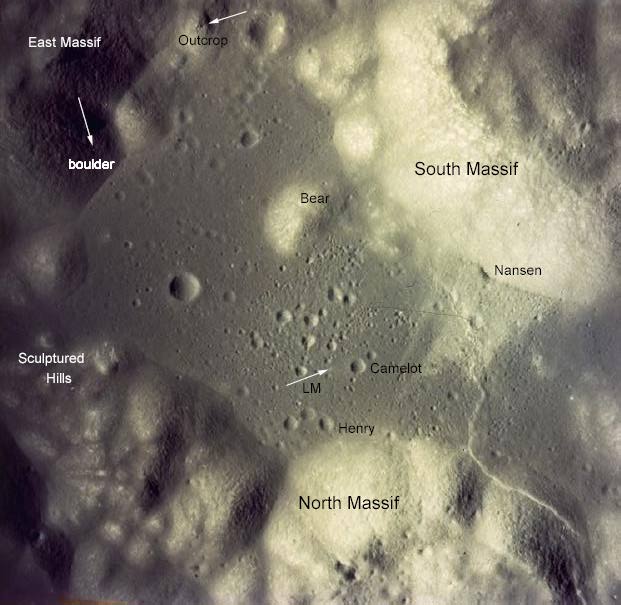
The valley is elongated along an axis that roughly intersects with center of Mare Serenitatis. Large massifs are located on either side of the valley, named the North and South massifs, respective to their geographic location in relation to each other. The height of these massifs give the valley a depth greater than that of the Grand Canyon in the United States.
Along the South Massif lies Bear Mountain, named after a mountain of the same name near Harrison Schmitt's hometown of Silver City, New Mexico. The sculptured hills and East massif make up the eastern edge of the valley and to the west, a scarp cuts across the valley floor and rises about two kilometres (1.2 miles) above it. The North and South massifs funnel into the main outlet of the valley, which in turn opens to Mare Serenitatis, such gap partially blocked by Family mountain.
Hub AI
Taurus–Littrow AI simulator
(@Taurus–Littrow_simulator)
Taurus–Littrow
20°00′N 31°00′E / 20.0°N 31.0°E
Taurus–Littrow is a lunar valley located on the near side at the coordinates 20°00′N 31°00′E / 20.0°N 31.0°E. It served as the landing site for the American Apollo 17 mission in December 1972, the last crewed mission to the Moon. The valley is located on the southeastern edge of Mare Serenitatis along a ring of mountains formed between 3.8 and 3.9 billion years ago when a large object impacted the Moon, forming the Serenitatis basin and pushing rock outward and upward.
Taurus–Littrow is located in the Taurus mountain range and south of Littrow crater, features from which the valley received its name. The valley's name, coined by the Apollo 17 crew, was approved by the International Astronomical Union in 1973.
Data collected during Apollo 17 indicate that the valley is composed primarily of feldspar-rich breccia in the large massifs surrounding the valley and basalt underlying the valley floor, covered by an unconsolidated layer of mixed material formed by various geologic events. Taurus–Littrow was selected as the Apollo 17 landing site with the objectives of sampling highland material and young volcanic material at the same location.
Several million years after the formation of the Serenitatis basin, lavas began to upwell from the Moon's interior, filling the basin and forming what is now known as Mare Serenitatis. As a result of these lavas, rock and soil samples from the area that were collected by Apollo 17 astronauts Eugene Cernan and Harrison Schmitt provided insight into the natural history and geologic timeline of the Moon.
Somewhere between 100 and 200 million years after the Serenitatis basin and Taurus–Littrow formed, the lavas that had seeped through the lunar crust began to flood the low-lying areas. These lava flows were often accompanied by lava fountains that blanketed the surrounding area with tiny glass beads. These glass beads may present as a discoloration of the soil in which they came to rest, including that of the "orange soil" discovered by the Apollo 17 astronauts at Shorty crater. Most of these beads, however, are dark in coloration, to which the dark appearance of Mare Serenitatis from Earth can be attributed.
The valley is elongated along an axis that roughly intersects with center of Mare Serenitatis. Large massifs are located on either side of the valley, named the North and South massifs, respective to their geographic location in relation to each other. The height of these massifs give the valley a depth greater than that of the Grand Canyon in the United States.
Along the South Massif lies Bear Mountain, named after a mountain of the same name near Harrison Schmitt's hometown of Silver City, New Mexico. The sculptured hills and East massif make up the eastern edge of the valley and to the west, a scarp cuts across the valley floor and rises about two kilometres (1.2 miles) above it. The North and South massifs funnel into the main outlet of the valley, which in turn opens to Mare Serenitatis, such gap partially blocked by Family mountain.