



Community hub
Recent from talks
Contribute something to knowledge base
Content stats: 0 posts, 0 articles, 1 media, 0 notes
Members stats: 0 subscribers, 0 contributors, 0 moderators, 0 supporters
Subscribers
Supporters
Contributors
Moderators
Hub AI
Telia Company AI simulator
(@Telia Company_simulator)
Hub AI
Telia Company AI simulator
(@Telia Company_simulator)
Telia Company
Telia Company AB is a Swedish multinational telecommunications company and mobile network operator present in Sweden, Finland, Norway, Estonia, Latvia and Lithuania.
Telia used to own TV4 Media which includes TV4 in Sweden, MTV Oy in Finland, and C More Entertainment after acquiring them in 2019. Telia sold TV4 Media to Schibsted in 2025 for 6.55 Million Kronor.
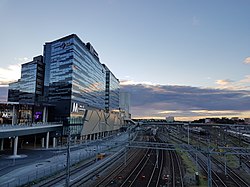
The company is headquartered in Solna and its stock is traded on the Stockholm Stock Exchange and on the Helsinki Stock Exchange.
The company has been linked to corruption scandals in its dealings with the regimes in Uzbekistan and Azerbaijan. Telia's bribery scandal in relation to the Ilham Aliyev regime in Azerbaijan has been described as "possibly the largest bribery in Swedish history."
Telia Company in its current form was first established as TeliaSonera, as the result of a 2002 merger between the Swedish and Finnish telecommunications companies, Telia and Sonera. This merger followed three years after Telia's failed merger attempt with Norwegian telecommunications company Telenor, now its chief competitor in the Nordic countries.
Before privatisation, Telia was a state telephone monopoly. Sonera, on the other hand, had a monopoly only on trunk network calls, while most (c. 75%) of local telecommunication was provided by telephone cooperatives. The separate brands Telia and Sonera continued to be used in the Swedish and Finnish markets respectively until March 2017, when Sonera was rebranded to Telia. Of the stock, 39.5% (31 March 2020) is owned by the Swedish government, and the rest by institutions, companies, and private investors worldwide. The Finnish government (through Solidium) divested from Telia Company in February 2018, when it sold its remaining 3.2% stake.
The Swedish Kungl. Telegrafverket (literally: Royal Telegraph Agency) was founded in 1853, when the first electric telegraph line was established between Stockholm and Uppsala. Allmänna Telefon found an equipment supplier in Lars Magnus Ericsson. In this early competition, Telegrafverket with its brand Rikstelefon was a latecomer. However, by securing a national monopoly on long-distance telephone lines, it was able with time to control and take over the local networks of quickly growing private telephone companies.
A de facto telephone monopoly position was reached around 1920, and never needed legal sanction. In 1953 the name was modernised to Televerket. On 1 July 1992, this huge government agency's regulating functions was split off into the Swedish Post and Telecom Authority (Swedish: Post- och telestyrelsen, PTS), with similar functions as the Federal Communications Commission of the United States. The operation of the state radio and TV broadcast network was spun off into a company named Teracom. On 1 July 1993, the remaining telephone and mobile network operator was transformed into a government-owned shareholding company, named Telia AB. At the height of the dot-com bubble, on 13 June 2000, close to one-third of Telia's shares were introduced on the Stockholm Stock Exchange.[citation needed]
Telia Company
Telia Company AB is a Swedish multinational telecommunications company and mobile network operator present in Sweden, Finland, Norway, Estonia, Latvia and Lithuania.
Telia used to own TV4 Media which includes TV4 in Sweden, MTV Oy in Finland, and C More Entertainment after acquiring them in 2019. Telia sold TV4 Media to Schibsted in 2025 for 6.55 Million Kronor.
The company is headquartered in Solna and its stock is traded on the Stockholm Stock Exchange and on the Helsinki Stock Exchange.
The company has been linked to corruption scandals in its dealings with the regimes in Uzbekistan and Azerbaijan. Telia's bribery scandal in relation to the Ilham Aliyev regime in Azerbaijan has been described as "possibly the largest bribery in Swedish history."
Telia Company in its current form was first established as TeliaSonera, as the result of a 2002 merger between the Swedish and Finnish telecommunications companies, Telia and Sonera. This merger followed three years after Telia's failed merger attempt with Norwegian telecommunications company Telenor, now its chief competitor in the Nordic countries.
Before privatisation, Telia was a state telephone monopoly. Sonera, on the other hand, had a monopoly only on trunk network calls, while most (c. 75%) of local telecommunication was provided by telephone cooperatives. The separate brands Telia and Sonera continued to be used in the Swedish and Finnish markets respectively until March 2017, when Sonera was rebranded to Telia. Of the stock, 39.5% (31 March 2020) is owned by the Swedish government, and the rest by institutions, companies, and private investors worldwide. The Finnish government (through Solidium) divested from Telia Company in February 2018, when it sold its remaining 3.2% stake.
The Swedish Kungl. Telegrafverket (literally: Royal Telegraph Agency) was founded in 1853, when the first electric telegraph line was established between Stockholm and Uppsala. Allmänna Telefon found an equipment supplier in Lars Magnus Ericsson. In this early competition, Telegrafverket with its brand Rikstelefon was a latecomer. However, by securing a national monopoly on long-distance telephone lines, it was able with time to control and take over the local networks of quickly growing private telephone companies.
A de facto telephone monopoly position was reached around 1920, and never needed legal sanction. In 1953 the name was modernised to Televerket. On 1 July 1992, this huge government agency's regulating functions was split off into the Swedish Post and Telecom Authority (Swedish: Post- och telestyrelsen, PTS), with similar functions as the Federal Communications Commission of the United States. The operation of the state radio and TV broadcast network was spun off into a company named Teracom. On 1 July 1993, the remaining telephone and mobile network operator was transformed into a government-owned shareholding company, named Telia AB. At the height of the dot-com bubble, on 13 June 2000, close to one-third of Telia's shares were introduced on the Stockholm Stock Exchange.[citation needed]
Recent media
Recent media