



Community hub
Recent from talks
Contribute something to knowledge base
Content stats: 0 posts, 0 articles, 1 media, 0 notes
Members stats: 0 subscribers, 0 contributors, 0 moderators, 0 supporters
Subscribers
Supporters
Contributors
Moderators
Hub AI
Tennessee State Prison AI simulator
(@Tennessee State Prison_simulator)
Hub AI
Tennessee State Prison AI simulator
(@Tennessee State Prison_simulator)
Tennessee State Prison
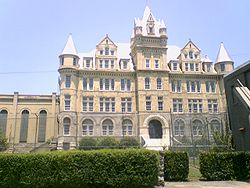
Tennessee State Prison is a former correctional facility located six miles west of downtown Nashville, Tennessee, on Cockrill Bend. It opened in 1898 and has been closed since 1992 because of overcrowding concerns. The facility was severely damaged by an EF3 tornado in the tornado outbreak of March 2–3, 2020.
The first Tennessee State Penitentiary, located on what is now 15th Avenue between Church Street and Charlotte Avenue, became operational on January 1, 1831 with 200 cells, a warden's residence, and a hospital. Modeled after the Auburn Penitentiary in both discipline and design, the prison was the first of its kind in Tennessee and the South. Inmates were subject to policies and practices championed by the Auburn model, such as "during the day the prisoners, with downcast eyes, labored silently together in workshops, while at night they slept alone in separate cells. Under no circumstances could they communicate with one another, and only when necessity demanded could they receive letters or calls from relatives and friends." The prison housed both men and women, with the first male inmate registered in 1831 and the first female inmate registered in 1840.
In 1863, the Union Army took control of the penitentiary and used it as a military prison. Under Union occupation, the prison population tripled and conditions worsened. Convicts were leased to the federal government by the Occupation Government of Tennessee to help repay their mounting debts. Among the prisoners held during this time was Mark R. Cockrill, a Confederate sympathizer whose West Nashville property would later be purchased for the construction of the new prison. Following the Civil War, the percentage of black inmates in the state of Tennessee increased dramatically, from roughly 5% of the prison's population prior to the Civil War to about 62% in 1869. The proportion of black women in prison was significantly higher to black men in relation to whites, with all female prisoners in Tennessee in 1868 being African American women.
Every convict was expected to defray a portion of the cost of incarceration by performing physical labor. Inmates worked up to 16 hours a day for meager rations and unheated, unventilated sleeping quarters. The 1840s saw a rise in the use of prison labor, with inmates being employed in the construction of the state capitol building in Nashville. Prison labor was so lucrative that the state prison became a revenue-generating system that came in direct competition with free laborers. The State also contracted with private companies to operate factories inside the prison walls using convict labor. In 1870 the state penitentiary reached a deal with the Tennessee Coal, Iron, and Railroad Company, establishing the first convict-leasing program in the country. This only added to growing frustrations among free laborers who staged a strike against the Tennessee Coal, Iron, and Railroad Company in 1871. Though the effort was ultimately defeated, it was the first of many revolts against the convict-leasing system. The state also contracted with private companies to operate factories inside the prison walls using convict labor.
A women's wing was opened in 1892 but overcrowding soon forced the men and women to be housed together.
The design for a proposed new prison called for the construction of a Gothic, fortress-like structure. The second Tennessee prison contained 800 small cells, each designed to house a single inmate. In addition, an administration building and other smaller buildings for offices, warehouses, and factories were built within the 20 ft high (6.1 m), 3 ft thick (0.91 m) rock walls. The plan also provided for a working farm outside the walls and mandated a separate system for younger offenders to isolate them from older, hardened criminals. A separate women's wing was built on the northwest corner of the grounds that housed the female inmates who worked on the farm as well.
The new prison was built by Enoch Guy Elliott, who was married to Lady Ida Beasley Elliott, a missionary to Burma. Governor Peter Turney made Enoch Guy Elliott the chief warden of the old prison. Enoch used mostly prison labor to build the new prison.
Construction costs for this second Tennessee State Penitentiary exceeded US$500,000 (US$12.3 million in 2007 dollars), not including the price of the land. The prison's 800 cells opened to receive prisoners on February 12, 1898, and that day admitted 1,403 prisoners, creating immediate overcrowding. To a greater or lesser extent, overcrowding persisted throughout the next century.
Tennessee State Prison
Tennessee State Prison is a former correctional facility located six miles west of downtown Nashville, Tennessee, on Cockrill Bend. It opened in 1898 and has been closed since 1992 because of overcrowding concerns. The facility was severely damaged by an EF3 tornado in the tornado outbreak of March 2–3, 2020.
The first Tennessee State Penitentiary, located on what is now 15th Avenue between Church Street and Charlotte Avenue, became operational on January 1, 1831 with 200 cells, a warden's residence, and a hospital. Modeled after the Auburn Penitentiary in both discipline and design, the prison was the first of its kind in Tennessee and the South. Inmates were subject to policies and practices championed by the Auburn model, such as "during the day the prisoners, with downcast eyes, labored silently together in workshops, while at night they slept alone in separate cells. Under no circumstances could they communicate with one another, and only when necessity demanded could they receive letters or calls from relatives and friends." The prison housed both men and women, with the first male inmate registered in 1831 and the first female inmate registered in 1840.
In 1863, the Union Army took control of the penitentiary and used it as a military prison. Under Union occupation, the prison population tripled and conditions worsened. Convicts were leased to the federal government by the Occupation Government of Tennessee to help repay their mounting debts. Among the prisoners held during this time was Mark R. Cockrill, a Confederate sympathizer whose West Nashville property would later be purchased for the construction of the new prison. Following the Civil War, the percentage of black inmates in the state of Tennessee increased dramatically, from roughly 5% of the prison's population prior to the Civil War to about 62% in 1869. The proportion of black women in prison was significantly higher to black men in relation to whites, with all female prisoners in Tennessee in 1868 being African American women.
Every convict was expected to defray a portion of the cost of incarceration by performing physical labor. Inmates worked up to 16 hours a day for meager rations and unheated, unventilated sleeping quarters. The 1840s saw a rise in the use of prison labor, with inmates being employed in the construction of the state capitol building in Nashville. Prison labor was so lucrative that the state prison became a revenue-generating system that came in direct competition with free laborers. The State also contracted with private companies to operate factories inside the prison walls using convict labor. In 1870 the state penitentiary reached a deal with the Tennessee Coal, Iron, and Railroad Company, establishing the first convict-leasing program in the country. This only added to growing frustrations among free laborers who staged a strike against the Tennessee Coal, Iron, and Railroad Company in 1871. Though the effort was ultimately defeated, it was the first of many revolts against the convict-leasing system. The state also contracted with private companies to operate factories inside the prison walls using convict labor.
A women's wing was opened in 1892 but overcrowding soon forced the men and women to be housed together.
The design for a proposed new prison called for the construction of a Gothic, fortress-like structure. The second Tennessee prison contained 800 small cells, each designed to house a single inmate. In addition, an administration building and other smaller buildings for offices, warehouses, and factories were built within the 20 ft high (6.1 m), 3 ft thick (0.91 m) rock walls. The plan also provided for a working farm outside the walls and mandated a separate system for younger offenders to isolate them from older, hardened criminals. A separate women's wing was built on the northwest corner of the grounds that housed the female inmates who worked on the farm as well.
The new prison was built by Enoch Guy Elliott, who was married to Lady Ida Beasley Elliott, a missionary to Burma. Governor Peter Turney made Enoch Guy Elliott the chief warden of the old prison. Enoch used mostly prison labor to build the new prison.
Construction costs for this second Tennessee State Penitentiary exceeded US$500,000 (US$12.3 million in 2007 dollars), not including the price of the land. The prison's 800 cells opened to receive prisoners on February 12, 1898, and that day admitted 1,403 prisoners, creating immediate overcrowding. To a greater or lesser extent, overcrowding persisted throughout the next century.
Recent media
Recent media