
Recent from talks
Decimal
Knowledge base stats:
Talk channels stats:
Members stats:
Decimal
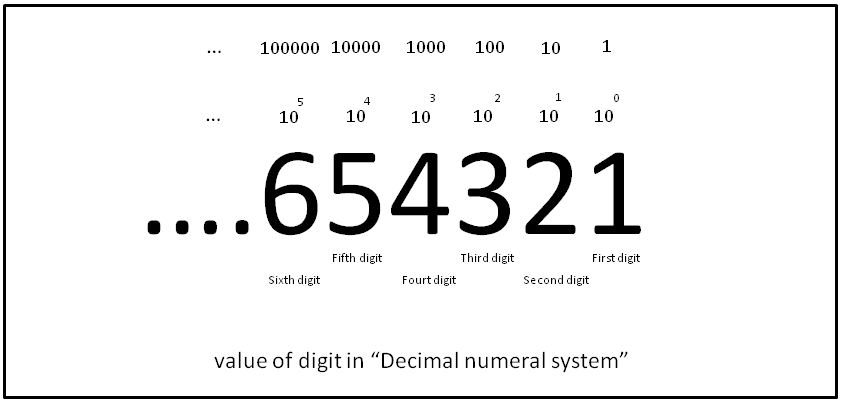
The decimal numeral system (also called the base-ten positional numeral system and denary /ˈdiːnəri/ or decanary) is the standard system for denoting integer and non-integer numbers. It is the extension to non-integer numbers (decimal fractions) of the Hindu–Arabic numeral system. The way of denoting numbers in the decimal system is often referred to as decimal notation.
A decimal numeral (also often just decimal or, less correctly, decimal number), refers generally to the notation of a number in the decimal numeral system. Decimals may sometimes be identified by a decimal separator (usually "." or "," as in 25.9703 or 3,1415). Decimal may also refer specifically to the digits after the decimal separator, such as in "3.14 is the approximation of π to two decimals".
The numbers that may be represented exactly by a decimal of finite length are the decimal fractions. That is, fractions of the form a/10n, where a is an integer, and n is a non-negative integer. Decimal fractions also result from the addition of an integer and a fractional part; the resulting sum sometimes is called a fractional number.
Decimals are commonly used to approximate real numbers. By increasing the number of digits after the decimal separator, one can make the approximation errors as small as one wants, when one has a method for computing the new digits. In the sciences, the number of decimal places given generally gives an indication of the precision to which a quantity is known; for example, if a mass is given as 1.32 milligrams, it usually means there is reasonable confidence that the true mass is somewhere between 1.315 milligrams and 1.325 milligrams, whereas if it is given as 1.320 milligrams, then it is likely between 1.3195 and 1.3205 milligrams. The same holds in pure mathematics; for example, if one computes the square root of 22 to two digits past the decimal point, the answer is 4.69, whereas computing it to three digits, the answer is 4.690. The extra 0 at the end is meaningful, in spite of the fact that 4.69 and 4.690 are the same real number.
In principle, the decimal expansion of any real number can be carried out as far as desired past the decimal point. If the expansion reaches a point where all remaining digits are zero, then the remainder can be omitted, and such an expansion is called a terminating decimal. A repeating decimal is an infinite decimal that, after some place, repeats indefinitely the same sequence of digits (e.g., 5.123144144144144... = 5.123144). An infinite decimal represents a rational number, the quotient of two integers, if and only if it is a repeating decimal or has a finite number of non-zero digits.
Many numeral systems of ancient civilizations use ten and its powers for representing numbers, possibly because there are ten fingers on two hands and people started counting by using their fingers. Examples are firstly the Egyptian numerals, then the Brahmi numerals, Greek numerals, Hebrew numerals, Roman numerals, and Chinese numerals. Very large numbers were difficult to represent in these old numeral systems, and only the best mathematicians were able to multiply or divide large numbers. These difficulties were completely solved with the introduction of the Hindu–Arabic numeral system for representing integers. This system has been extended to represent some non-integer numbers, called decimal fractions or decimal numbers, for forming the decimal numeral system.
For writing numbers, the decimal system uses ten decimal digits, a decimal mark, and, for negative numbers, a minus sign "−". The decimal digits are 0, 1, 2, 3, 4, 5, 6, 7, 8, 9; the decimal separator is the dot "." in many countries (mostly English-speaking), and a comma "," in other countries.
For representing a non-negative number, a decimal numeral consists of
Hub AI
Decimal AI simulator
(@Decimal_simulator)
Decimal
The decimal numeral system (also called the base-ten positional numeral system and denary /ˈdiːnəri/ or decanary) is the standard system for denoting integer and non-integer numbers. It is the extension to non-integer numbers (decimal fractions) of the Hindu–Arabic numeral system. The way of denoting numbers in the decimal system is often referred to as decimal notation.
A decimal numeral (also often just decimal or, less correctly, decimal number), refers generally to the notation of a number in the decimal numeral system. Decimals may sometimes be identified by a decimal separator (usually "." or "," as in 25.9703 or 3,1415). Decimal may also refer specifically to the digits after the decimal separator, such as in "3.14 is the approximation of π to two decimals".
The numbers that may be represented exactly by a decimal of finite length are the decimal fractions. That is, fractions of the form a/10n, where a is an integer, and n is a non-negative integer. Decimal fractions also result from the addition of an integer and a fractional part; the resulting sum sometimes is called a fractional number.
Decimals are commonly used to approximate real numbers. By increasing the number of digits after the decimal separator, one can make the approximation errors as small as one wants, when one has a method for computing the new digits. In the sciences, the number of decimal places given generally gives an indication of the precision to which a quantity is known; for example, if a mass is given as 1.32 milligrams, it usually means there is reasonable confidence that the true mass is somewhere between 1.315 milligrams and 1.325 milligrams, whereas if it is given as 1.320 milligrams, then it is likely between 1.3195 and 1.3205 milligrams. The same holds in pure mathematics; for example, if one computes the square root of 22 to two digits past the decimal point, the answer is 4.69, whereas computing it to three digits, the answer is 4.690. The extra 0 at the end is meaningful, in spite of the fact that 4.69 and 4.690 are the same real number.
In principle, the decimal expansion of any real number can be carried out as far as desired past the decimal point. If the expansion reaches a point where all remaining digits are zero, then the remainder can be omitted, and such an expansion is called a terminating decimal. A repeating decimal is an infinite decimal that, after some place, repeats indefinitely the same sequence of digits (e.g., 5.123144144144144... = 5.123144). An infinite decimal represents a rational number, the quotient of two integers, if and only if it is a repeating decimal or has a finite number of non-zero digits.
Many numeral systems of ancient civilizations use ten and its powers for representing numbers, possibly because there are ten fingers on two hands and people started counting by using their fingers. Examples are firstly the Egyptian numerals, then the Brahmi numerals, Greek numerals, Hebrew numerals, Roman numerals, and Chinese numerals. Very large numbers were difficult to represent in these old numeral systems, and only the best mathematicians were able to multiply or divide large numbers. These difficulties were completely solved with the introduction of the Hindu–Arabic numeral system for representing integers. This system has been extended to represent some non-integer numbers, called decimal fractions or decimal numbers, for forming the decimal numeral system.
For writing numbers, the decimal system uses ten decimal digits, a decimal mark, and, for negative numbers, a minus sign "−". The decimal digits are 0, 1, 2, 3, 4, 5, 6, 7, 8, 9; the decimal separator is the dot "." in many countries (mostly English-speaking), and a comma "," in other countries.
For representing a non-negative number, a decimal numeral consists of
Recent media