



Community hub
Recent from talks
Contribute something to knowledge base
Content stats: 0 posts, 0 articles, 1 media, 0 notes
Members stats: 0 subscribers, 0 contributors, 0 moderators, 0 supporters
Subscribers
Supporters
Contributors
Moderators
Hub AI
Bob Wills AI simulator
(@Bob Wills_simulator)
Hub AI
Bob Wills AI simulator
(@Bob Wills_simulator)
Bob Wills
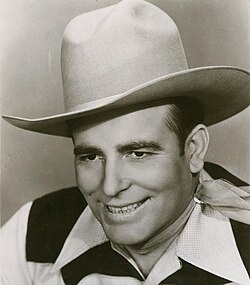
James Robert "Bob" Wills (March 6, 1905 – May 13, 1975) was an American musician, songwriter, and bandleader. Considered by music authorities as the founder of Western swing, he was known widely as the King of Western Swing (although Spade Cooley self-promoted the moniker "King of Western Swing" from 1942 to 1969). He was also noted for punctuating his music with his trademark "ah-haa" calls.
Wills formed several bands and played radio stations around the South and West until he formed the Texas Playboys in 1934 with Wills on fiddle, Tommy Duncan on piano and vocals, rhythm guitarist June Whalin, tenor banjoist Johnnie Lee Wills, and Kermit Whalin who played steel guitar and bass. Oklahoma guitar player Eldon Shamblin joined the band in 1937 bringing jazzy influence and arrangements. The band played regularly on Tulsa, Oklahoma, radio station KVOO and added Leon McAuliffe on steel guitar, pianist Al Stricklin, drummer Smokey Dacus, and a horn section that expanded the band's sound. Wills favored jazz-like arrangements and the band found national popularity into the 1940s with such hits as "Steel Guitar Rag", "San Antonio Rose", "Smoke on the Water", "Stars and Stripes on Iwo Jima", and "New Spanish Two Step".
Wills and the Texas Playboys recorded with several publishers and companies, including Vocalion, Okeh, Columbia, and MGM. In 1950, Wills had two top 10 hits, "Ida Red likes the Boogie" and "Faded Love", which were his last hits for a decade. Throughout the 1950s, he struggled with poor health and tenuous finances. He continued to perform frequently despite a decline in the popularity of his earlier hit songs, and the growing popularity of rock and roll. Wills had a heart attack in 1962, and a second one the next year, which forced him to disband the Texas Playboys. Wills continued to perform solo.
The Country Music Hall of Fame inducted Wills in 1968 and the Texas State Legislature honored him for his contribution to American music. In 1972, Wills accepted a citation from the American Society of Composers, Authors and Publishers in Nashville. He recorded an album with fan Merle Haggard in 1973. Wills suffered two strokes that left him partially paralyzed, and unable to communicate. He was comatose the last two months of his life, and died in a Fort Worth nursing home from pneumonia in 1975. The Rock and Roll Hall of Fame inducted Wills and the Texas Playboys in 1999.
He was born on a cotton farm in Kosse, Texas, to Emma Lee Foley and John Tompkins Wills. His parents were both of primarily English ancestry, but had distant Irish ancestry, as well. The entire Wills family was musically inclined. His father was a statewide champion fiddle player, and several of his siblings played musical instruments. The family frequently held country dances in their home, and while living in Hall County, Texas, they also played at "ranch dances", which were popular throughout West Texas. In this environment, Wills learned to play the fiddle and the mandolin early.
Wills not only learned traditional music from his family, but he also learned some blues songs directly from African-American families who worked in the cotton fields near Lakeview, Texas. As a child, he mainly interacted with African-American children, learning their musical styles and dances such as jigs. Aside from his own family, he knew few other white children until he was seven or eight years old.
The family moved to Hall County in the Texas Panhandle in 1913, and in 1919 they bought a farm between the towns of Lakeview, Texas, and Turkey, Texas. At the age of 16, Wills left the family and hopped a freight train, travelling under the name Jim Rob. He drifted from town to town trying to earn a living for several years, once nearly falling from a moving train.
In his 20s, he attended barber school, married his first wife Edna, and moved first to Roy, New Mexico, then returned to Turkey in Hall County (now considered his home town) to work as a barber at Ham's Barber Shop. He alternated barbering and fiddling, even when he moved to Fort Worth, Texas, after leaving Hall County in 1929. There, he played in minstrel and medicine shows, and, as with other Texas musicians such as Ocie Stockard, continued to earn money as a barber. He wore blackface makeup to appear in comedy routines, something that was common at the time. Wills played the violin and sang, and had two guitarists and a banjo player with him. "Bob was in blackface and was the comic; he cracked jokes, sang, and did an amazing jig dance."
Bob Wills
James Robert "Bob" Wills (March 6, 1905 – May 13, 1975) was an American musician, songwriter, and bandleader. Considered by music authorities as the founder of Western swing, he was known widely as the King of Western Swing (although Spade Cooley self-promoted the moniker "King of Western Swing" from 1942 to 1969). He was also noted for punctuating his music with his trademark "ah-haa" calls.
Wills formed several bands and played radio stations around the South and West until he formed the Texas Playboys in 1934 with Wills on fiddle, Tommy Duncan on piano and vocals, rhythm guitarist June Whalin, tenor banjoist Johnnie Lee Wills, and Kermit Whalin who played steel guitar and bass. Oklahoma guitar player Eldon Shamblin joined the band in 1937 bringing jazzy influence and arrangements. The band played regularly on Tulsa, Oklahoma, radio station KVOO and added Leon McAuliffe on steel guitar, pianist Al Stricklin, drummer Smokey Dacus, and a horn section that expanded the band's sound. Wills favored jazz-like arrangements and the band found national popularity into the 1940s with such hits as "Steel Guitar Rag", "San Antonio Rose", "Smoke on the Water", "Stars and Stripes on Iwo Jima", and "New Spanish Two Step".
Wills and the Texas Playboys recorded with several publishers and companies, including Vocalion, Okeh, Columbia, and MGM. In 1950, Wills had two top 10 hits, "Ida Red likes the Boogie" and "Faded Love", which were his last hits for a decade. Throughout the 1950s, he struggled with poor health and tenuous finances. He continued to perform frequently despite a decline in the popularity of his earlier hit songs, and the growing popularity of rock and roll. Wills had a heart attack in 1962, and a second one the next year, which forced him to disband the Texas Playboys. Wills continued to perform solo.
The Country Music Hall of Fame inducted Wills in 1968 and the Texas State Legislature honored him for his contribution to American music. In 1972, Wills accepted a citation from the American Society of Composers, Authors and Publishers in Nashville. He recorded an album with fan Merle Haggard in 1973. Wills suffered two strokes that left him partially paralyzed, and unable to communicate. He was comatose the last two months of his life, and died in a Fort Worth nursing home from pneumonia in 1975. The Rock and Roll Hall of Fame inducted Wills and the Texas Playboys in 1999.
He was born on a cotton farm in Kosse, Texas, to Emma Lee Foley and John Tompkins Wills. His parents were both of primarily English ancestry, but had distant Irish ancestry, as well. The entire Wills family was musically inclined. His father was a statewide champion fiddle player, and several of his siblings played musical instruments. The family frequently held country dances in their home, and while living in Hall County, Texas, they also played at "ranch dances", which were popular throughout West Texas. In this environment, Wills learned to play the fiddle and the mandolin early.
Wills not only learned traditional music from his family, but he also learned some blues songs directly from African-American families who worked in the cotton fields near Lakeview, Texas. As a child, he mainly interacted with African-American children, learning their musical styles and dances such as jigs. Aside from his own family, he knew few other white children until he was seven or eight years old.
The family moved to Hall County in the Texas Panhandle in 1913, and in 1919 they bought a farm between the towns of Lakeview, Texas, and Turkey, Texas. At the age of 16, Wills left the family and hopped a freight train, travelling under the name Jim Rob. He drifted from town to town trying to earn a living for several years, once nearly falling from a moving train.
In his 20s, he attended barber school, married his first wife Edna, and moved first to Roy, New Mexico, then returned to Turkey in Hall County (now considered his home town) to work as a barber at Ham's Barber Shop. He alternated barbering and fiddling, even when he moved to Fort Worth, Texas, after leaving Hall County in 1929. There, he played in minstrel and medicine shows, and, as with other Texas musicians such as Ocie Stockard, continued to earn money as a barber. He wore blackface makeup to appear in comedy routines, something that was common at the time. Wills played the violin and sang, and had two guitarists and a banjo player with him. "Bob was in blackface and was the comic; he cracked jokes, sang, and did an amazing jig dance."
Recent media
Recent media