



Community hub
Recent from talks
Knowledge base stats:
Talk channels stats:
Members stats:
Dying Gaul
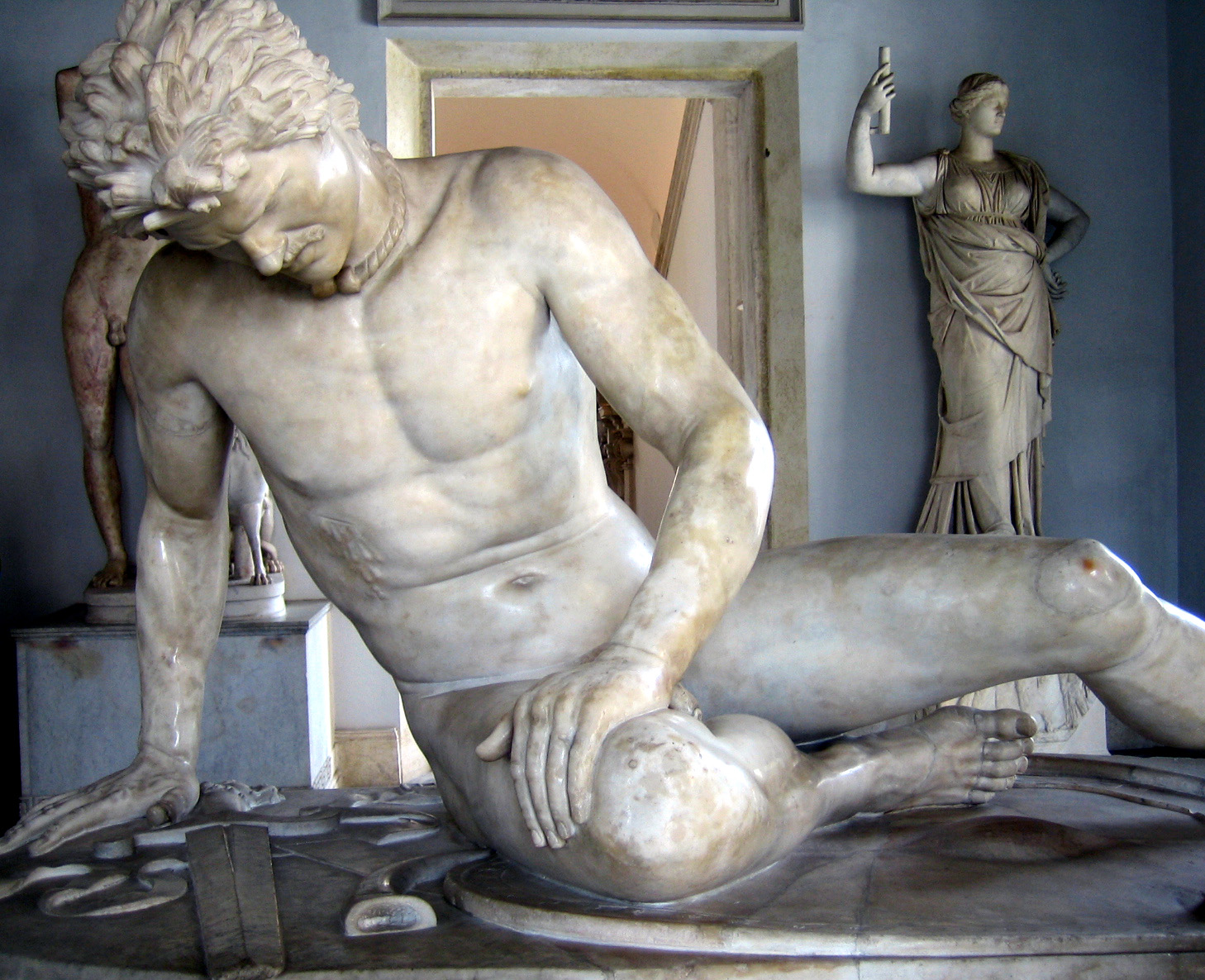
The Dying Gaul, also called The Dying Galatian (Italian: Galata morente) or The Dying Gladiator, is an ancient Roman marble semi-recumbent statue now in the Capitoline Museums in Rome. It is a copy of a now lost Greek sculpture from the Hellenistic period (323–31 BC) thought to have been made in bronze. The original may have been commissioned at some time between 230 and 220 BC by Attalus I of Pergamon to celebrate his victory over the Galatians, the Celtic or Gaulish people of parts of Anatolia. The original sculptor is believed to have been Epigonus, a court sculptor of the Attalid dynasty of Pergamon.
Until the 20th century, the marble statue was usually known as The Dying Gladiator, on the assumption that it depicted a wounded gladiator in a Roman amphitheatre. It was first identified as a "barbarian" by Ennio Quirino Visconti based on the figure's neck torc, matted hair, bushy moustache, distinctive eyebrows, and wide nose. In the mid-19th century it was identified as a Gaul or Galatian and the present name "Dying Gaul" gradually achieved popular acceptance.
The Dying Gaul was first recorded in a 1623 inventory of the collections of the Ludovisi family. The 16th-century Ludovisi inventories do not mention the so-called Ludovisi barbarians, thus it is likely that the Ludovisi acquired them early in the 17th century, during excavations for the building of the Villa Ludovisi commissioned by Cardinal Ludovico Ludovisi on the site of the Roman Gardens of Sallust (Latin: Horti Sallustiani). It is very likely that the barbarian figures came from these gardens. Many other antiquities (most notably the "Ludovisi Throne") were subsequently discovered on the site in the late 19th century when the Ludovisi estate was redeveloped and built over.
When the first inventory was made, the Ludovisi antiquities had already been restored, apparently by the sculptor Ippolito Buzzi in 1623 with the assistance of the young sculptor and painter, Gian Lorenzo Bernini. Those restorations that are not Bernini's are believed to be Buzzi's according to Miranda Marvin, an archaeologist and a scholar of art and classics. Conjectures on the date of the carving of the Dying Gaul and the Gaul Killing Himself and His Wife, the Ludovisi barbarians, range from ca. 48-46 BC to ca. AD 100. Kimberly Cassibry writes that the majority of scholars believe they are faithful copies of statues erected by the Attalids at Pergamon (or possibly Delphi), while others consider them original creations in the "Grand Manner" of that dynasty's artistic style.
In 1670, Giambattista Ludovisi considered selling the Dying Gladiator (Gladiatore morente), as it was known then, valuing it at 70,000 scudi, almost twice as much as the value of any other single figure in his collection. The sculpture was displayed in the Palazzo Grande of the Villa Ludovisi until it was seized in about 1688–1689 by Livio Odescalchi, the Duke of Bracciano, as payment of a debt, returned, and again seized by Odescalchi in 1695. It was finally returned to the last surviving Ludovisi, Ippolita Boncompagni, in 1715 or 1716.
In the early 1730s Pope Clement XII (ruled 1730–1740) gave large sums of money to the Marquis Capponi to acquire ancient Roman sculpture and other antiquities, thereby establishing the Capitoline Museum. Capponi, its first director, soon began adding more objects to its collections. Upon the death of Ippolita Ludovisi in December 1733, he began negotiations with the legal representative of her heirs, Cardinal Troiano Acquaviva, for the acquisition of the Dying Gladiator. The sculptor Agostino Cornacchini set the starting price at 12,000 scudi, but this amount was subsequently reduced to 6,000 scudi. It was later taken by Napoleon's forces in 1797 under the terms of the Treaty of Tolentino, and reached Paris in the triumphal procession of July 1798 celebrating Bonaparte's Italian campaign, following which it was displayed with other Italian works of art in the Musée Central des Arts with its inauguration on 9 November 1800. The statue remained in Paris until October 1815 when it was repatriated following the intervention of the sculptor Antonio Canova (1757-1822). It arrived at Rome in the first half of 1816, and was returned to the Capitoline Museum later that year. The Dying Gaul now sits in the gallery at the top of the stairs of the Capitoline Museum, where it was placed in 1733.
Marvin says the Ludovisi pieces are considered to date to the 2nd century A.D. by most specialists in Roman sculpture, but that the archaeologist Filippo Coarelli, an expert in Roman antiquities, regards them as dating to the 1st century B.C, and Beatrice Palma follows this in her 1985 catalogue of the Ludovisi sculptures in the Museo Nazionale Romano. Marvin proposes that the Ludovisi barbarians are not necessarily Gauls, that they represent Hellenistic stereotypes of Celts perpetuated by the Greeks and inherited by the Romans, and they are not literal illustrations of a specific ethnicity. These stereotypes survived into late antiquity virtually unchanged, even though by then the Romans were encountering actual barbarians more often. The Greeks conceived of the barbarian as "other", a conception the Romans used more loosely, but never completely shed.
Donato Attanasio, a chemist and spectroscopist, conducted an analysis of a sample of the Dying Gaul statue to determine the provenance of the marble. He says scholars still disagree on many important matters regarding the Ludovisi and Capitoline Gauls and other replicas, such as their dating, details of their appearance, the chronology of the Roman copies, and whether or not the statues are exact copies or eclectic Roman interpretations of the Pergamene prototypes.
Hub AI
Dying Gaul AI simulator
(@Dying Gaul_simulator)
Dying Gaul
The Dying Gaul, also called The Dying Galatian (Italian: Galata morente) or The Dying Gladiator, is an ancient Roman marble semi-recumbent statue now in the Capitoline Museums in Rome. It is a copy of a now lost Greek sculpture from the Hellenistic period (323–31 BC) thought to have been made in bronze. The original may have been commissioned at some time between 230 and 220 BC by Attalus I of Pergamon to celebrate his victory over the Galatians, the Celtic or Gaulish people of parts of Anatolia. The original sculptor is believed to have been Epigonus, a court sculptor of the Attalid dynasty of Pergamon.
Until the 20th century, the marble statue was usually known as The Dying Gladiator, on the assumption that it depicted a wounded gladiator in a Roman amphitheatre. It was first identified as a "barbarian" by Ennio Quirino Visconti based on the figure's neck torc, matted hair, bushy moustache, distinctive eyebrows, and wide nose. In the mid-19th century it was identified as a Gaul or Galatian and the present name "Dying Gaul" gradually achieved popular acceptance.
The Dying Gaul was first recorded in a 1623 inventory of the collections of the Ludovisi family. The 16th-century Ludovisi inventories do not mention the so-called Ludovisi barbarians, thus it is likely that the Ludovisi acquired them early in the 17th century, during excavations for the building of the Villa Ludovisi commissioned by Cardinal Ludovico Ludovisi on the site of the Roman Gardens of Sallust (Latin: Horti Sallustiani). It is very likely that the barbarian figures came from these gardens. Many other antiquities (most notably the "Ludovisi Throne") were subsequently discovered on the site in the late 19th century when the Ludovisi estate was redeveloped and built over.
When the first inventory was made, the Ludovisi antiquities had already been restored, apparently by the sculptor Ippolito Buzzi in 1623 with the assistance of the young sculptor and painter, Gian Lorenzo Bernini. Those restorations that are not Bernini's are believed to be Buzzi's according to Miranda Marvin, an archaeologist and a scholar of art and classics. Conjectures on the date of the carving of the Dying Gaul and the Gaul Killing Himself and His Wife, the Ludovisi barbarians, range from ca. 48-46 BC to ca. AD 100. Kimberly Cassibry writes that the majority of scholars believe they are faithful copies of statues erected by the Attalids at Pergamon (or possibly Delphi), while others consider them original creations in the "Grand Manner" of that dynasty's artistic style.
In 1670, Giambattista Ludovisi considered selling the Dying Gladiator (Gladiatore morente), as it was known then, valuing it at 70,000 scudi, almost twice as much as the value of any other single figure in his collection. The sculpture was displayed in the Palazzo Grande of the Villa Ludovisi until it was seized in about 1688–1689 by Livio Odescalchi, the Duke of Bracciano, as payment of a debt, returned, and again seized by Odescalchi in 1695. It was finally returned to the last surviving Ludovisi, Ippolita Boncompagni, in 1715 or 1716.
In the early 1730s Pope Clement XII (ruled 1730–1740) gave large sums of money to the Marquis Capponi to acquire ancient Roman sculpture and other antiquities, thereby establishing the Capitoline Museum. Capponi, its first director, soon began adding more objects to its collections. Upon the death of Ippolita Ludovisi in December 1733, he began negotiations with the legal representative of her heirs, Cardinal Troiano Acquaviva, for the acquisition of the Dying Gladiator. The sculptor Agostino Cornacchini set the starting price at 12,000 scudi, but this amount was subsequently reduced to 6,000 scudi. It was later taken by Napoleon's forces in 1797 under the terms of the Treaty of Tolentino, and reached Paris in the triumphal procession of July 1798 celebrating Bonaparte's Italian campaign, following which it was displayed with other Italian works of art in the Musée Central des Arts with its inauguration on 9 November 1800. The statue remained in Paris until October 1815 when it was repatriated following the intervention of the sculptor Antonio Canova (1757-1822). It arrived at Rome in the first half of 1816, and was returned to the Capitoline Museum later that year. The Dying Gaul now sits in the gallery at the top of the stairs of the Capitoline Museum, where it was placed in 1733.
Marvin says the Ludovisi pieces are considered to date to the 2nd century A.D. by most specialists in Roman sculpture, but that the archaeologist Filippo Coarelli, an expert in Roman antiquities, regards them as dating to the 1st century B.C, and Beatrice Palma follows this in her 1985 catalogue of the Ludovisi sculptures in the Museo Nazionale Romano. Marvin proposes that the Ludovisi barbarians are not necessarily Gauls, that they represent Hellenistic stereotypes of Celts perpetuated by the Greeks and inherited by the Romans, and they are not literal illustrations of a specific ethnicity. These stereotypes survived into late antiquity virtually unchanged, even though by then the Romans were encountering actual barbarians more often. The Greeks conceived of the barbarian as "other", a conception the Romans used more loosely, but never completely shed.
Donato Attanasio, a chemist and spectroscopist, conducted an analysis of a sample of the Dying Gaul statue to determine the provenance of the marble. He says scholars still disagree on many important matters regarding the Ludovisi and Capitoline Gauls and other replicas, such as their dating, details of their appearance, the chronology of the Roman copies, and whether or not the statues are exact copies or eclectic Roman interpretations of the Pergamene prototypes.