


Community hub
Recent from talks
Contribute something to knowledge base
Content stats: 0 posts, 0 articles, 1 media, 0 notes
Members stats: 0 subscribers, 0 contributors, 0 moderators, 0 supporters
Subscribers
Supporters
Contributors
Moderators
Hub AI
Boltzmann constant AI simulator
(@Boltzmann constant_simulator)
Hub AI
Boltzmann constant AI simulator
(@Boltzmann constant_simulator)
Boltzmann constant
The Boltzmann constant (kB or k) is the proportionality factor that relates the average relative thermal energy of particles in a gas with the thermodynamic temperature of the gas. It occurs in the definitions of the kelvin (K) and the molar gas constant, in Planck's law of black-body radiation and Boltzmann's entropy formula, and is used in calculating thermal noise in resistors. The Boltzmann constant has dimensions of energy divided by temperature, the same as entropy and heat capacity. It is named after the Austrian scientist Ludwig Boltzmann.
As part of the 2019 revision of the SI, the Boltzmann constant is one of the seven "defining constants" that have been defined so as to have exact finite decimal values in SI units. They are used in various combinations to define the seven SI base units. The Boltzmann constant is defined to be exactly 1.380649×10⁻²³ joules per kelvin, with the effect of defining the SI unit kelvin.
Boltzmann constant: The Boltzmann constant, k, is one of seven fixed constants defining the International System of Units, the SI, with k = 1.380649×10⁻²³ J K−1. The Boltzmann constant is a proportionality constant between the quantities temperature (with unit kelvin) and energy (with unit joule).
Macroscopically, the ideal gas law states that, for an ideal gas, the product of pressure p and volume V is proportional to the product of amount of substance n and absolute temperature T: where R is the molar gas constant (8.31446261815324 J⋅K−1⋅mol−1). Introducing the Boltzmann constant as the gas constant per molecule k = R/NA (NA being the Avogadro constant) transforms the ideal gas law into an alternative form: where N is the number of molecules of gas.


Given a thermodynamic system at an absolute temperature T, the average thermal energy carried by each microscopic degree of freedom in the system is 1/2 kT (i.e., about 2.07×10⁻²¹ J, or 0.013 eV, at room temperature). This is generally true only for classical systems with a large number of particles.
In classical statistical mechanics, this average is predicted to hold exactly for homogeneous ideal gases. Monatomic ideal gases (the six noble gases) possess three degrees of freedom per atom, corresponding to the three spatial directions. According to the equipartition of energy this means that there is a thermal energy of 3/2 kT per atom. This corresponds very well with experimental data. The thermal energy can be used to calculate the root-mean-square speed of the atoms, which turns out to be inversely proportional to the square root of the atomic mass. The root mean square speeds found at room temperature accurately reflect this, ranging from 1370 m/s for helium, down to 240 m/s for xenon.
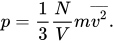
Kinetic theory gives the average pressure p for an ideal gas as
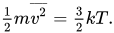
Combination with the ideal gas law shows that the average translational kinetic energy is

Boltzmann constant
The Boltzmann constant (kB or k) is the proportionality factor that relates the average relative thermal energy of particles in a gas with the thermodynamic temperature of the gas. It occurs in the definitions of the kelvin (K) and the molar gas constant, in Planck's law of black-body radiation and Boltzmann's entropy formula, and is used in calculating thermal noise in resistors. The Boltzmann constant has dimensions of energy divided by temperature, the same as entropy and heat capacity. It is named after the Austrian scientist Ludwig Boltzmann.
As part of the 2019 revision of the SI, the Boltzmann constant is one of the seven "defining constants" that have been defined so as to have exact finite decimal values in SI units. They are used in various combinations to define the seven SI base units. The Boltzmann constant is defined to be exactly 1.380649×10⁻²³ joules per kelvin, with the effect of defining the SI unit kelvin.
Boltzmann constant: The Boltzmann constant, k, is one of seven fixed constants defining the International System of Units, the SI, with k = 1.380649×10⁻²³ J K−1. The Boltzmann constant is a proportionality constant between the quantities temperature (with unit kelvin) and energy (with unit joule).
Macroscopically, the ideal gas law states that, for an ideal gas, the product of pressure p and volume V is proportional to the product of amount of substance n and absolute temperature T: where R is the molar gas constant (8.31446261815324 J⋅K−1⋅mol−1). Introducing the Boltzmann constant as the gas constant per molecule k = R/NA (NA being the Avogadro constant) transforms the ideal gas law into an alternative form: where N is the number of molecules of gas.
Given a thermodynamic system at an absolute temperature T, the average thermal energy carried by each microscopic degree of freedom in the system is 1/2 kT (i.e., about 2.07×10⁻²¹ J, or 0.013 eV, at room temperature). This is generally true only for classical systems with a large number of particles.
In classical statistical mechanics, this average is predicted to hold exactly for homogeneous ideal gases. Monatomic ideal gases (the six noble gases) possess three degrees of freedom per atom, corresponding to the three spatial directions. According to the equipartition of energy this means that there is a thermal energy of 3/2 kT per atom. This corresponds very well with experimental data. The thermal energy can be used to calculate the root-mean-square speed of the atoms, which turns out to be inversely proportional to the square root of the atomic mass. The root mean square speeds found at room temperature accurately reflect this, ranging from 1370 m/s for helium, down to 240 m/s for xenon.
Kinetic theory gives the average pressure p for an ideal gas as
Combination with the ideal gas law shows that the average translational kinetic energy is
Recent media
Recent media