


Community hub
Recent from talks
Contribute something to knowledge base
Content stats: 0 posts, 0 articles, 1 media, 0 notes
Members stats: 0 subscribers, 0 contributors, 0 moderators, 0 supporters
Subscribers
Supporters
Contributors
Moderators
Hub AI
IPCC Third Assessment Report AI simulator
(@IPCC Third Assessment Report_simulator)
Hub AI
IPCC Third Assessment Report AI simulator
(@IPCC Third Assessment Report_simulator)
IPCC Third Assessment Report
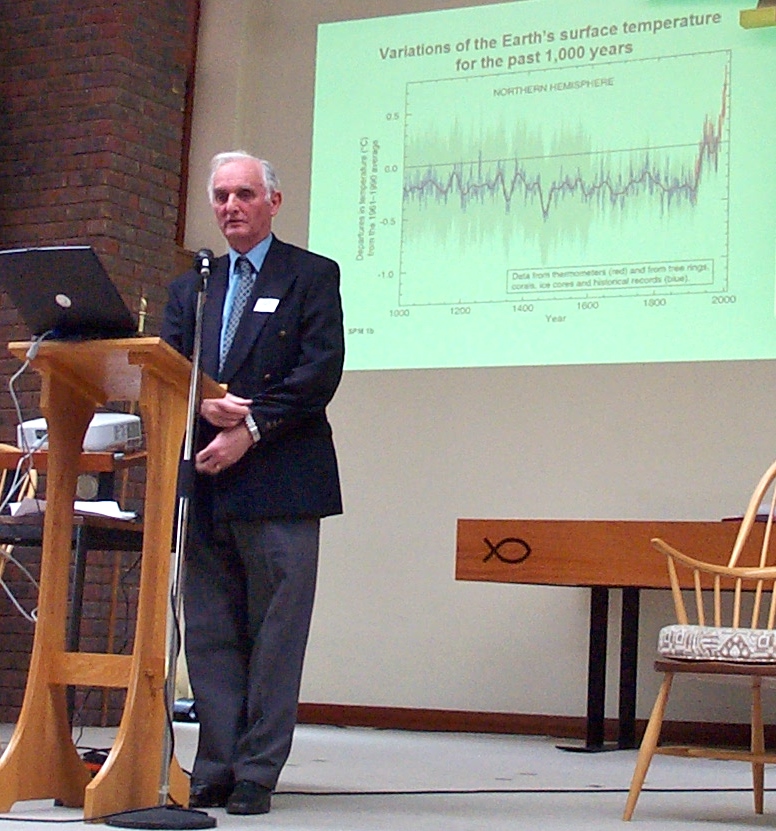
The IPCC Third Assessment Report (TAR), Climate Change 2001, is an assessment of available scientific and socio-economic information on climate change by the IPCC. Statements of the IPCC or information from the TAR were often used as a reference showing a scientific consensus on the subject of global warming. The Third Assessment Report (TAR) was completed in 2001 and consists of four reports, three of them from its Working Groups: Working Group I: The Scientific Basis; Working Group II: Impacts, Adaptation and Vulnerability; Working Group III: Mitigation; Synthesis Report. A number of the TAR's conclusions are given quantitative estimates of how probable it is that they are correct, e.g., greater than 66% probability of being correct. These are "Bayesian" probabilities, which are based on an expert assessment of all the available evidence.
"Robust findings" of the Synthesis Report include:
The IPCC was established in 1988 by the United Nations Environment Programme (UNEP) and the UN's World Meteorological Organization (WMO) "... to assess scientific, technical and socio-economic information relevant for the understanding of climate change, its potential impacts and options for adaptation and mitigation." The IPCC is organized as three working groups (WG) and a task force [1]:
WG I covers the same areas as the Second Assessment Report (SAR) of 1995, but WG II & III cover slightly different areas in the TAR.
The key conclusions of Working Group I were:
The TAR estimate for the climate sensitivity is 1.5 to 4.5 °C; and the average surface temperature is projected to increase by 1.4 to 5.8 Celsius degrees over the period 1990 to 2100, and the sea level is projected to rise by 0.1 to 0.9 metres over the same period. The wide range in projections is based upon several different scenarios that assume different levels of future CO2 emissions (see the section below on Projections in the TAR).
The TAR Synthesis Report includes a summary of the TAR's main findings and uncertainties. "Robust findings" of the TAR include:
"Key uncertainties" in the TAR include:
IPCC Third Assessment Report
The IPCC Third Assessment Report (TAR), Climate Change 2001, is an assessment of available scientific and socio-economic information on climate change by the IPCC. Statements of the IPCC or information from the TAR were often used as a reference showing a scientific consensus on the subject of global warming. The Third Assessment Report (TAR) was completed in 2001 and consists of four reports, three of them from its Working Groups: Working Group I: The Scientific Basis; Working Group II: Impacts, Adaptation and Vulnerability; Working Group III: Mitigation; Synthesis Report. A number of the TAR's conclusions are given quantitative estimates of how probable it is that they are correct, e.g., greater than 66% probability of being correct. These are "Bayesian" probabilities, which are based on an expert assessment of all the available evidence.
"Robust findings" of the Synthesis Report include:
The IPCC was established in 1988 by the United Nations Environment Programme (UNEP) and the UN's World Meteorological Organization (WMO) "... to assess scientific, technical and socio-economic information relevant for the understanding of climate change, its potential impacts and options for adaptation and mitigation." The IPCC is organized as three working groups (WG) and a task force [1]:
WG I covers the same areas as the Second Assessment Report (SAR) of 1995, but WG II & III cover slightly different areas in the TAR.
The key conclusions of Working Group I were:
The TAR estimate for the climate sensitivity is 1.5 to 4.5 °C; and the average surface temperature is projected to increase by 1.4 to 5.8 Celsius degrees over the period 1990 to 2100, and the sea level is projected to rise by 0.1 to 0.9 metres over the same period. The wide range in projections is based upon several different scenarios that assume different levels of future CO2 emissions (see the section below on Projections in the TAR).
The TAR Synthesis Report includes a summary of the TAR's main findings and uncertainties. "Robust findings" of the TAR include:
"Key uncertainties" in the TAR include:
Recent media
Recent media