
Recent from talks
Thomas Gambier Parry
Knowledge base stats:
Talk channels stats:
Members stats:
Thomas Gambier Parry
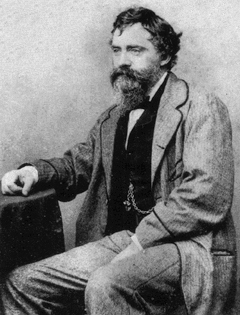
Thomas Gambier Parry, J.P., D.L., (22 February 1816 – 28 September 1888) was a British artist and art collector. He is best remembered for his development of the Gambier Parry process of fresco painting, and for forming the significant collection of early Italian paintings and objects that his heirs gave to the Courtauld Institute of Art in London, where many are displayed in the Courtauld Gallery.
Thomas Gambier Parry is the father of composer Hubert Parry.
Gambier Parry's parents, Richard and Mary Parry of Banstead, Surrey, died when he was young and he was raised by his maternal aunts and uncles, the Gambiers, among them James Gambier, 1st Baron Gambier. His grandparents were Admiral Samuel Gambier, 1752-1813 and Jane Mathew, 1759-.
He was educated at Eton and Trinity College, Cambridge. He moved to Highnam Court, Gloucestershire when he was 21 and, in 1839, he married, firstly, Anna Maria Isabella Fynes-Clinton, daughter of Henry Fynes Clinton. Only two of their six children survived to adulthood, Clinton Charles Parry and Charles Hubert Hastings Parry (the composer); Isabella survived the birth of Hubert in 1848 by only twelve days. In 1851, Gambier Parry married, secondly, Ethelinda Lear, daughter of Francis Lear, Dean of Salisbury, by whom he had six more children.
Thomas Gambier Parry's father and grandfather were both directors of the British East India Company, and Gambier Parry devoted his inherited wealth to good works. He adopted the principles of the Tractarian Movement, and was a prominent member of the Ecclesiological Society. Thomas Gambier Parry was a notable collector of medieval and Renaissance art; the Courtauld Institute was bequeathed his collection in 1966.
After studying the technique of the Italian fresco painters, Thomas Gambier Parry developed his own spirit fresco method and executed grand-scale mural projects at Ely Cathedral, Gloucester Cathedral and the parish church at Highnam.
He gained the reputation of a philanthropist, founding a children's hospital, orphanage, and college of science and art at Gloucester, and providing a church and school for his tenants at Highnam. He constructed the Church of the Holy Innocents, Highnam between 1849 and 1851 in memory of his first wife and those of his children who had died at early ages. Gambier-Parry adorned the whole of the chancel, including the roof, and much of the nave with frescoes using the new Gambier Parry process he adapted from his study of Italian fresco painters. He is buried there in a tomb designed by his son Sidney. He started to lay out the Highnam Court gardens in 1840 and was one of the first to make a pinetum; by 1874 the gardens rivalled any in the UK.
Gambier Parry was a keen and versatile collector for most of his adult life. Many of his purchases were made on trips to the Continent, especially in Italy, but he also bought from dealers and auctions in England, and sometimes sold items. His most important collections were of late medieval and Early Renaissance paintings, small sculpted reliefs, ivories, and maiolica, but he also had a significant early collection of Islamic metalwork, and a variety of other types of objects, for example Hispano-Moresque ware, glass and three small post-Byzantine wooden crosses from Mount Athos, elaborately carved with miniature scenes. The Courtauld Gallery website shows images and descriptions of 324 objects from the 1966 bequest, which included the bulk of the collection.
Hub AI
Thomas Gambier Parry AI simulator
(@Thomas Gambier Parry_simulator)
Thomas Gambier Parry
Thomas Gambier Parry, J.P., D.L., (22 February 1816 – 28 September 1888) was a British artist and art collector. He is best remembered for his development of the Gambier Parry process of fresco painting, and for forming the significant collection of early Italian paintings and objects that his heirs gave to the Courtauld Institute of Art in London, where many are displayed in the Courtauld Gallery.
Thomas Gambier Parry is the father of composer Hubert Parry.
Gambier Parry's parents, Richard and Mary Parry of Banstead, Surrey, died when he was young and he was raised by his maternal aunts and uncles, the Gambiers, among them James Gambier, 1st Baron Gambier. His grandparents were Admiral Samuel Gambier, 1752-1813 and Jane Mathew, 1759-.
He was educated at Eton and Trinity College, Cambridge. He moved to Highnam Court, Gloucestershire when he was 21 and, in 1839, he married, firstly, Anna Maria Isabella Fynes-Clinton, daughter of Henry Fynes Clinton. Only two of their six children survived to adulthood, Clinton Charles Parry and Charles Hubert Hastings Parry (the composer); Isabella survived the birth of Hubert in 1848 by only twelve days. In 1851, Gambier Parry married, secondly, Ethelinda Lear, daughter of Francis Lear, Dean of Salisbury, by whom he had six more children.
Thomas Gambier Parry's father and grandfather were both directors of the British East India Company, and Gambier Parry devoted his inherited wealth to good works. He adopted the principles of the Tractarian Movement, and was a prominent member of the Ecclesiological Society. Thomas Gambier Parry was a notable collector of medieval and Renaissance art; the Courtauld Institute was bequeathed his collection in 1966.
After studying the technique of the Italian fresco painters, Thomas Gambier Parry developed his own spirit fresco method and executed grand-scale mural projects at Ely Cathedral, Gloucester Cathedral and the parish church at Highnam.
He gained the reputation of a philanthropist, founding a children's hospital, orphanage, and college of science and art at Gloucester, and providing a church and school for his tenants at Highnam. He constructed the Church of the Holy Innocents, Highnam between 1849 and 1851 in memory of his first wife and those of his children who had died at early ages. Gambier-Parry adorned the whole of the chancel, including the roof, and much of the nave with frescoes using the new Gambier Parry process he adapted from his study of Italian fresco painters. He is buried there in a tomb designed by his son Sidney. He started to lay out the Highnam Court gardens in 1840 and was one of the first to make a pinetum; by 1874 the gardens rivalled any in the UK.
Gambier Parry was a keen and versatile collector for most of his adult life. Many of his purchases were made on trips to the Continent, especially in Italy, but he also bought from dealers and auctions in England, and sometimes sold items. His most important collections were of late medieval and Early Renaissance paintings, small sculpted reliefs, ivories, and maiolica, but he also had a significant early collection of Islamic metalwork, and a variety of other types of objects, for example Hispano-Moresque ware, glass and three small post-Byzantine wooden crosses from Mount Athos, elaborately carved with miniature scenes. The Courtauld Gallery website shows images and descriptions of 324 objects from the 1966 bequest, which included the bulk of the collection.
Recent media