



Community hub
Recent from talks
Contribute something to knowledge base
Content stats: 0 posts, 0 articles, 1 media, 0 notes
Members stats: 0 subscribers, 0 contributors, 0 moderators, 0 supporters
Subscribers
Supporters
Contributors
Moderators
Hub AI
Thoracic vertebrae AI simulator
(@Thoracic vertebrae_simulator)
Hub AI
Thoracic vertebrae AI simulator
(@Thoracic vertebrae_simulator)
Thoracic vertebrae
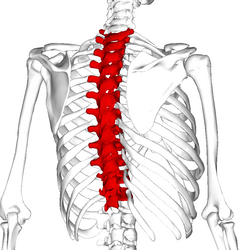
In vertebrates, thoracic vertebrae compose the middle segment of the vertebral column, between the cervical vertebrae and the lumbar vertebrae. In humans, there are twelve thoracic vertebrae of intermediate size between the cervical and lumbar vertebrae; they increase in size going towards the lumbar vertebrae.[citation needed] They are distinguished by the presence of facets on the sides of the bodies for articulation with the heads of the ribs, as well as facets on the transverse processes of all, except the eleventh and twelfth, for articulation with the tubercles of the ribs. By convention, the human thoracic vertebrae are numbered T1–T12, with the first one (T1) located closest to the skull and the others going down the spine toward the lumbar region.
These are the general characteristics of the second through eighth thoracic vertebrae. The first and ninth through twelfth vertebrae contain certain peculiarities, and are detailed below.
The vertebral bodies in the middle of the thoracic region are heart-shaped and as broad in the anteroposterior as in the transverse direction. At the ends of the thoracic region they resemble respectively those of the cervical and lumbar vertebrae. They are slightly thicker behind than in front, flat above and below, convex from side to side in front, deeply concave behind, and slightly constricted laterally and in front. They present, on either side, two costal demi-facets, one above, near the root of the pedicle, the other below, in front of the inferior vertebral notch; these are covered with cartilage in the fresh state, and, when the vertebrae are articulated with one another, form, with the intervening intervertebral fibrocartilages, oval surfaces for the reception of the heads of the ribs.
The pedicles are directed backward and slightly upward, and the inferior vertebral notches are of large size, and deeper than in any other region of the vertebral column.
The laminae are broad, thick, and imbricated – that is to say, they overlap those of subjacent vertebrae like tiles on a roof and connect with the pedicles to surround and protect the spinal cord.
The intervertebral foramen is small, and circular, with two at each intervertebral level, one for the right and one for the left exiting nerve roots.
The vertebral foramen is the large opening posterior to the vertebral body also known as the spinal canal. It contains and protects the spinal cord at the thoracic level.
The spinous process is long, triangular on coronal section, directed obliquely downward, arising from the lamina and ending in a tuberculated extremity. These processes overlap from the fifth to the eighth, but are less oblique in direction above and below.
Thoracic vertebrae
In vertebrates, thoracic vertebrae compose the middle segment of the vertebral column, between the cervical vertebrae and the lumbar vertebrae. In humans, there are twelve thoracic vertebrae of intermediate size between the cervical and lumbar vertebrae; they increase in size going towards the lumbar vertebrae.[citation needed] They are distinguished by the presence of facets on the sides of the bodies for articulation with the heads of the ribs, as well as facets on the transverse processes of all, except the eleventh and twelfth, for articulation with the tubercles of the ribs. By convention, the human thoracic vertebrae are numbered T1–T12, with the first one (T1) located closest to the skull and the others going down the spine toward the lumbar region.
These are the general characteristics of the second through eighth thoracic vertebrae. The first and ninth through twelfth vertebrae contain certain peculiarities, and are detailed below.
The vertebral bodies in the middle of the thoracic region are heart-shaped and as broad in the anteroposterior as in the transverse direction. At the ends of the thoracic region they resemble respectively those of the cervical and lumbar vertebrae. They are slightly thicker behind than in front, flat above and below, convex from side to side in front, deeply concave behind, and slightly constricted laterally and in front. They present, on either side, two costal demi-facets, one above, near the root of the pedicle, the other below, in front of the inferior vertebral notch; these are covered with cartilage in the fresh state, and, when the vertebrae are articulated with one another, form, with the intervening intervertebral fibrocartilages, oval surfaces for the reception of the heads of the ribs.
The pedicles are directed backward and slightly upward, and the inferior vertebral notches are of large size, and deeper than in any other region of the vertebral column.
The laminae are broad, thick, and imbricated – that is to say, they overlap those of subjacent vertebrae like tiles on a roof and connect with the pedicles to surround and protect the spinal cord.
The intervertebral foramen is small, and circular, with two at each intervertebral level, one for the right and one for the left exiting nerve roots.
The vertebral foramen is the large opening posterior to the vertebral body also known as the spinal canal. It contains and protects the spinal cord at the thoracic level.
The spinous process is long, triangular on coronal section, directed obliquely downward, arising from the lamina and ending in a tuberculated extremity. These processes overlap from the fifth to the eighth, but are less oblique in direction above and below.
Recent media
Recent media