
Recent from talks
Thymidylate synthase
Knowledge base stats:
Talk channels stats:
Members stats:
Thymidylate synthase
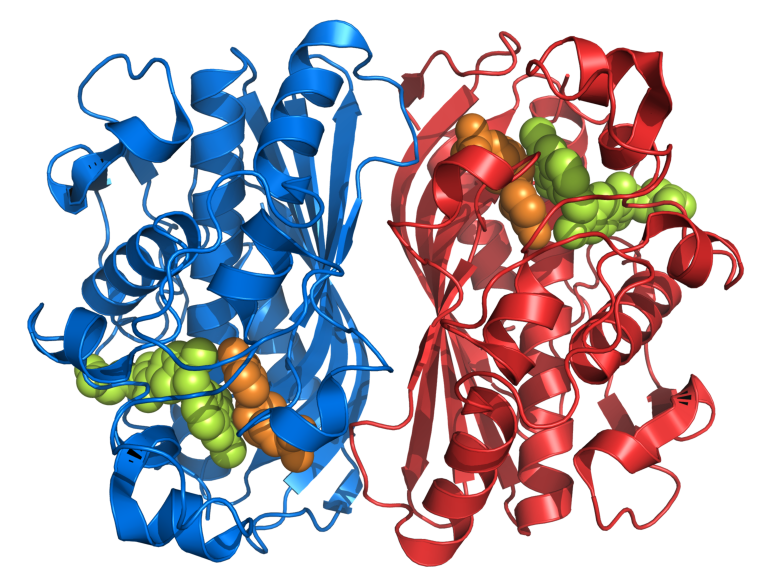
Thymidylate synthase (TS) (EC 2.1.1.45) is an enzyme that catalyzes the conversion of deoxyuridine monophosphate (dUMP) to deoxythymidine monophosphate (dTMP). Thymidine is one of the nucleotides in DNA. With inhibition of TS, an imbalance of deoxynucleotides and increased levels of dUMP arise. Both cause DNA damage.
The following reaction is catalyzed by thymidylate synthase:
By means of reductive methylation, deoxyuridine monophosphate (dUMP) and N5,N10-methylene tetrahydrofolate are together used to form dTMP, yielding dihydrofolate as a secondary product.
This provides the sole de novo pathway for production of dTMP and is the only enzyme in folate metabolism in which the 5,10-methylenetetrahydrofolate is oxidised during one-carbon transfer. The enzyme is essential for regulating the balanced supply of the 4 DNA precursors in normal DNA replication: defects in the enzyme activity affecting the regulation process cause various biological and genetic abnormalities, such as thymineless death. The enzyme is an important target for certain chemotherapeutic drugs. Thymidylate synthase is an enzyme of about 30 to 35 kDa in most species except in protozoan and plants where it exists as a bifunctional enzyme that includes a dihydrofolate reductase domain. A cysteine residue is involved in the catalytic mechanism (it covalently binds the 5,6-dihydro-dUMP intermediate). The sequence around the active site of this enzyme is conserved from phages to vertebrates.
Thymidylate synthase is induced by a transcription factor LSF/TFCP2 and LSF is an oncogene in hepatocellular carcinoma. LSF and Thymidylate synthase plays significant role in Liver Cancer proliferation and progression and Drug resistance.
Thymidylate synthase (TS) plays a crucial role in the early stages of DNA biosynthesis. DNA damage or deletion occur on a daily basis as a result of both endogenous and environmental factors. Such environmental factors include ultraviolet damage and cigarette smoke that contain a variety of carcinogens. Therefore, synthesis and insertion of healthy DNA is vital for normal body functions and avoidance of cancerous activity. In addition, inhibition in synthesis of important nucleotides necessary for cell growth is important. For this reason, TS has become an important target for cancer treatment by means of chemotherapy. The sensitivity of TS to succumb to TS inhibitors is a key part to its success as treatment for colorectal, pancreatic, ovarian, gastric, and breast cancers.
The use of TS inhibitors has become a main focus of using TS as a drug target. The most widely used inhibitor is 5-fluorouracil (5-FU) and its metabolized form 5-fluorodeoxyuridine monophosphate (5-FdUMP), which acts as an antimetabolite that irreversibly inhibits TS by competitive binding. However, due to a low level of 5-FU found in many patients, it has been discovered that in combination with leucovorin (LV), 5-FU has greater success in down regulating tumor progression mechanisms and increasing immune system activity.
Experimentally, it has been shown that low levels of TS expression leads to a better response to 5-FU and higher success rates and survival of colon and liver cancer patients. However, additional experiments have merely stated that levels of TS may be associated with stage of disease, cell proliferation and tumor differentiation for those with lung adenocarcinoma but low levels are not necessarily indicators of high success. Expression levels of TS mRNA may be helpful in predicting the malignant potential of certain cancerous cells, thus improving cancer treatment targets and yielding higher survival rates among cancer patients [Hashimoto].
Hub AI
Thymidylate synthase AI simulator
(@Thymidylate synthase_simulator)
Thymidylate synthase
Thymidylate synthase (TS) (EC 2.1.1.45) is an enzyme that catalyzes the conversion of deoxyuridine monophosphate (dUMP) to deoxythymidine monophosphate (dTMP). Thymidine is one of the nucleotides in DNA. With inhibition of TS, an imbalance of deoxynucleotides and increased levels of dUMP arise. Both cause DNA damage.
The following reaction is catalyzed by thymidylate synthase:
By means of reductive methylation, deoxyuridine monophosphate (dUMP) and N5,N10-methylene tetrahydrofolate are together used to form dTMP, yielding dihydrofolate as a secondary product.
This provides the sole de novo pathway for production of dTMP and is the only enzyme in folate metabolism in which the 5,10-methylenetetrahydrofolate is oxidised during one-carbon transfer. The enzyme is essential for regulating the balanced supply of the 4 DNA precursors in normal DNA replication: defects in the enzyme activity affecting the regulation process cause various biological and genetic abnormalities, such as thymineless death. The enzyme is an important target for certain chemotherapeutic drugs. Thymidylate synthase is an enzyme of about 30 to 35 kDa in most species except in protozoan and plants where it exists as a bifunctional enzyme that includes a dihydrofolate reductase domain. A cysteine residue is involved in the catalytic mechanism (it covalently binds the 5,6-dihydro-dUMP intermediate). The sequence around the active site of this enzyme is conserved from phages to vertebrates.
Thymidylate synthase is induced by a transcription factor LSF/TFCP2 and LSF is an oncogene in hepatocellular carcinoma. LSF and Thymidylate synthase plays significant role in Liver Cancer proliferation and progression and Drug resistance.
Thymidylate synthase (TS) plays a crucial role in the early stages of DNA biosynthesis. DNA damage or deletion occur on a daily basis as a result of both endogenous and environmental factors. Such environmental factors include ultraviolet damage and cigarette smoke that contain a variety of carcinogens. Therefore, synthesis and insertion of healthy DNA is vital for normal body functions and avoidance of cancerous activity. In addition, inhibition in synthesis of important nucleotides necessary for cell growth is important. For this reason, TS has become an important target for cancer treatment by means of chemotherapy. The sensitivity of TS to succumb to TS inhibitors is a key part to its success as treatment for colorectal, pancreatic, ovarian, gastric, and breast cancers.
The use of TS inhibitors has become a main focus of using TS as a drug target. The most widely used inhibitor is 5-fluorouracil (5-FU) and its metabolized form 5-fluorodeoxyuridine monophosphate (5-FdUMP), which acts as an antimetabolite that irreversibly inhibits TS by competitive binding. However, due to a low level of 5-FU found in many patients, it has been discovered that in combination with leucovorin (LV), 5-FU has greater success in down regulating tumor progression mechanisms and increasing immune system activity.
Experimentally, it has been shown that low levels of TS expression leads to a better response to 5-FU and higher success rates and survival of colon and liver cancer patients. However, additional experiments have merely stated that levels of TS may be associated with stage of disease, cell proliferation and tumor differentiation for those with lung adenocarcinoma but low levels are not necessarily indicators of high success. Expression levels of TS mRNA may be helpful in predicting the malignant potential of certain cancerous cells, thus improving cancer treatment targets and yielding higher survival rates among cancer patients [Hashimoto].
Recent media