A Timed Event System defining the state trajectory associated with the current and event segments came from the class of General System to allows non-deterministic behaviors in it.[3] Since the behaviors of DEVS can be described by Timed Event System, DEVS and RTDEVS is a sub-class or an equivalent class of Timed Event System.
A timed event system is a structure

where
 is the set of events;
 is the set of states;
 is the set of initial states;
 is the set of accepting states;
![{\displaystyle \Delta \subseteq Q\times \Omega _{Z,[t_{l},t_{u}]}\times Q}](https://wikimedia.org/api/rest_v1/media/math/render/svg/dd4aa1a8249e4c2515cbf417a658ae967a8c0215) is the set of state trajectories in which
is the set of state trajectories in which 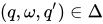 indicates that a state
  can change into
  along with an event segment
 ![{\displaystyle \omega \in \Omega _{Z,[t_{l},t_{u}]}}](https://wikimedia.org/api/rest_v1/media/math/render/svg/b7cfe075628a7736029e86ae72332f6f2c53bfb9) . If two state trajectories
. If two state trajectories  and
and  are called contiguous if
  , and two event trajectories
  and
and  are contiguous. Two contiguous state trajectories
  and
and 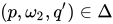 implies
  .
.
Given a timed event system , the set of its behaviors is called its language depending on the
observation time length. Let  be the observation time length.
If
be the observation time length.
If  , -length observation language of
 is denoted by
  , and defined as
![{\displaystyle L({\mathcal {G}},t)=\{\omega \in \Omega _{Z,[0,t]}:\exists (q_{0},\omega ,q)\in \Delta ,q_{0}\in Q_{0},q\in Q_{A}\}.}](https://wikimedia.org/api/rest_v1/media/math/render/svg/208d64904cee9a5882695934e19baef37159d226)
We call an event segment ![{\displaystyle \omega \in \Omega _{Z,[0,t]}}](https://wikimedia.org/api/rest_v1/media/math/render/svg/bfb0d5bc3fdd4876f2b1031c6b0eec316c497056) a -length behavior of , if
a -length behavior of , if  .
.
By sending the observation time length to infinity, we define infinite length observation language of
is denoted by  , and defined as
![{\displaystyle L({\mathcal {G}},\infty )=\{\omega \in {\underset {t\rightarrow \infty }{\lim }}\Omega _{Z,[0,t]}:\exists \{q:(q_{0},\omega ,q)\in \Delta ,q_{0}\in Q_{0}\}\subseteq Q_{A}\}.}](https://wikimedia.org/api/rest_v1/media/math/render/svg/1074fd4431b43b11336aeefc545b6e32ef8c9ad6)
We call an event segment ![{\displaystyle \omega \in {\underset {t\rightarrow \infty }{\lim }}\Omega _{Z,[0,t]}}](https://wikimedia.org/api/rest_v1/media/math/render/svg/e3d49a62bff81d741b329204e536d50753433377) an infinite-length behavior of , if
an infinite-length behavior of , if  .
.





