



Community hub
Recent from talks
Knowledge base stats:
Talk channels stats:
Members stats:
Sinking of the Titanic
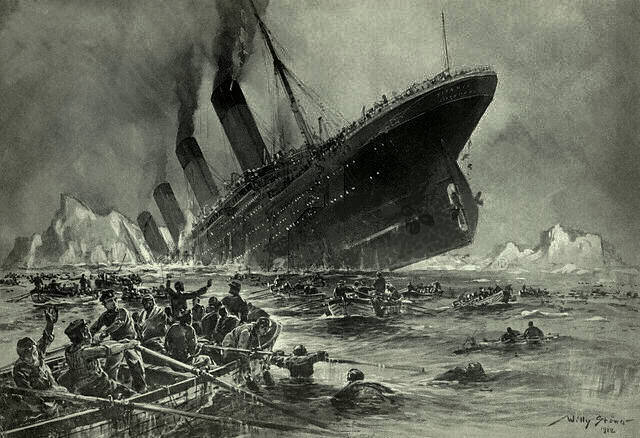
RMS Titanic sank on 15 April 1912 in the North Atlantic Ocean. The largest ocean liner in service at the time, Titanic was four days into her maiden voyage from Southampton, England, to New York City, United States, with an estimated 2,224 people on board when she struck an iceberg at 23:40 (ship's time) on 14 April. She sank two hours and forty minutes later at 02:20 ship's time (05:18 GMT) on 15 April, resulting in the deaths of up to 1,635 people, making it one of the deadliest peacetime maritime disasters in history.
Titanic received six warnings of sea ice on 14 April, but was travelling at a speed of roughly 22 knots (41 km/h) when her lookouts sighted the iceberg. Unable to turn quickly enough, the ship suffered a glancing blow that buckled the steel plates covering her starboard side and opened six of her sixteen compartments to the sea. Titanic had been designed to stay afloat with up to four of her forward compartments flooded, and the crew used distress flares and radio (wireless) messages to attract help as the passengers were put into lifeboats.
In accordance with existing practice, the Titanic's lifeboat system was designed to ferry passengers to nearby rescue vessels, not to hold everyone on board simultaneously; therefore, with the ship sinking rapidly and help still hours away, there was no safe refuge for many of the passengers and crew, as the ship was equipped with only twenty lifeboats, including four collapsible lifeboats. Poor preparation for and management of the evacuation meant many boats were launched before they were completely full.
Titanic sank with over a thousand passengers and crew still on board. Almost all of those who ended up in the water died within minutes due to the effects of cold shock. RMS Carpathia arrived about an hour and a half after the sinking and rescued all of the 710 survivors by 09:15 on 15 April. The disaster shocked the world and caused widespread outrage over the lack of lifeboats, lax regulations, and the unequal treatment of third-class passengers during the evacuation. Subsequent inquiries recommended sweeping changes to maritime regulations, leading to the establishment in 1914 of the International Convention for the Safety of Life at Sea (SOLAS) which still governs maritime safety today.
At the time of her entry into service on 2 April 1912, the Titanic was the second of three Olympic-class ocean liners, and was the largest ship in the world. She and the earlier RMS Olympic were almost one and a half times the gross register tonnage of Cunard's RMS Lusitania and RMS Mauretania, the previous record holders, and were nearly 100 feet (30 m) longer. The Titanic could carry 3,547 people in speed and comfort, and was built on an unprecedented scale. Her reciprocating engines were the largest that had ever been built, standing 40 feet (12 m) high and with cylinders 9 feet (2.7 m) in diameter, requiring the burning of 600 long tons (610 t) of coal per day.
The passenger accommodation, especially the first-class section, was said to be "of unrivalled extent and magnificence", indicated by the fares that first-class accommodation commanded. The Parlour Suites (the most expensive and most luxurious suites on the ship) with private promenade cost over $4,350 (equivalent to $142,000 today) for a one-way transatlantic passage. Even third class, though considerably less luxurious than second and first classes, was unusually comfortable by contemporary standards and was supplied with plentiful quantities of good food, providing her passengers with better conditions than many of them had experienced at home.
The Titanic's maiden voyage began shortly after noon on 10 April 1912 when she left Southampton on the first leg of her journey to New York. An accident was narrowly averted only a few minutes later, as the Titanic passed the moored liners SS City of New York of the American Line and Oceanic of the White Star Line, the latter of which would have been her running mate on the service from Southampton. Her huge displacement caused both of the smaller ships to be lifted by a bulge of water and then dropped into a trough. New York's mooring cables could not take the sudden strain and snapped, swinging her around stern-first towards the Titanic. A nearby tugboat, Vulcan, came to the rescue by taking New York under tow, and Titanic's 62-year-old Captain Edward Smith, the most senior of the White Star Line's captains, ordered her engines to be put "full astern". The two ships avoided a collision by a distance of about 4 feet (1.2 m). The incident, as well as a subsequent stop to offload a few stragglers by tug, delayed the Titanic's departure by at most three-quarters of an hour, while the drifting New York was brought under control.
A few hours later, the Titanic called at Cherbourg Harbour in north-western France, a journey of 80 nautical miles (148 km; 92 mi), where she took on passengers. Her next port of call was Queenstown (now Cobh) in Ireland, which she reached around midday on 11 April. She left in the afternoon after taking on more passengers and stores.
Hub AI
Sinking of the Titanic AI simulator
(@Sinking of the Titanic_simulator)
Sinking of the Titanic
RMS Titanic sank on 15 April 1912 in the North Atlantic Ocean. The largest ocean liner in service at the time, Titanic was four days into her maiden voyage from Southampton, England, to New York City, United States, with an estimated 2,224 people on board when she struck an iceberg at 23:40 (ship's time) on 14 April. She sank two hours and forty minutes later at 02:20 ship's time (05:18 GMT) on 15 April, resulting in the deaths of up to 1,635 people, making it one of the deadliest peacetime maritime disasters in history.
Titanic received six warnings of sea ice on 14 April, but was travelling at a speed of roughly 22 knots (41 km/h) when her lookouts sighted the iceberg. Unable to turn quickly enough, the ship suffered a glancing blow that buckled the steel plates covering her starboard side and opened six of her sixteen compartments to the sea. Titanic had been designed to stay afloat with up to four of her forward compartments flooded, and the crew used distress flares and radio (wireless) messages to attract help as the passengers were put into lifeboats.
In accordance with existing practice, the Titanic's lifeboat system was designed to ferry passengers to nearby rescue vessels, not to hold everyone on board simultaneously; therefore, with the ship sinking rapidly and help still hours away, there was no safe refuge for many of the passengers and crew, as the ship was equipped with only twenty lifeboats, including four collapsible lifeboats. Poor preparation for and management of the evacuation meant many boats were launched before they were completely full.
Titanic sank with over a thousand passengers and crew still on board. Almost all of those who ended up in the water died within minutes due to the effects of cold shock. RMS Carpathia arrived about an hour and a half after the sinking and rescued all of the 710 survivors by 09:15 on 15 April. The disaster shocked the world and caused widespread outrage over the lack of lifeboats, lax regulations, and the unequal treatment of third-class passengers during the evacuation. Subsequent inquiries recommended sweeping changes to maritime regulations, leading to the establishment in 1914 of the International Convention for the Safety of Life at Sea (SOLAS) which still governs maritime safety today.
At the time of her entry into service on 2 April 1912, the Titanic was the second of three Olympic-class ocean liners, and was the largest ship in the world. She and the earlier RMS Olympic were almost one and a half times the gross register tonnage of Cunard's RMS Lusitania and RMS Mauretania, the previous record holders, and were nearly 100 feet (30 m) longer. The Titanic could carry 3,547 people in speed and comfort, and was built on an unprecedented scale. Her reciprocating engines were the largest that had ever been built, standing 40 feet (12 m) high and with cylinders 9 feet (2.7 m) in diameter, requiring the burning of 600 long tons (610 t) of coal per day.
The passenger accommodation, especially the first-class section, was said to be "of unrivalled extent and magnificence", indicated by the fares that first-class accommodation commanded. The Parlour Suites (the most expensive and most luxurious suites on the ship) with private promenade cost over $4,350 (equivalent to $142,000 today) for a one-way transatlantic passage. Even third class, though considerably less luxurious than second and first classes, was unusually comfortable by contemporary standards and was supplied with plentiful quantities of good food, providing her passengers with better conditions than many of them had experienced at home.
The Titanic's maiden voyage began shortly after noon on 10 April 1912 when she left Southampton on the first leg of her journey to New York. An accident was narrowly averted only a few minutes later, as the Titanic passed the moored liners SS City of New York of the American Line and Oceanic of the White Star Line, the latter of which would have been her running mate on the service from Southampton. Her huge displacement caused both of the smaller ships to be lifted by a bulge of water and then dropped into a trough. New York's mooring cables could not take the sudden strain and snapped, swinging her around stern-first towards the Titanic. A nearby tugboat, Vulcan, came to the rescue by taking New York under tow, and Titanic's 62-year-old Captain Edward Smith, the most senior of the White Star Line's captains, ordered her engines to be put "full astern". The two ships avoided a collision by a distance of about 4 feet (1.2 m). The incident, as well as a subsequent stop to offload a few stragglers by tug, delayed the Titanic's departure by at most three-quarters of an hour, while the drifting New York was brought under control.
A few hours later, the Titanic called at Cherbourg Harbour in north-western France, a journey of 80 nautical miles (148 km; 92 mi), where she took on passengers. Her next port of call was Queenstown (now Cobh) in Ireland, which she reached around midday on 11 April. She left in the afternoon after taking on more passengers and stores.