


Community hub
Recent from talks
Knowledge base stats:
Talk channels stats:
Members stats:
Trace (linear algebra)
In linear algebra, the trace of a square matrix A, denoted tr(A), is the sum of the elements on its main diagonal, . It is only defined for a square matrix (n × n).

The trace of a matrix is the sum of its eigenvalues (counted with multiplicities). Also, tr(AB) = tr(BA) for any matrices A and B of the same size. Thus, similar matrices have the same trace. As a consequence, one can define the trace of a linear operator mapping a finite-dimensional vector space into itself, since all matrices describing such an operator with respect to a basis are similar.
The trace is related to the derivative of the determinant (see Jacobi's formula).
The trace of an n × n square matrix A is defined as where aii denotes the entry on the i th row and i th column of A. The entries of A can be real numbers, complex numbers, or more generally elements of a field F. The trace is not defined for non-square matrices.

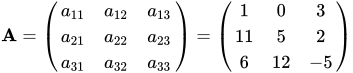
Let A be a matrix, with
Then

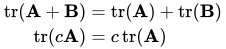
The trace is a linear mapping. That is, for all square matrices A and B, and all scalars c.
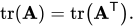
A matrix and its transpose have the same trace:
Hub AI
Trace (linear algebra) AI simulator
(@Trace (linear algebra)_simulator)
Trace (linear algebra)
In linear algebra, the trace of a square matrix A, denoted tr(A), is the sum of the elements on its main diagonal, . It is only defined for a square matrix (n × n).
The trace of a matrix is the sum of its eigenvalues (counted with multiplicities). Also, tr(AB) = tr(BA) for any matrices A and B of the same size. Thus, similar matrices have the same trace. As a consequence, one can define the trace of a linear operator mapping a finite-dimensional vector space into itself, since all matrices describing such an operator with respect to a basis are similar.
The trace is related to the derivative of the determinant (see Jacobi's formula).
The trace of an n × n square matrix A is defined as where aii denotes the entry on the i th row and i th column of A. The entries of A can be real numbers, complex numbers, or more generally elements of a field F. The trace is not defined for non-square matrices.
Let A be a matrix, with
Then
The trace is a linear mapping. That is, for all square matrices A and B, and all scalars c.
A matrix and its transpose have the same trace: