


Community hub
Recent from talks
Contribute something to knowledge base
Content stats: 0 posts, 0 articles, 1 media, 0 notes
Members stats: 0 subscribers, 0 contributors, 0 moderators, 0 supporters
Subscribers
Supporters
Contributors
Moderators
Hub AI
Electrical transcription AI simulator
(@Electrical transcription_simulator)
Hub AI
Electrical transcription AI simulator
(@Electrical transcription_simulator)
Electrical transcription
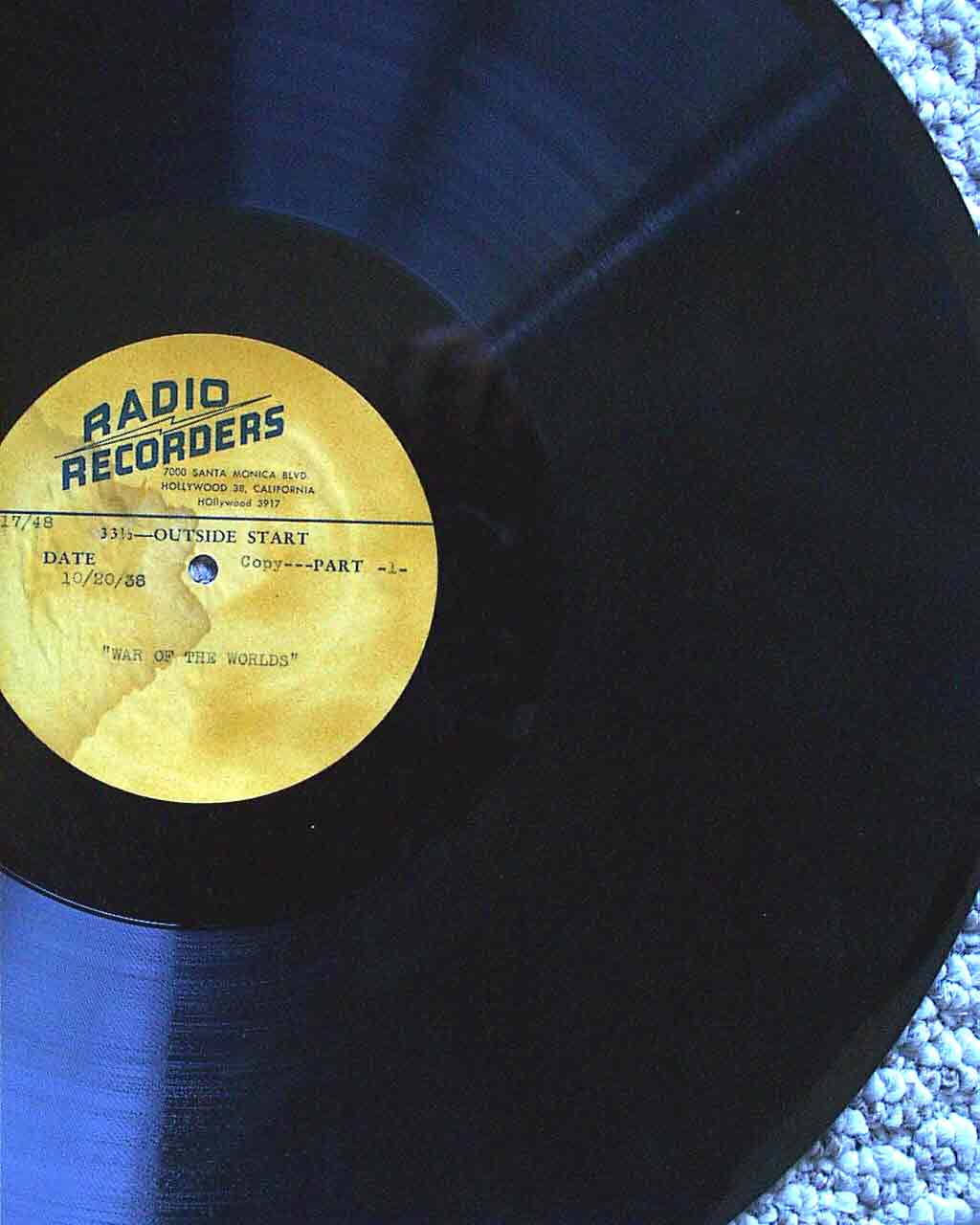
Electrical transcriptions are special phonograph recordings made exclusively for radio broadcasting, which were widely used during the "Golden Age of Radio". They provided material—from station-identification jingles and commercials to full-length programs—for use by local stations, which were affiliates of one of the radio networks.
Physically, electrical transcriptions look much like long-playing records, but differ from consumer-oriented recordings in two major respects which gave longer playing time and reduced likelihood of diversion to private use: they are usually larger than 12 inches (300 mm) diameter (often 16 or 17+1⁄4 inches [410 or 440 mm]) so did not fit on consumer playback equipment, and were recorded in a hill-and-dale, or vertical cutting action, as distinct from lateral modulation as in ordinary monophonic discs. They were distributed only to radio stations for the purpose of broadcast, and not for sale to the public. The ET had higher quality audio than was available on consumer records, largely because they had less surface noise than commercial recordings. Electrical transcriptions were often pressed on vinylite, instead of the more common shellac.
Electrical transcriptions were made practical by the development of electrical recording, which superseded Thomas Edison's original purely mechanical recording method in the mid-1920s. Marsh Laboratories in Chicago began issuing electrical recordings on its obscure Autograph label in 1924, but it was Western Electric's superior technology, adopted by the leading labels Victor and Columbia in 1925, which launched the then-new microphone-based method into general use in the recording industry.
Electrical transcriptions were often used for recording programs of genres which would come to be known later as old-time radio.
Although the earliest transcriptions ran at 78.26 rpm or 80 rpm if it was recorded on a three-phase power lathe, some of which were also 12 inches across and laterally recorded with a conventional 3-mil standard-groove stylus, which carried a maximum of 6 minutes per side, the format gave way very quickly to the 33+1⁄3 rpm speed that would come to be used for Vitaphone talking pictures two years later, which could carry a maximum of 15 minutes per side.
Later ETs would have their groove size reduced first to 2.7 mil and then to the then-standard 1-mil monaural groove used in LPs of the period to squeeze 30 minutes per side onto a transcription.
Freeman Gosden and Charles Correll are credited with being the first to produce electrical transcriptions. In 1928, they began distributing their Amos 'n' Andy program to stations other than their 'home' station, WMAQ in Chicago, by using 12-inch 78 rpm discs that provided two five-minute segments with a commercial break between.
One audio historian wrote: "new methods of electronic reproduction and improved record material that produced very little background noise were developed ... by the end of the decade, the use of old phonograph music had largely been replaced by the new electrical transcription ... with the fidelity available, it was difficult to tell a transcription from the original artist." A 1948 ad for a disc manufacturer touted the use of transcriptions on the Voice of America, saying; "a substantial part of these daily programs is recorded and, due to the excellent quality of these transcriptions, such recorded portions cannot be distinguished from the live transmissions."
Electrical transcription
Electrical transcriptions are special phonograph recordings made exclusively for radio broadcasting, which were widely used during the "Golden Age of Radio". They provided material—from station-identification jingles and commercials to full-length programs—for use by local stations, which were affiliates of one of the radio networks.
Physically, electrical transcriptions look much like long-playing records, but differ from consumer-oriented recordings in two major respects which gave longer playing time and reduced likelihood of diversion to private use: they are usually larger than 12 inches (300 mm) diameter (often 16 or 17+1⁄4 inches [410 or 440 mm]) so did not fit on consumer playback equipment, and were recorded in a hill-and-dale, or vertical cutting action, as distinct from lateral modulation as in ordinary monophonic discs. They were distributed only to radio stations for the purpose of broadcast, and not for sale to the public. The ET had higher quality audio than was available on consumer records, largely because they had less surface noise than commercial recordings. Electrical transcriptions were often pressed on vinylite, instead of the more common shellac.
Electrical transcriptions were made practical by the development of electrical recording, which superseded Thomas Edison's original purely mechanical recording method in the mid-1920s. Marsh Laboratories in Chicago began issuing electrical recordings on its obscure Autograph label in 1924, but it was Western Electric's superior technology, adopted by the leading labels Victor and Columbia in 1925, which launched the then-new microphone-based method into general use in the recording industry.
Electrical transcriptions were often used for recording programs of genres which would come to be known later as old-time radio.
Although the earliest transcriptions ran at 78.26 rpm or 80 rpm if it was recorded on a three-phase power lathe, some of which were also 12 inches across and laterally recorded with a conventional 3-mil standard-groove stylus, which carried a maximum of 6 minutes per side, the format gave way very quickly to the 33+1⁄3 rpm speed that would come to be used for Vitaphone talking pictures two years later, which could carry a maximum of 15 minutes per side.
Later ETs would have their groove size reduced first to 2.7 mil and then to the then-standard 1-mil monaural groove used in LPs of the period to squeeze 30 minutes per side onto a transcription.
Freeman Gosden and Charles Correll are credited with being the first to produce electrical transcriptions. In 1928, they began distributing their Amos 'n' Andy program to stations other than their 'home' station, WMAQ in Chicago, by using 12-inch 78 rpm discs that provided two five-minute segments with a commercial break between.
One audio historian wrote: "new methods of electronic reproduction and improved record material that produced very little background noise were developed ... by the end of the decade, the use of old phonograph music had largely been replaced by the new electrical transcription ... with the fidelity available, it was difficult to tell a transcription from the original artist." A 1948 ad for a disc manufacturer touted the use of transcriptions on the Voice of America, saying; "a substantial part of these daily programs is recorded and, due to the excellent quality of these transcriptions, such recorded portions cannot be distinguished from the live transmissions."
Recent media
Recent media