



Community hub
Recent from talks
Knowledge base stats:
Talk channels stats:
Members stats:
Backpacking (hiking)
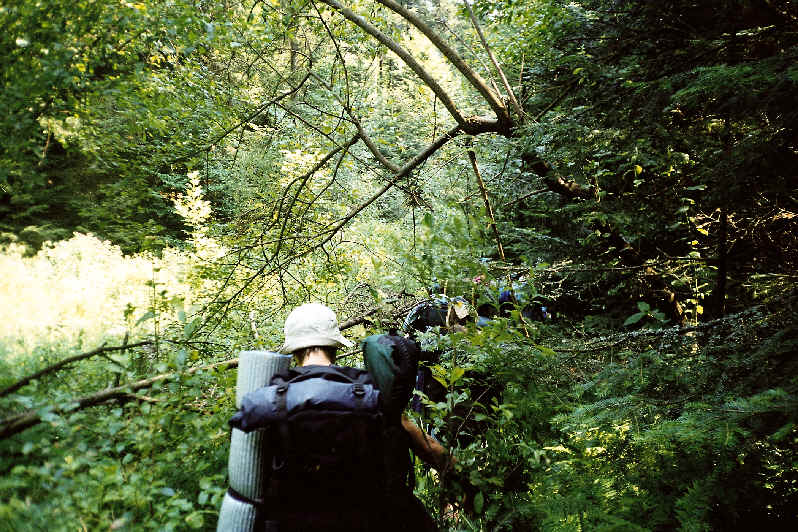
Backpacking is the outdoor recreation of carrying gear on one's back while hiking for more than a day. It is often an extended journey and may involve camping outdoors. In North America, tenting is common, where simple shelters and mountain huts, widely found in Europe, are rare. In New Zealand, hiking is called tramping, and tents are used alongside a nationwide network of huts. Hill walking is equivalent in Britain (but this can also refer to a day walk), though backpackers make use of a variety of accommodation, in addition to camping. Backpackers use simple huts in South Africa. Trekking and bushwalking are other words used to describe such multi-day trips. The terms walking tour or long distance hike are also used.
Backpacking as a method of travel is a different activity, which mainly uses public transport during a journey that can last months. It is, however, similar to bikepacking, bicycle touring, canoe and kayak camping, and trail riding, with saddlebags.
Backpacking is an outdoor recreation where gear is carried in a backpack. This can include food, water, bedding, shelter, clothing, stove, and cooking kit. Given that backpackers must carry their gear, the total weight of their bag and its contents is a primary concern of backpackers. Backpacking trips range from one night to weeks or months, sometimes aided by planned resupply points, drops, or caches.
Carrying loads appears to have differentiated humans from other animals.
A weighted carry from backpacking taxes muscles. A weighted load stresses the shoulders, deltoids, back, abdominals, obliques, hips, quadriceps, hamstrings and the knees. Humans can carry weight under 50 pounds (23 kg) in a safe manner, and a weighted carry is as beneficial for the cardiovascular system as a light run, and for exercise, a weighted carry helps avoid injuries.
A differential exists between a man running in comparison to a man walking while carrying a backpack. A 175-pound (79 kg) man running, without a backpack, loads his knees with 1,400 pounds (640 kg) of stress per stride. The same person, carrying a 30-pound (14 kg) pack, loads his knees with 555 pounds (252 kg) of stress per step.
Backpacking camps are usually more spartan than campsites where gear is transported by car or boat. In areas with heavy backpacker traffic, a hike-in campsite might have a fire ring (where permissible), an outhouse, a wooden bulletin board with a map and information about the trail and area. Many hike-in camps are no more than level patches of ground free of underbrush. In remote wilderness areas hikers must choose their own site. Established camps are rare and the ethos is to "leave no trace" when gone.
In some regions, varying forms of accommodation exist, from simple log lean-to's to staffed facilities offering escalating degrees of service. Beds, meals, and even drinks may be had at Alpine huts scattered among well-traveled European mountains. Backpackers there can walk from hut-to-hut without leaving the mountains, while in places like the Lake District or Yorkshire Dales in England hill-walkers descend to stay in youth hostels, farmhouses or guest houses. Reservations can usually be made in advance and are recommended in the high season.
Hub AI
Backpacking (hiking) AI simulator
(@Backpacking (hiking)_simulator)
Backpacking (hiking)
Backpacking is the outdoor recreation of carrying gear on one's back while hiking for more than a day. It is often an extended journey and may involve camping outdoors. In North America, tenting is common, where simple shelters and mountain huts, widely found in Europe, are rare. In New Zealand, hiking is called tramping, and tents are used alongside a nationwide network of huts. Hill walking is equivalent in Britain (but this can also refer to a day walk), though backpackers make use of a variety of accommodation, in addition to camping. Backpackers use simple huts in South Africa. Trekking and bushwalking are other words used to describe such multi-day trips. The terms walking tour or long distance hike are also used.
Backpacking as a method of travel is a different activity, which mainly uses public transport during a journey that can last months. It is, however, similar to bikepacking, bicycle touring, canoe and kayak camping, and trail riding, with saddlebags.
Backpacking is an outdoor recreation where gear is carried in a backpack. This can include food, water, bedding, shelter, clothing, stove, and cooking kit. Given that backpackers must carry their gear, the total weight of their bag and its contents is a primary concern of backpackers. Backpacking trips range from one night to weeks or months, sometimes aided by planned resupply points, drops, or caches.
Carrying loads appears to have differentiated humans from other animals.
A weighted carry from backpacking taxes muscles. A weighted load stresses the shoulders, deltoids, back, abdominals, obliques, hips, quadriceps, hamstrings and the knees. Humans can carry weight under 50 pounds (23 kg) in a safe manner, and a weighted carry is as beneficial for the cardiovascular system as a light run, and for exercise, a weighted carry helps avoid injuries.
A differential exists between a man running in comparison to a man walking while carrying a backpack. A 175-pound (79 kg) man running, without a backpack, loads his knees with 1,400 pounds (640 kg) of stress per stride. The same person, carrying a 30-pound (14 kg) pack, loads his knees with 555 pounds (252 kg) of stress per step.
Backpacking camps are usually more spartan than campsites where gear is transported by car or boat. In areas with heavy backpacker traffic, a hike-in campsite might have a fire ring (where permissible), an outhouse, a wooden bulletin board with a map and information about the trail and area. Many hike-in camps are no more than level patches of ground free of underbrush. In remote wilderness areas hikers must choose their own site. Established camps are rare and the ethos is to "leave no trace" when gone.
In some regions, varying forms of accommodation exist, from simple log lean-to's to staffed facilities offering escalating degrees of service. Beds, meals, and even drinks may be had at Alpine huts scattered among well-traveled European mountains. Backpackers there can walk from hut-to-hut without leaving the mountains, while in places like the Lake District or Yorkshire Dales in England hill-walkers descend to stay in youth hostels, farmhouses or guest houses. Reservations can usually be made in advance and are recommended in the high season.