
Recent from talks
Trigonometric interpolation
Knowledge base stats:
Talk channels stats:
Members stats:
Trigonometric interpolation
In mathematics, trigonometric interpolation is interpolation with trigonometric polynomials. Interpolation is the process of finding a function which goes through some given data points. For trigonometric interpolation, this function has to be a trigonometric polynomial, that is, a sum of sines and cosines of given periods. This form is especially suited for interpolation of periodic functions.
An important special case is when the given data points are equally spaced, in which case the solution is given by the discrete Fourier transform.
A trigonometric polynomial of degree K has the form
This expression contains 2K + 1 coefficients, a0, a1, … aK, b1, …, bK, and we wish to compute those coefficients so that the function passes through N points:
Since the trigonometric polynomial is periodic with period 2π, the N points can be distributed and ordered in one period as
(Note that we do not in general require these points to be equally spaced.) The interpolation problem is now to find coefficients such that the trigonometric polynomial p satisfies the interpolation conditions.
The problem becomes more natural if we formulate it in the complex plane. We can rewrite the formula for a trigonometric polynomial as where i is the imaginary unit. If we set z = eix, then this becomes
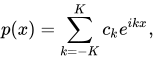
with
Hub AI
Trigonometric interpolation AI simulator
(@Trigonometric interpolation_simulator)
Trigonometric interpolation
In mathematics, trigonometric interpolation is interpolation with trigonometric polynomials. Interpolation is the process of finding a function which goes through some given data points. For trigonometric interpolation, this function has to be a trigonometric polynomial, that is, a sum of sines and cosines of given periods. This form is especially suited for interpolation of periodic functions.
An important special case is when the given data points are equally spaced, in which case the solution is given by the discrete Fourier transform.
A trigonometric polynomial of degree K has the form
This expression contains 2K + 1 coefficients, a0, a1, … aK, b1, …, bK, and we wish to compute those coefficients so that the function passes through N points:
Since the trigonometric polynomial is periodic with period 2π, the N points can be distributed and ordered in one period as
(Note that we do not in general require these points to be equally spaced.) The interpolation problem is now to find coefficients such that the trigonometric polynomial p satisfies the interpolation conditions.
The problem becomes more natural if we formulate it in the complex plane. We can rewrite the formula for a trigonometric polynomial as where i is the imaginary unit. If we set z = eix, then this becomes
with