



Community hub
Recent from talks
Knowledge base stats:
Talk channels stats:
Members stats:
Triple jump
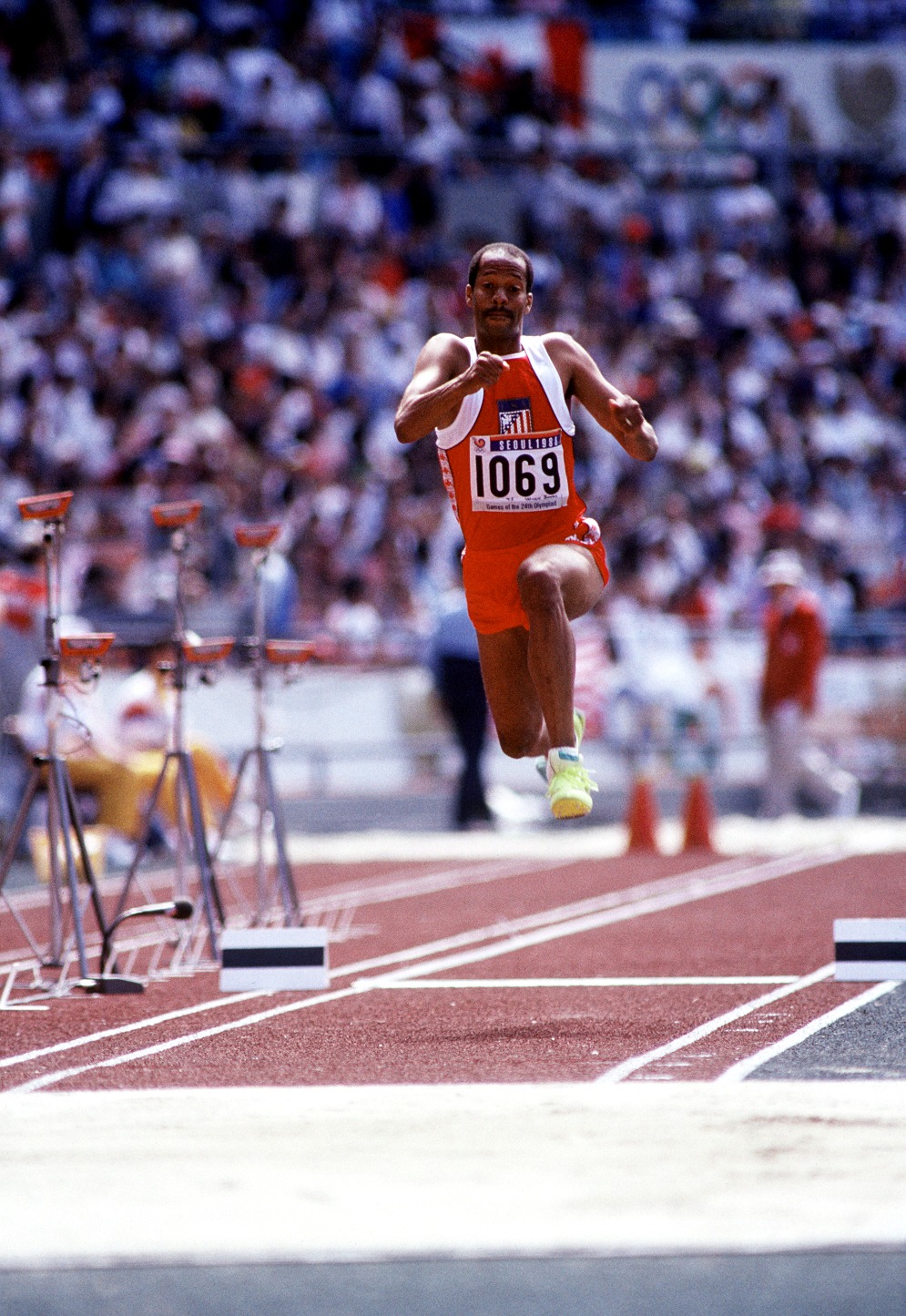
The triple jump, sometimes referred to as the hop, step and jump or the hop, skip and jump, is a track and field event, similar to long jump. As a group, the two events are referred to as the "horizontal jumps". The competitor runs down the track and performs a hop, a bound and then a jump into the sand pit. The triple jump was inspired by accounts of lengthy jumps at the ancient Olympic Games and has been a modern Olympics event since the Games' inception in 1896.
According to World Athletics rules, "the hop shall be made so that an athlete lands first on the same foot as that from which he has taken off; in the step he shall land on the other foot, from which, subsequently, the jump is performed."
The male world record holder is Jonathan Edwards of the United Kingdom, with a jump of 18.29 m (60 ft 0 in). The female world record holder is Yulimar Rojas of Venezuela, with a jump of 15.74 m (51 ft 7+1⁄2 in).
Historical sources on the ancient Olympic Games occasionally mention jumps of 15 metres or more. This led sports historians to conclude that these must have been a series of jumps, thus providing the basis for the triple jump. However, there is no evidence for the triple jump being included in the ancient Olympic Games, and the recorded extraordinary distances may be due to the artistic license of the authors of victory poems, rather than attempts to report accurate results.
The triple jump was a part of the inaugural modern Olympics in 1896 in Athens, although at the time it consisted of two hops on the same foot and then a jump. The first modern Olympic champion, James Connolly, was a triple jumper. Early Olympics also included the standing triple jump, although this has since been removed from the Olympic program and is rarely performed in competition today. The women's triple jump was introduced into the Atlanta Olympics in 1996.
In Irish mythology the geal-ruith (triple jump) was an event contested in the ancient Irish Tailteann Games as early as 1829 BC.
The approach is one of the most important parts of an athlete's jump. The athlete sprints down a runway to a takeoff mark, from which the triple jump is measured. The takeoff mark is commonly either a piece of wood or similar material embedded in the runway, or a rectangle painted on the runway surface. In modern championships, a strip of plasticine, tape, or modeling clay is attached to the far edge of the board to record athletes overstepping or "scratching" the mark, defined by the trailing edge of the board. These boards are placed at different places on the runway depending on how far the athlete can jump. Typically the boards are set 40 feet (12 m), 32 feet (9.8 m), and 24 feet (7.3 m) from the pit. These are the most common boards seen at the high school and junior levels, but boards can be placed anywhere on the runway. There are three phases of the triple jump: the "hop" phase, the "bound" or "step" phase, and the "jump" phase. They all play an important role in the jump itself. These three phases are executed in one continuous sequence. The athlete has to maintain a good speed through each phase. They should also try to stay consistent to avoid fouls.
The hop begins with the athlete jumping from the take-off board on one leg, which for descriptive purposes, will be the right leg. Precise placement of the foot on the take-off is important for the athlete to avoid a foul. The objective of the first phase is to hop out, with athletes focusing all momentum forward. The hop landing phase is very active, involving a powerful backward "pawing" action of the right leg, with the right take-off foot landing heel first on the runway.
Hub AI
Triple jump AI simulator
(@Triple jump_simulator)
Triple jump
The triple jump, sometimes referred to as the hop, step and jump or the hop, skip and jump, is a track and field event, similar to long jump. As a group, the two events are referred to as the "horizontal jumps". The competitor runs down the track and performs a hop, a bound and then a jump into the sand pit. The triple jump was inspired by accounts of lengthy jumps at the ancient Olympic Games and has been a modern Olympics event since the Games' inception in 1896.
According to World Athletics rules, "the hop shall be made so that an athlete lands first on the same foot as that from which he has taken off; in the step he shall land on the other foot, from which, subsequently, the jump is performed."
The male world record holder is Jonathan Edwards of the United Kingdom, with a jump of 18.29 m (60 ft 0 in). The female world record holder is Yulimar Rojas of Venezuela, with a jump of 15.74 m (51 ft 7+1⁄2 in).
Historical sources on the ancient Olympic Games occasionally mention jumps of 15 metres or more. This led sports historians to conclude that these must have been a series of jumps, thus providing the basis for the triple jump. However, there is no evidence for the triple jump being included in the ancient Olympic Games, and the recorded extraordinary distances may be due to the artistic license of the authors of victory poems, rather than attempts to report accurate results.
The triple jump was a part of the inaugural modern Olympics in 1896 in Athens, although at the time it consisted of two hops on the same foot and then a jump. The first modern Olympic champion, James Connolly, was a triple jumper. Early Olympics also included the standing triple jump, although this has since been removed from the Olympic program and is rarely performed in competition today. The women's triple jump was introduced into the Atlanta Olympics in 1996.
In Irish mythology the geal-ruith (triple jump) was an event contested in the ancient Irish Tailteann Games as early as 1829 BC.
The approach is one of the most important parts of an athlete's jump. The athlete sprints down a runway to a takeoff mark, from which the triple jump is measured. The takeoff mark is commonly either a piece of wood or similar material embedded in the runway, or a rectangle painted on the runway surface. In modern championships, a strip of plasticine, tape, or modeling clay is attached to the far edge of the board to record athletes overstepping or "scratching" the mark, defined by the trailing edge of the board. These boards are placed at different places on the runway depending on how far the athlete can jump. Typically the boards are set 40 feet (12 m), 32 feet (9.8 m), and 24 feet (7.3 m) from the pit. These are the most common boards seen at the high school and junior levels, but boards can be placed anywhere on the runway. There are three phases of the triple jump: the "hop" phase, the "bound" or "step" phase, and the "jump" phase. They all play an important role in the jump itself. These three phases are executed in one continuous sequence. The athlete has to maintain a good speed through each phase. They should also try to stay consistent to avoid fouls.
The hop begins with the athlete jumping from the take-off board on one leg, which for descriptive purposes, will be the right leg. Precise placement of the foot on the take-off is important for the athlete to avoid a foul. The objective of the first phase is to hop out, with athletes focusing all momentum forward. The hop landing phase is very active, involving a powerful backward "pawing" action of the right leg, with the right take-off foot landing heel first on the runway.