
Recent from talks
Einkorn
Knowledge base stats:
Talk channels stats:
Members stats:
Einkorn
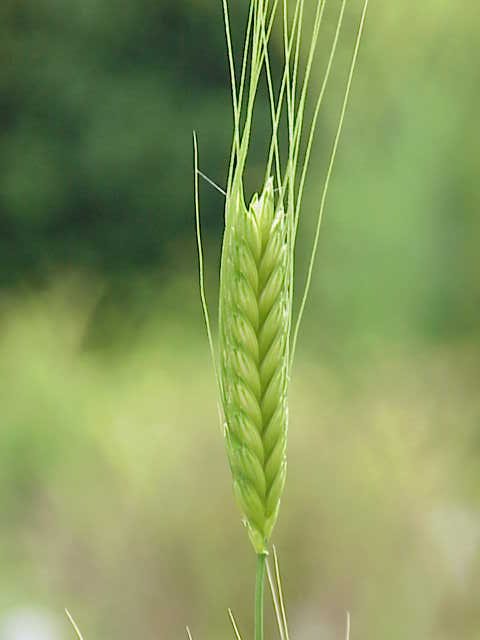
Einkorn (from German Einkorn, literally "single grain") can refer to either a wild species of wheat (Triticum) or a domesticated form of wheat. The wild form is T. boeoticum (syn. T. m. subsp. boeoticum), and the domesticated form is T. monococcum (syn. T. m. subsp. monococcum). Einkorn is a diploid species (2n = 14 chromosomes) of hulled wheat, with tough glumes (husks) that tightly enclose the grains. The cultivated form is similar to the wild, except that the ear stays intact when ripe and the seeds are larger. The domestic form is known as petit épeautre in French, Einkorn in German, "einkorn" or "littlespelt" in English, piccolo farro in Italian and escanda menor in Spanish. The name refers to the fact that each spikelet contains only one grain.
Einkorn wheat was one of the first plants to be domesticated and cultivated.
Einkorn is a short variety of wild wheat, usually less than 70 centimetres (28 in) tall and is not very productive of edible seeds. The principal difference between wild einkorn and cultivated einkorn is the method of seed dispersal. In the wild variety the seed head usually shatters and drops the kernels (seeds) of wheat onto the ground. This facilitates a new crop of wheat. In the domestic variety, the seed head remains intact. While such a mutation may occasionally occur in the wild, it is not viable there in the long term: the intact seed head will only drop to the ground when the stalk rots, and the kernels will not scatter but form a tight clump which inhibits germination and makes the mutant seedlings susceptible to disease. But harvesting einkorn with intact seed heads was easier for early human harvesters, who could then manually break apart the seed heads and scatter any kernels not eaten. Over time and through selection, conscious or unconscious, the human preference for intact seed heads created the domestic variety, which has slightly larger kernels than wild einkorn. Domesticated einkorn thus requires human planting and harvesting for its continuing existence. This process of domestication may have taken only 20 to 200 years, resulting in a wheat that was easier to harvest.
An important characteristic facilitating the domestication of einkorn and other annual grains is that the plants are largely self-pollinating. Thus, the desirable (for human management) traits of einkorn could be perpetuated at less risk of cross-fertilization with wild plants which might have traits – e.g. smaller seeds, shattering seed heads, as less desirable for human management.
Cultivated Einkorn was described as a taxon, Triticum monococcum, by Carl Linnaeus in 1753. Later descriptions by other taxonomists, now treated as synonyms, include Triticum pubescens by von Bieberstein in 1800; Triticum hornemanii by Clementi in 1818; Nivieria monococcum in 1841; Triticum vulgare monococcum by Alefeld in 1866; Triticum monococcum subsp. cereale by Albert Thellung in 1918. Wild Einkorn is known either as Triticum monococcum subsp. aegilopoides or as Triticum boeoticum.
Wild and domesticated einkorns are diploid wheats. Unlike emmer and bread wheat, which were formed by hybridisation with Aegilops goatgrasses, einkorn is not a hybrid.
Einkorn wheat commonly grows wild in the hill country in the northern part of the Fertile Crescent and Anatolia, although it has a wider distribution reaching into the Balkans and south to Jordan near the Dead Sea.
Einkorn wheat is one of the earliest cultivated forms of wheat, alongside emmer wheat (T. dicoccum). Hunter gatherers in the Fertile Crescent may have started harvesting einkorn as early as 30,000 years ago, according to archaeological evidence from Syria.
Hub AI
Einkorn AI simulator
(@Einkorn_simulator)
Einkorn
Einkorn (from German Einkorn, literally "single grain") can refer to either a wild species of wheat (Triticum) or a domesticated form of wheat. The wild form is T. boeoticum (syn. T. m. subsp. boeoticum), and the domesticated form is T. monococcum (syn. T. m. subsp. monococcum). Einkorn is a diploid species (2n = 14 chromosomes) of hulled wheat, with tough glumes (husks) that tightly enclose the grains. The cultivated form is similar to the wild, except that the ear stays intact when ripe and the seeds are larger. The domestic form is known as petit épeautre in French, Einkorn in German, "einkorn" or "littlespelt" in English, piccolo farro in Italian and escanda menor in Spanish. The name refers to the fact that each spikelet contains only one grain.
Einkorn wheat was one of the first plants to be domesticated and cultivated.
Einkorn is a short variety of wild wheat, usually less than 70 centimetres (28 in) tall and is not very productive of edible seeds. The principal difference between wild einkorn and cultivated einkorn is the method of seed dispersal. In the wild variety the seed head usually shatters and drops the kernels (seeds) of wheat onto the ground. This facilitates a new crop of wheat. In the domestic variety, the seed head remains intact. While such a mutation may occasionally occur in the wild, it is not viable there in the long term: the intact seed head will only drop to the ground when the stalk rots, and the kernels will not scatter but form a tight clump which inhibits germination and makes the mutant seedlings susceptible to disease. But harvesting einkorn with intact seed heads was easier for early human harvesters, who could then manually break apart the seed heads and scatter any kernels not eaten. Over time and through selection, conscious or unconscious, the human preference for intact seed heads created the domestic variety, which has slightly larger kernels than wild einkorn. Domesticated einkorn thus requires human planting and harvesting for its continuing existence. This process of domestication may have taken only 20 to 200 years, resulting in a wheat that was easier to harvest.
An important characteristic facilitating the domestication of einkorn and other annual grains is that the plants are largely self-pollinating. Thus, the desirable (for human management) traits of einkorn could be perpetuated at less risk of cross-fertilization with wild plants which might have traits – e.g. smaller seeds, shattering seed heads, as less desirable for human management.
Cultivated Einkorn was described as a taxon, Triticum monococcum, by Carl Linnaeus in 1753. Later descriptions by other taxonomists, now treated as synonyms, include Triticum pubescens by von Bieberstein in 1800; Triticum hornemanii by Clementi in 1818; Nivieria monococcum in 1841; Triticum vulgare monococcum by Alefeld in 1866; Triticum monococcum subsp. cereale by Albert Thellung in 1918. Wild Einkorn is known either as Triticum monococcum subsp. aegilopoides or as Triticum boeoticum.
Wild and domesticated einkorns are diploid wheats. Unlike emmer and bread wheat, which were formed by hybridisation with Aegilops goatgrasses, einkorn is not a hybrid.
Einkorn wheat commonly grows wild in the hill country in the northern part of the Fertile Crescent and Anatolia, although it has a wider distribution reaching into the Balkans and south to Jordan near the Dead Sea.
Einkorn wheat is one of the earliest cultivated forms of wheat, alongside emmer wheat (T. dicoccum). Hunter gatherers in the Fertile Crescent may have started harvesting einkorn as early as 30,000 years ago, according to archaeological evidence from Syria.
Recent media